
Explore Our Best Laptops by Use Case
This guide to Best Laptops for Cybersecurity in 2026: Top Picks for Kali Linux, VMs & Ethical Hacking is part of our curated laptop recommendations by use case. Explore more expert comparisons and buying guides designed to help you choose the right laptop for cybersecurity, Kali Linux, virtual machines, penetration testing, ethical hacking, security research, programming, professional workloads, and other specialized use cases.Best Laptops for Cybersecurity in 2026: Top Picks for Kali Linux, VMs & Ethical Hacking
The best laptop for cybersecurity in 2026 is not necessarily the laptop with the fastest processor or most powerful graphics card. The right choice depends on the type of security work you perform, the operating systems and tools you use, how many virtual machines you run, and whether your workflow focuses on penetration testing, network analysis, web application security, reverse engineering, security research, or a combination of these workloads.From Kali Linux and Parrot Security to Nmap, Wireshark, Burp Suite, Metasploit, Ghidra, Docker, and virtualization platforms, modern cybersecurity workflows can place significant demands on CPU resources, memory, storage, networking, and system compatibility. For many users, 32GB of RAM and a strong multi-core processor can be more valuable than a high-end dedicated GPU.
In this guide, we've selected the best laptops for cybersecurity in 2026 based on processor performance, RAM capacity, virtualization capability, Linux compatibility, storage speed, networking, thermal performance, portability, build quality, battery life, GPU capability, and long-term value. We also considered the practical requirements of cybersecurity professionals, penetration testers, security analysts, students, researchers, and ethical hackers who work with Kali Linux, virtual machines, network analysis, web security testing, reverse engineering, scripting, containerized environments, and security labs.The Lenovo ThinkPad P14s Gen 6 with AMD Ryzen AI 9 HX PRO 370, 64GB of RAM, and 1TB SSD takes our top position for its combination of high-end processing performance, exceptional memory capacity, business-class construction, portability, and suitability for demanding virtualized security environments. The Lenovo ThinkPad X1 Carbon Gen 14 Aura Edition is our preferred choice for professionals who prioritize mobility and premium business productivity, while the Lenovo ThinkPad T14 Gen 6 provides a more accessible platform for everyday cybersecurity labs and virtual machines.For users who need workstation-class hardware, the HP ZBook Power G11 provides additional performance headroom, while the ASUS ROG Zephyrus G14 with an NVIDIA RTX 5070 Ti and 32GB of memory is our strongest choice for GPU-accelerated security workloads. The Lenovo Legion 5i offers another high-performance option, particularly for users who combine cybersecurity labs with demanding GPU workloads and gaming. Mac users can consider the Apple 14-inch MacBook Pro with the M5 Pro and 48GB of unified memory, although professionals should carefully consider software, virtualization, architecture, and Linux compatibility before choosing Apple silicon for specialized security environments.
Lenovo ThinkPad P14s Gen 6
Best Laptop for Kali Linux, Virtual Machines & Professional Security Work
The Lenovo ThinkPad P14s Gen 6 with the AMD Ryzen AI 9 HX PRO 370, 64GB of DDR5 memory, and 1TB SSD is our top overall recommendation for cybersecurity in 2026. Its 12-core, 24-thread Ryzen AI PRO processor, large 64GB memory configuration, fast SSD, integrated Radeon 890M graphics, Wi-Fi 7, Gigabit Ethernet, and extensive port selection create an exceptionally capable platform for Kali Linux, virtual machines, security labs, penetration testing, network analysis, programming, and professional multitasking.For cybersecurity professionals, the P14s Gen 6 is particularly compelling because its 64GB of RAM provides substantial headroom for running a host operating system alongside Kali Linux and additional Windows or Linux virtual machines. This makes it easier to work with tools such as Nmap, Wireshark, Burp Suite, Metasploit, Ghidra, Docker, and other security-testing environments without immediately running into memory limitations. The AMD Ryzen AI 9 HX PRO 370 also supports AMD-V virtualization and modern security technologies, making the hardware well suited to virtualized security workflows.
The ThinkPad P14s Gen 6 earns our Best Overall Cybersecurity Laptop award because it prioritizes the resources that security professionals actually use. Instead of relying on a large gaming GPU, it combines a powerful 12-core processor, 64GB of RAM, fast storage, virtualization support, Ethernet, modern wireless connectivity, and a professional ThinkPad design. That balance makes it particularly effective for Kali Linux, virtualized security laboratories, penetration testing, network analysis, reverse engineering, scripting, and demanding multitasking.
Compared with gaming-oriented laptops such as the ASUS ROG Zephyrus G14 and Lenovo Legion 5i, the P14s Gen 6 is less focused on dedicated GPU performance and more focused on professional mobility, memory capacity, connectivity, virtualization, and business-class usability. That distinction matters for cybersecurity because many common workflows are primarily CPU-, memory-, storage-, and network-dependent rather than GPU-dependent.Compared with the Lenovo ThinkPad X1 Carbon Gen 14, the P14s Gen 6 offers a more substantial memory configuration in this specific listing and a stronger overall platform for users who expect to run several virtual machines or demanding local security environments. Its 64GB configuration gives it a particularly large advantage for advanced virtualization and laboratory workloads.The P14s Gen 6 is also a more specialized choice than the Dell XPS 14. The XPS emphasizes premium design and display quality, while the ThinkPad's combination of 64GB memory, Ethernet, business-oriented connectivity, and professional workstation positioning makes it the more appropriate tool for serious cybersecurity workloads.
Key Features
Lenovo ThinkPad X1 Carbon Gen 14 Aura Edition
Best Premium Laptop for Mobile Cybersecurity, Linux & Security Work
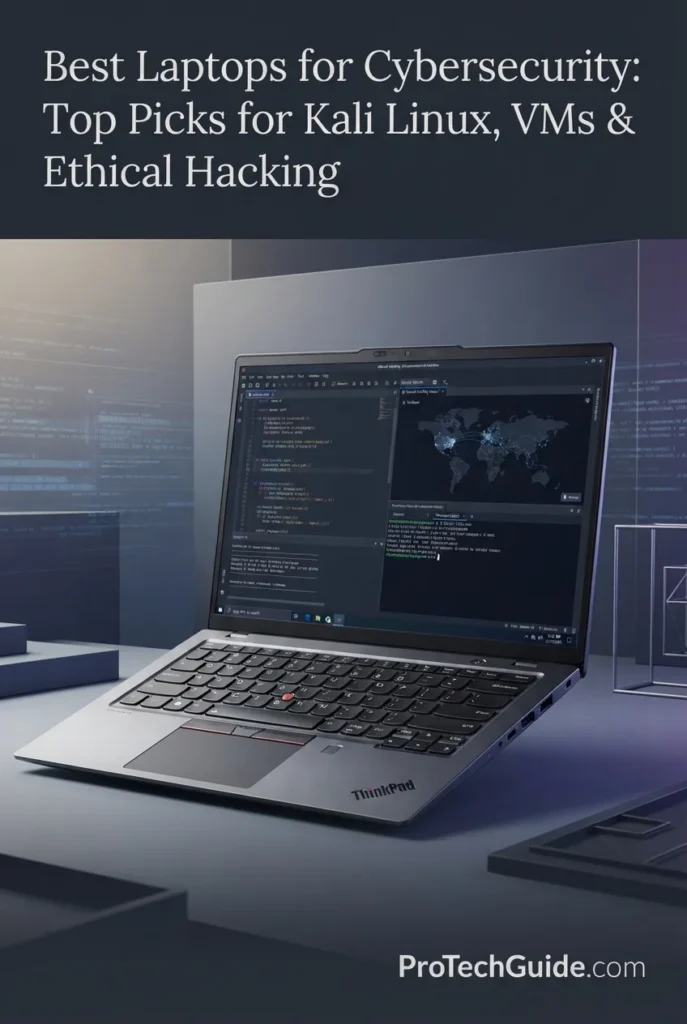
The Lenovo ThinkPad X1 Carbon Gen 14 Aura Edition with the Intel Core Ultra 7 365 vPro, 32GB LPDDR5X memory, and 1TB PCIe Gen4 SSD is our top premium business laptop for cybersecurity in 2026. Its 8-core Intel Core Ultra 7 365 vPro processor, fast LPDDR5X memory, enterprise-focused security features, Wi-Fi 7, three Thunderbolt 4 ports, and lightweight 14-inch design provide an excellent platform for professional security workflows including Kali Linux, Nmap, Wireshark, Burp Suite, Metasploit, Ghidra, Python, Docker, remote administration, and moderate virtual machine workloads. The 32GB memory configuration provides strong multitasking headroom for cybersecurity applications, development environments, browsers, containers, and security labs while maintaining the portability expected from a premium ThinkPad.
The ThinkPad X1 Carbon Gen 14 earns our Best Premium Business Laptop for Cybersecurity award because it combines professional security capabilities, strong CPU performance, 32GB of fast memory, high-speed storage, extensive connectivity, and exceptional portability. For cybersecurity professionals who regularly move between offices, client environments, remote work locations, and security labs, it provides a particularly strong balance between professional functionality and mobility.
Compared with the Lenovo ThinkPad P14s Gen 6, the X1 Carbon places greater emphasis on premium mobility and business-oriented design, while the P14s is the stronger choice for heavier local virtualization thanks to its 64GB memory configuration. Compared with dedicated-GPU laptops such as the ASUS ROG Zephyrus G14 and Lenovo Legion 5i, the X1 Carbon gives up GPU acceleration but offers a more professional mobile platform. Its 32GB soldered memory is also an important consideration: it is excellent for moderate security labs, but professionals planning to run several demanding VMs simultaneously should choose a higher-memory workstation instead.
Key Features
Lenovo ThinkPad T14 Gen 6
Best Value Laptop for Kali Linux, Security Tools & Virtual Machines
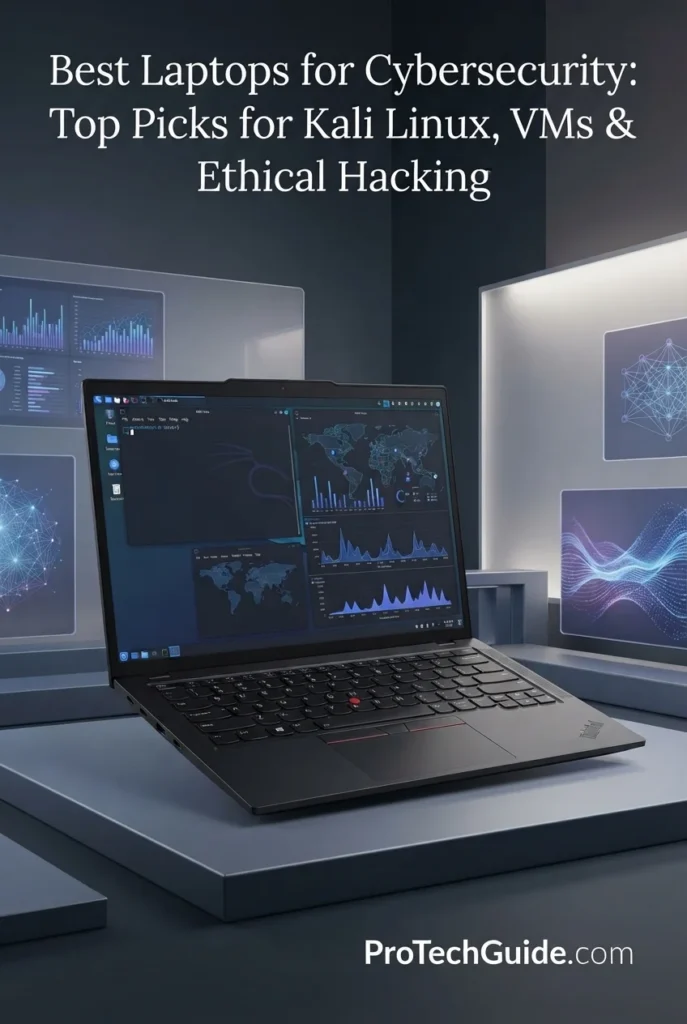
The Lenovo ThinkPad T14 Gen 6 with the Intel Core Ultra 5 225U, 32GB DDR5 memory, and 1TB PCIe NVMe SSD is our Best Value cybersecurity laptop in 2026. Its 12-core Intel processor, 32GB of memory, fast SSD, integrated Intel graphics, Thunderbolt 4 connectivity, Ethernet, Wi-Fi 6E, and professional ThinkPad design provide a strong foundation for cybersecurity students, analysts, penetration testers, developers, and IT professionals. It is particularly well suited to Kali Linux, Nmap, Wireshark, Burp Suite, Metasploit, Python, Docker, scripting, network analysis, and moderate virtual machine workloads.
The ThinkPad T14 Gen 6 earns our Best Value Cybersecurity Laptop award because it delivers the core hardware required for serious security work without moving into the price and size of a dedicated mobile workstation. Its 32GB RAM, 1TB SSD, 12-core processor, business-class design, Ethernet connectivity, and Thunderbolt 4 support make it a particularly well-balanced option for students, professionals, and security practitioners building their own local labs.
Compared with the ThinkPad X1 Carbon Gen 14, the T14 focuses more on practical value while still providing the professional ThinkPad experience and 32GB of memory. Compared with the ThinkPad P14s Gen 6, it offers less overall processing headroom but remains an attractive option for users whose cybersecurity workloads do not require 64GB of RAM. Its integrated graphics also make it less suitable than dedicated-GPU laptops such as the ASUS ROG Zephyrus G14 for GPU-accelerated security workloads.
Key Features
HP ZBook Power G11 16-inch
Best Workstation Laptop for Virtual Machines, Security Research & GPU-Accelerated Workloads
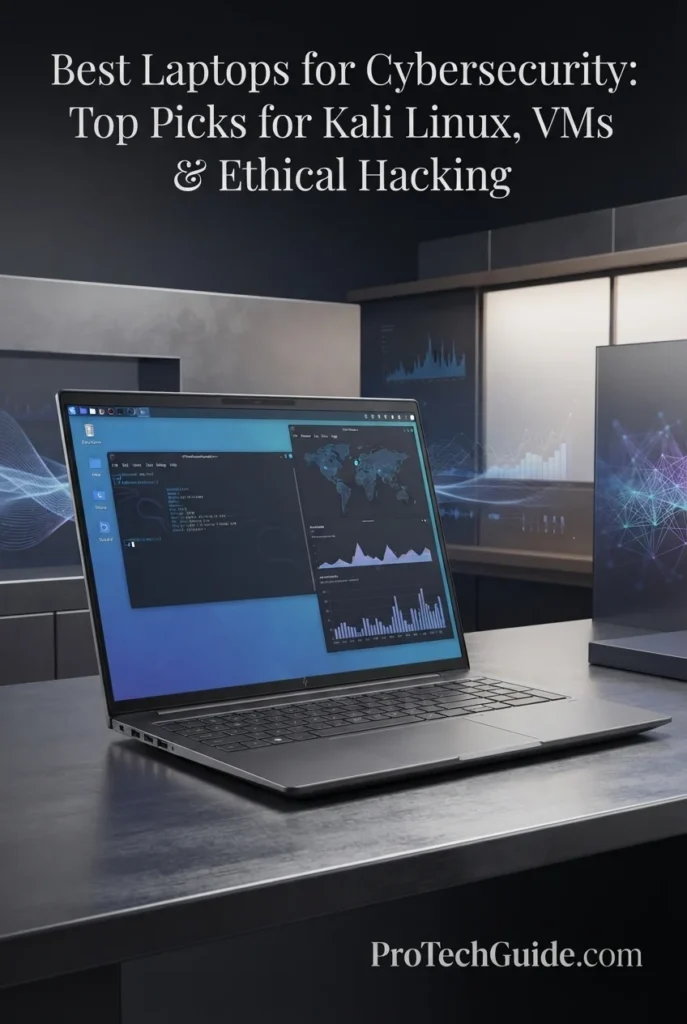
The HP ZBook Power G11 with the Intel Core Ultra 9 185H, 32GB of DDR5 memory, 1TB SSD, and NVIDIA RTX A1000 graphics is our Best Mobile Workstation for Cybersecurity in 2026. Designed for professional computing workloads, it combines a high-performance 16-inch workstation platform with dedicated graphics, business-class connectivity, Ethernet, Thunderbolt 4, and Windows 11 Pro. It is particularly well suited to cybersecurity professionals who work with multiple virtual machines, security research, reverse engineering, development environments, GPU-accelerated workloads, and demanding local security labs.
The HP ZBook Power G11 earns our Best Mobile Workstation for Cybersecurity award because it combines a high-end Intel processor, dedicated NVIDIA professional graphics, 32GB of DDR5 memory, 1TB SSD storage, and extensive workstation connectivity in a single 16-inch system. It is especially compelling for professionals whose cybersecurity workloads extend beyond conventional penetration testing into virtualization, reverse engineering, development, security research, and GPU-accelerated tasks.
Compared with the ThinkPad P14s Gen 6, the ZBook Power G11 offers a larger 16-inch chassis and dedicated NVIDIA graphics, making it better suited to GPU-accelerated workloads and users who prioritize workstation capabilities. The ThinkPad P14s remains more attractive for portability and its 64GB memory configuration provides greater capacity for extremely memory-intensive multi-VM labs. Compared with the ASUS ROG Zephyrus G14, the ZBook emphasizes professional workstation design and NVIDIA professional graphics rather than gaming-oriented GPU performance.
Key Features
The Intel Core Ultra 9 185H provides up to 5.1GHz of processing performance and is well suited to demanding cybersecurity workflows. It provides the CPU headroom needed for virtualization, compiling security tools, running development environments, processing data, and multitasking across terminals, browsers, and analysis applications.
For workloads involving Kali Linux, Metasploit, Burp Suite, Ghidra, Python, Docker, and multiple security applications, the processor provides considerably more performance headroom than entry-level business laptops.
The 32GB of DDR5 memory provides a strong foundation for cybersecurity labs involving virtual machines, development environments, browsers, terminals, and security tools running simultaneously.
The Amazon configuration includes two memory slots with one available slot, providing useful upgrade flexibility compared with laptops that use completely soldered memory. For especially demanding multi-VM environments, additional memory can be valuable when supported by the exact configuration.
The ZBook Power G11 is well suited to professional cybersecurity environments built around Kali Linux, virtual machines, Docker containers, and isolated security labs. Its combination of CPU performance, 32GB RAM, fast SSD storage, and workstation-class hardware provides a strong platform for testing security tools without relying entirely on remote systems.
It can also serve as a versatile host for environments using VirtualBox, VMware, Hyper-V, or other virtualization solutions, although the number of simultaneously active virtual machines will depend on their individual CPU, memory, and storage requirements.
The ZBook Power G11 has the processing and memory resources needed for common professional security applications including Nmap, Wireshark, Burp Suite, Metasploit Framework, sqlmap, Ghidra, Radare2, John the Ripper, and Python-based security tooling.
Its dedicated NVIDIA GPU also makes this system more interesting for specialized workloads that can benefit from GPU acceleration, while CPU-focused applications such as network analysis, web security testing, scripting, and reverse engineering continue to rely primarily on processor and memory resources.
The NVIDIA RTX A1000 with 6GB of GDDR6 memory gives the ZBook dedicated graphics resources that are useful for selected cybersecurity workloads. This can be particularly relevant for applications capable of using GPU acceleration, including certain password-auditing and computational workloads.
However, a dedicated GPU is not required for most everyday penetration testing, network analysis, web application security, or scripting tasks. Its main advantage here is providing additional flexibility for specialized workloads where GPU acceleration can meaningfully contribute to performance.
The ZBook Power G11 provides the connectivity expected from a professional workstation, including two Thunderbolt 4 ports, USB connectivity, HDMI, Ethernet, Wi-Fi, and Bluetooth.
The integrated RJ-45 Ethernet port is particularly useful for cybersecurity labs, network troubleshooting, isolated test networks, virtualization environments, and direct connections to networking equipment. External adapters and specialized lab hardware can also be connected when required.
The 16-inch 1920×1200 WUXGA display provides more screen area than the 14-inch laptops in this guide, which can be valuable when working with multiple terminals, code windows, packet captures, virtual machines, browser tabs, and technical documentation.
The matte anti-glare finish also makes the display practical for extended professional work in different lighting environments.
The 1TB SSD provides practical high-speed storage for cybersecurity workloads, including Kali Linux environments, virtual machines, ISO files, Docker images, packet captures, security datasets, source code, and research projects.
Storage requirements can grow quickly when maintaining several virtual machines and snapshots, so users building larger local labs may eventually benefit from additional storage or external high-speed storage.
The ZBook Power G11 combines professional workstation hardware with Windows 11 Pro, fingerprint recognition, and a 5MP front camera. These features make it appropriate for professional environments where security, authentication, remote collaboration, and productivity are part of the daily workflow.
For Linux-based security work, users can also build dedicated environments around virtualization or compatible Linux installations, while Windows 11 Pro can remain the primary operating system for business applications and management tools.
At approximately 4.67 pounds, the ZBook Power G11 is considerably more substantial than ultraportable business laptops such as the ThinkPad X1 Carbon. That additional size and weight are the trade-off for its larger display, workstation-oriented hardware, dedicated graphics, and extensive connectivity.
It is therefore best suited to cybersecurity professionals who want a mobile workstation they can carry between offices, labs, classrooms, or client environments, rather than users whose primary priority is minimum weight.
The HP ZBook Power G11 is best for cybersecurity professionals who need a workstation-class laptop for virtual machines, security research, reverse engineering, development, GPU-accelerated workloads, Kali Linux labs, and demanding professional multitasking.
It is an especially strong choice for users who value dedicated NVIDIA graphics and workstation connectivity more than ultra-portability. If your primary requirement is running several memory-heavy virtual machines simultaneously, a 64GB configuration such as the ThinkPad P14s Gen 6 may be a better fit.
Dell XPS 14 Premium Laptop
Best Premium Laptop for Mobile Security Work, Linux & Cybersecurity Tools
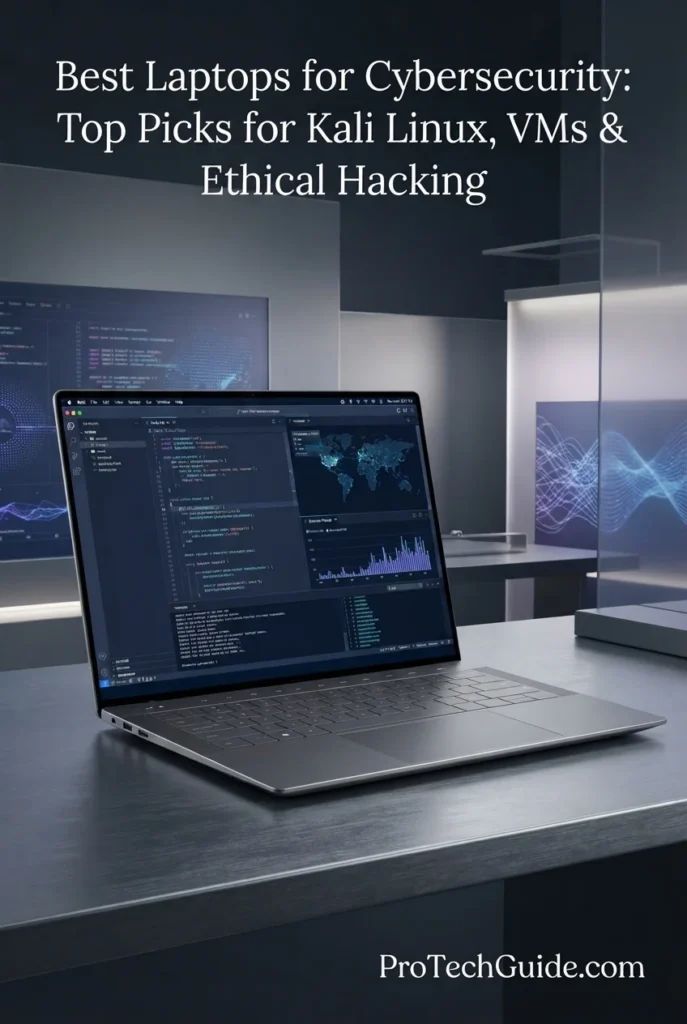
The Dell XPS 14 with the Intel Core Ultra 7 255H, 16GB of LPDDR5X memory, 1TB PCIe NVMe SSD, and integrated Intel Arc graphics is our Best Premium Laptop for Cybersecurity in 2026. Its 16-core processor, fast SSD, high-resolution 14.5-inch OLED touchscreen, Wi-Fi 7, three Thunderbolt 4 ports, fingerprint reader, and Windows 11 Pro make it an excellent premium platform for mobile cybersecurity work, programming, network analysis, web security, Linux environments, and professional security tooling.
The Dell XPS 14 earns our Best Premium Laptop for Cybersecurity award because it combines a powerful modern Intel processor with a premium OLED display, fast storage, Wi-Fi 7, Thunderbolt 4 connectivity, fingerprint authentication, and Windows 11 Pro in a refined mobile platform. It is an especially attractive choice for cybersecurity professionals who value portability, premium build quality, and display quality alongside solid security-tool performance.
Compared with the ThinkPad X1 Carbon Gen 14, the Dell XPS 14 emphasizes its high-resolution OLED touchscreen and premium multimedia experience, while the X1 Carbon focuses more heavily on business mobility and enterprise-oriented features. Compared with the ThinkPad T14 Gen 6, the XPS 14 offers a more premium display and design but has less memory capacity in this configuration. Its 16GB RAM is the main limitation for advanced local cybersecurity labs involving several demanding virtual machines, where the 32GB ThinkPad systems or 64GB ThinkPad P14s Gen 6 are better choices.
Key Features
The Intel Core Ultra 7 255H provides 16 CPU cores and boost speeds of up to 5.1GHz, giving the XPS 14 strong processing capability for professional cybersecurity workflows.
It is well suited to Nmap, Wireshark, Burp Suite, Metasploit, Python, scripting, development, browser-based security applications, and general security research, particularly when multiple applications need to remain responsive at the same time.
The 16GB of LPDDR5X memory running at 6400MHz provides responsive performance for everyday cybersecurity applications, development tools, browsers, terminals, documentation, and professional multitasking.
However, this configuration has 16GB as its maximum listed memory capacity, so it is important to set realistic expectations. It is suitable for lighter virtualization and security labs, but users who regularly run several demanding VMs simultaneously should choose a 32GB or 64GB system instead.
The XPS 14 can serve as a capable platform for cybersecurity environments involving Kali Linux, virtual machines, Docker containers, and isolated security labs, provided the workload is appropriate for its 16GB memory configuration.
For a single lightweight VM or moderate laboratory environment, the combination of the Core Ultra 7 processor and 1TB SSD provides a strong foundation. For multiple memory-intensive VMs, however, the 16GB RAM ceiling makes the XPS 14 less suitable than the higher-memory ThinkPad and workstation options in this guide.
The XPS 14 provides enough CPU performance for common cybersecurity applications including Nmap, Wireshark, Burp Suite, Metasploit Framework, sqlmap, Python, Git, SSH, and other command-line security tools.
Its premium hardware is particularly useful for users who combine security applications with programming, documentation, browsers, communication tools, and other professional workloads throughout the day.
The integrated Intel Arc graphics provide the graphical resources required for the XPS 14's display and everyday professional workloads without requiring a dedicated GPU.
For most penetration testing, web application security, network analysis, scripting, and security research tasks, GPU performance is not the primary requirement. Users specifically interested in GPU-accelerated password auditing or computational security workloads should consider a laptop with a dedicated NVIDIA GPU, such as the ASUS ROG Zephyrus G14 or HP ZBook Power G11.
The XPS 14 includes three Thunderbolt 4 ports and Wi-Fi 7, providing high-speed connectivity for external displays, storage devices, docking stations, networking accessories, and other cybersecurity lab equipment.
For specialized wireless penetration-testing work, users should not assume that the internal Wi-Fi adapter automatically supports every monitor-mode or packet-injection requirement. A compatible external wireless adapter may still be necessary depending on the specific Kali Linux workflow.
The 14.5-inch 3200×2000 OLED touchscreen is one of the XPS 14's strongest advantages. Its high pixel density and 16:10 aspect ratio provide a detailed workspace for source code, terminals, packet analysis, documentation, browser-based security applications, and dashboards.
The 120Hz refresh rate also provides smoother interaction during everyday use, while the OLED panel delivers the premium visual experience expected from Dell's XPS line.
The 1TB PCIe NVMe SSD provides fast storage for cybersecurity applications, Linux environments, virtual machines, ISO images, Docker data, packet captures, source code, and security research projects.
Although 1TB is a practical starting point, users who maintain large VM collections, extensive packet captures, or multiple operating-system images may eventually benefit from external high-speed storage.
The XPS 14 includes Windows 11 Pro and a fingerprint reader, providing useful authentication and professional security features for business and cybersecurity workflows.
Windows 11 Pro can remain the primary environment while Linux security distributions and specialized labs are used through compatible virtualization or other supported configurations.
The XPS 14 is designed for users who want a premium computer that can transition between cybersecurity work, programming, professional productivity, and everyday use.
Its premium design, backlit keyboard, touchscreen, fingerprint reader, and high-resolution OLED display make it particularly attractive to professionals who want their security workstation to also function as a refined daily productivity machine.
The Dell XPS 14 is best for cybersecurity professionals, students, developers, and IT users who prioritize premium design, a high-quality OLED display, strong CPU performance, modern connectivity, and mobile security work.
It is an excellent choice for Nmap, Wireshark, Burp Suite, Metasploit, Python, scripting, web security, network analysis, and moderate virtualization. If your primary requirement is running several demanding virtual machines simultaneously, choose a system with 32GB or 64GB of RAM instead.
ASUS ROG Zephyrus G14
Best Laptop for GPU-Accelerated Security Workloads, Password Auditing & Advanced Labs
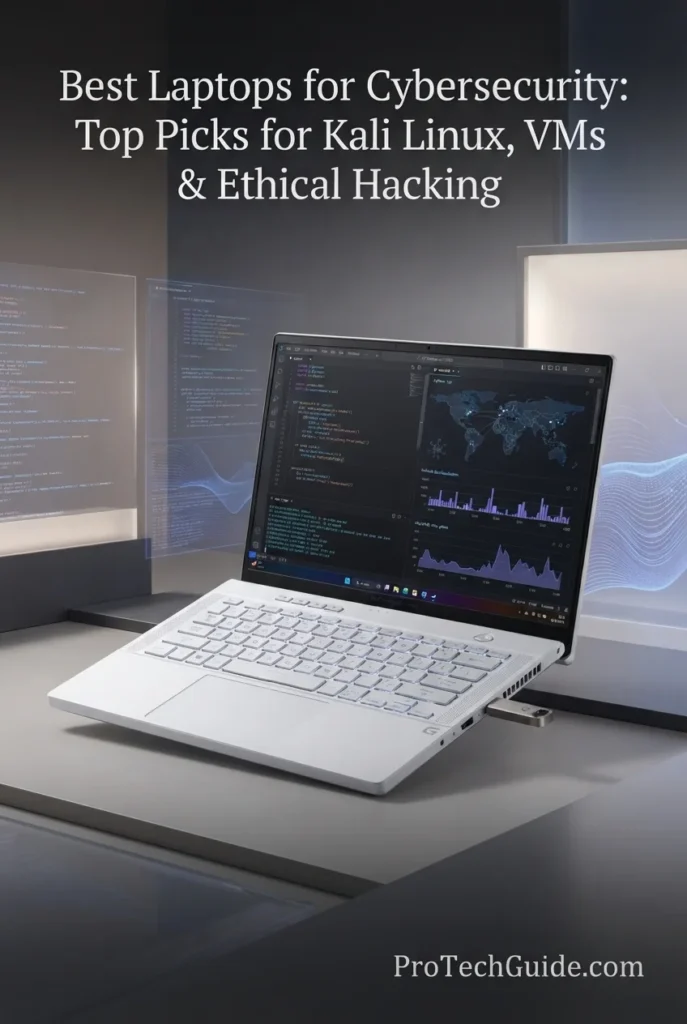
The ASUS ROG Zephyrus G14 with the AMD Ryzen AI 9 HX 370, NVIDIA GeForce RTX 5070 Ti with 12GB GDDR7, 32GB LPDDR5X memory, and 2TB SSD is our Best GPU Performance laptop for cybersecurity in 2026. Its combination of a powerful 12-core processor, dedicated high-performance NVIDIA GPU, 32GB of memory, and large SSD capacity makes it particularly attractive for GPU-accelerated security workloads, password auditing, advanced cybersecurity labs, development, virtualization, and security research.
The ASUS ROG Zephyrus G14 earns our Best GPU Performance for Cybersecurity award because it brings a powerful dedicated NVIDIA GPU into a relatively compact 14-inch laptop. While most penetration testing and network-security tools remain primarily CPU- and memory-focused, specialized workloads such as GPU-accelerated password auditing can make substantially better use of its graphics hardware. Combined with 32GB RAM, a 2TB SSD, and the Ryzen AI 9 HX 370, it is one of the most versatile high-performance options in this guide.
Compared with the HP ZBook Power G11, the Zephyrus G14 offers a more compact design and a considerably more performance-oriented gaming-class GPU, making it particularly attractive for GPU-accelerated workloads. The ZBook Power G11 remains the better fit for users who prioritize a professional mobile-workstation platform. Compared with the ThinkPad P14s Gen 6, the G14 has a much stronger dedicated GPU, while the P14s offers 64GB of RAM in its selected configuration and is therefore better suited to extremely memory-intensive multi-VM environments.
Key Features
The AMD Ryzen AI 9 HX 370 provides 12 CPU cores and boost speeds of up to 5.1GHz, giving the Zephyrus G14 strong processing performance for demanding cybersecurity workloads.
It is well suited to virtualization, Python development, compilation, Metasploit, Burp Suite, Ghidra, Docker, scripting, reverse engineering, and professional multitasking, while the dedicated NVIDIA GPU handles workloads that can benefit from GPU acceleration.
The 32GB of LPDDR5X memory running at 8000MHz provides strong capacity for cybersecurity applications, development tools, browsers, terminals, Docker containers, and moderate virtual machine workloads.
This configuration provides substantially more memory headroom than the 16GB Dell XPS 14, although users building especially large multi-VM environments may still benefit from a 64GB system such as the ThinkPad P14s Gen 6.
The Zephyrus G14 provides a powerful platform for Kali Linux, virtual machines, Docker containers, isolated security labs, and advanced cybersecurity research.
Its combination of CPU performance, 32GB RAM, and 2TB SSD makes it particularly useful for maintaining several security environments locally. As with any laptop, the practical number of simultaneously active VMs depends on their CPU, memory, storage, and network requirements.
The NVIDIA GeForce RTX 5070 Ti with 12GB of GDDR7 memory is the defining feature of this configuration for cybersecurity. Dedicated GPU resources can be valuable for workloads capable of distributing computation across many GPU cores.
One important example is Hashcat, where supported password-hashing algorithms can take advantage of GPU acceleration for password-auditing and security-testing workloads. This does not mean every cybersecurity application becomes faster with a GPU; tools such as Nmap, Wireshark, and many web-security workflows remain primarily CPU- and network-focused.
For authorized password-auditing and security-testing environments, the RTX 5070 Ti's 12GB of GDDR7 VRAM gives the G14 substantial GPU resources for compatible Hashcat workloads and other computational tasks designed for GPU acceleration.
The important distinction is that GPU performance is highly workload-dependent. A powerful GPU is a major advantage for suitable parallel-computation workloads, but it does not replace the CPU, RAM, storage, and network connectivity required for a complete cybersecurity laboratory.
The G14 provides more than enough CPU and memory resources for common security applications including Nmap, Wireshark, Burp Suite, Metasploit Framework, sqlmap, Ghidra, Radare2, Python, Git, SSH, and Docker.
Its hardware advantage becomes most apparent when a workflow combines conventional security applications with GPU-accelerated computation, development, virtualization, or other demanding workloads.
The Zephyrus G14 includes USB-A, USB-C 3.2, USB4, HDMI 2.1, Wi-Fi 7, and Bluetooth, providing flexible connectivity for external displays, storage, networking equipment, and cybersecurity accessories.
For wireless penetration-testing workflows, users should not assume that the internal Wi-Fi adapter automatically provides every capability required for monitor mode or packet injection. A compatible external wireless adapter may be necessary depending on the specific Kali Linux lab.
The 14-inch 2880×1800 OLED display provides a sharp and detailed workspace for terminals, source code, documentation, browser-based security applications, packet analysis, and security dashboards.
The 120Hz refresh rate and OLED panel also make the G14 particularly well suited to users who want their cybersecurity laptop to double as a high-end general-purpose and gaming system.
The 2TB SSD is a major advantage for cybersecurity labs because virtual machines, snapshots, ISO files, Docker images, packet captures, datasets, and development environments can consume storage quickly.
The additional capacity gives security researchers considerably more flexibility to maintain multiple operating systems and laboratory environments locally without immediately depending on external storage.
At approximately 3.46 pounds, the Zephyrus G14 packs unusually powerful hardware into a relatively compact 14-inch chassis. This makes it attractive to professionals and students who want high performance without moving to a larger 15- or 16-inch workstation.
The trade-off is that high-performance CPU and GPU hardware can generate substantially more heat and power consumption than an ultraportable business laptop, particularly under sustained workloads.
This particular Amazon configuration also includes a 2TB USB flash drive as part of the listed package. External storage can be useful for transferring ISO images, backups, tools, datasets, or laboratory files.
For cybersecurity work, however, the internal 2TB SSD remains the more important storage resource for actively running virtual machines and applications.
The ASUS ROG Zephyrus G14 is best for cybersecurity professionals, researchers, students, and advanced users who need dedicated GPU performance for specialized security workloads while still requiring strong CPU performance, 32GB RAM, and substantial local storage.
It is particularly attractive for GPU-accelerated password auditing, advanced security research, Kali Linux labs, virtualization, development, reverse engineering, and demanding multitasking. For users whose work consists primarily of network analysis, web security, and conventional penetration testing, a less GPU-focused laptop may provide better value.
Lenovo Legion 5i
Best Performance Laptop for GPU-Accelerated Security Workloads, Development & Advanced Labs
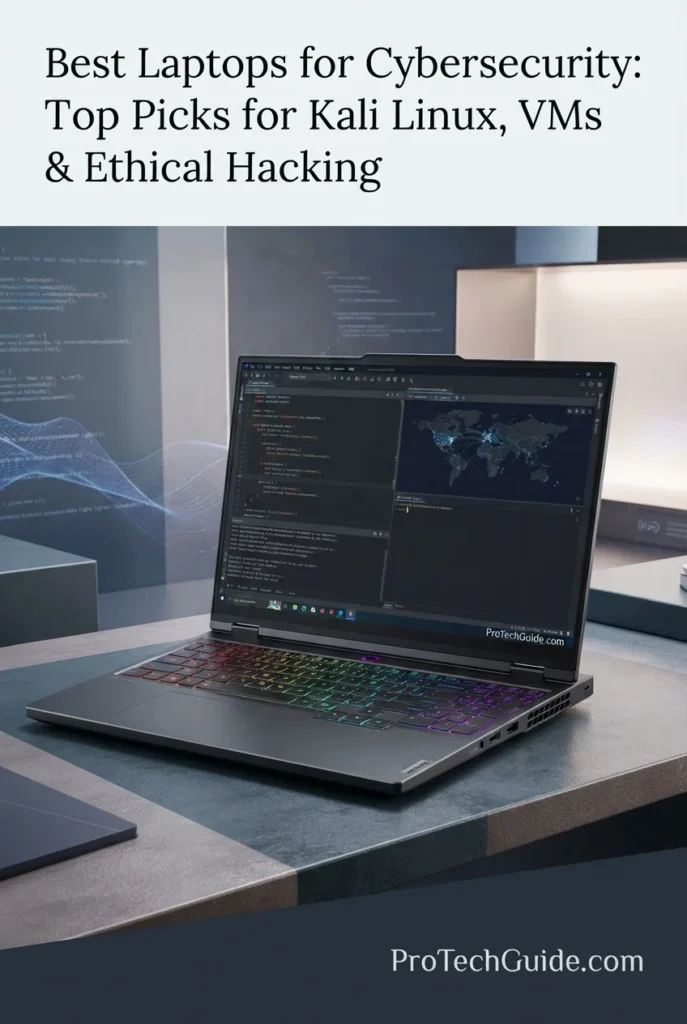
The Lenovo Legion 5i with the Intel Core i7-14700HX, NVIDIA GeForce RTX 5070 with 8GB of GDDR7 memory, 16GB of DDR5 memory, and 1TB SSD is our Best Performance Value for Cybersecurity in 2026. Its high-performance 14-core processor, dedicated NVIDIA GPU, fast DDR5 memory, and 1TB storage make it particularly well suited to GPU-accelerated security workloads, penetration testing, development, virtualization, security research, and demanding local cybersecurity labs.
The Lenovo Legion 5i earns our Best Performance Value for Cybersecurity award because it combines a high-performance Intel HX processor with a dedicated NVIDIA RTX 5070 GPU and a high-quality 2.5K OLED display at a more accessible level than many workstation-class systems. While its standard 16GB RAM configuration limits its suitability for heavily virtualized environments, the platform's support for up to 64GB makes it a strong foundation for users who want to prioritize CPU and GPU performance and upgrade memory as their cybersecurity workloads grow.
Compared with the ASUS ROG Zephyrus G14, the Legion 5i offers a larger 15.1-inch display and a powerful HX-series Intel processor, while the G14 provides a more compact design and a higher-tier RTX 5070 Ti with 12GB of VRAM. Compared with the HP ZBook Power G11, the Legion emphasizes gaming-class GPU performance and high-refresh OLED display technology rather than professional workstation positioning. Its biggest limitation against the ThinkPad P14s Gen 6 is memory capacity: the P14s configuration includes 64GB of RAM, making it the stronger choice for extremely memory-intensive multi-VM cybersecurity labs.
Key Features
The Intel Core i7-14700HX provides a high-performance 20-core architecture with boost speeds up to 5.5GHz. Its substantial CPU resources are well suited to virtualization, compilation, security-tool workloads, development, scripting, malware-analysis environments, and demanding multitasking.
The 16GB of DDR5-5600 memory provides solid performance for everyday cybersecurity tools, development environments, browsers, terminals, and lighter virtual machine workloads. Because cybersecurity labs can become memory-intensive when multiple VMs are running simultaneously, the platform's support for up to 64GB of RAM makes a future memory upgrade particularly valuable for advanced users.
The Legion 5i's x86-64 platform and high-performance processor make it a strong candidate for Kali Linux, virtualization, Docker, development environments, and local cybersecurity labs. Users can build isolated environments for penetration testing, network analysis, web security, malware-analysis research, and security experimentation. For demanding multi-VM workloads, additional RAM is recommended.
The dedicated NVIDIA GeForce RTX 5070 with 8GB of GDDR7 memory provides substantial GPU resources for workloads capable of using parallel computation. This is particularly relevant to Hashcat and GPU-accelerated password auditing, while many conventional penetration-testing and network-security tools remain primarily CPU- and memory-focused.
The Legion 5i has the processing capacity to handle a broad cybersecurity software stack including Nmap, Wireshark, Burp Suite, Metasploit Framework, Ghidra, Python, Bash, PowerShell, Git, Docker, and SSH. Its high-performance CPU is particularly useful when these tools are combined with development environments, browsers, virtual machines, and other research applications.
The laptop provides Wi-Fi 7, HDMI, USB connectivity, and Bluetooth 5.3 for modern peripherals, displays, storage devices, and networking equipment. For wireless penetration testing, users should verify whether their specific adapter supports the required monitor mode and packet injection capabilities; Wi-Fi 7 alone does not guarantee those functions, so an external compatible adapter may be preferable for dedicated wireless-security labs.
The 15.1-inch 2560×1600 WQXGA OLED display with a 165Hz refresh rate and up to 500 nits provides a high-resolution workspace for terminals, source code, packet captures, virtual machines, documentation, browser-based security tools, and security dashboards. The larger panel is particularly useful when working with several windows simultaneously.
The 1TB SSD provides practical capacity for Kali Linux installations, virtual machines, snapshots, ISO images, Docker containers, packet captures, development environments, security datasets, and research projects. Users maintaining several large VMs may eventually benefit from additional storage.
The Legion 5i uses Lenovo's Legion Coldfront: Hyper cooling design with dedicated airflow, heat pipes, and heatsinks to manage its high-performance CPU and GPU hardware. This is useful for sustained workloads such as compilation, virtualization, GPU computation, security research, and extended development sessions.
At approximately 4.4 pounds, the Legion 5i balances a relatively portable 15-inch chassis with powerful HX-series processing and dedicated NVIDIA graphics. It is best suited to users who value performance over ultralight mobility and want one system capable of handling both everyday computing and demanding cybersecurity workloads.
Best for: cybersecurity students and professionals, penetration testing, GPU-accelerated password auditing, Kali Linux, security research, development, Docker, moderate virtualization, reverse engineering, and advanced local cybersecurity labs where CPU/GPU performance is prioritized over having 32GB or 64GB of memory out of the box.
Apple 14-inch MacBook Pro M5 Pro
Best Mac Laptop for Security Research, Programming & Professional Cybersecurity Work
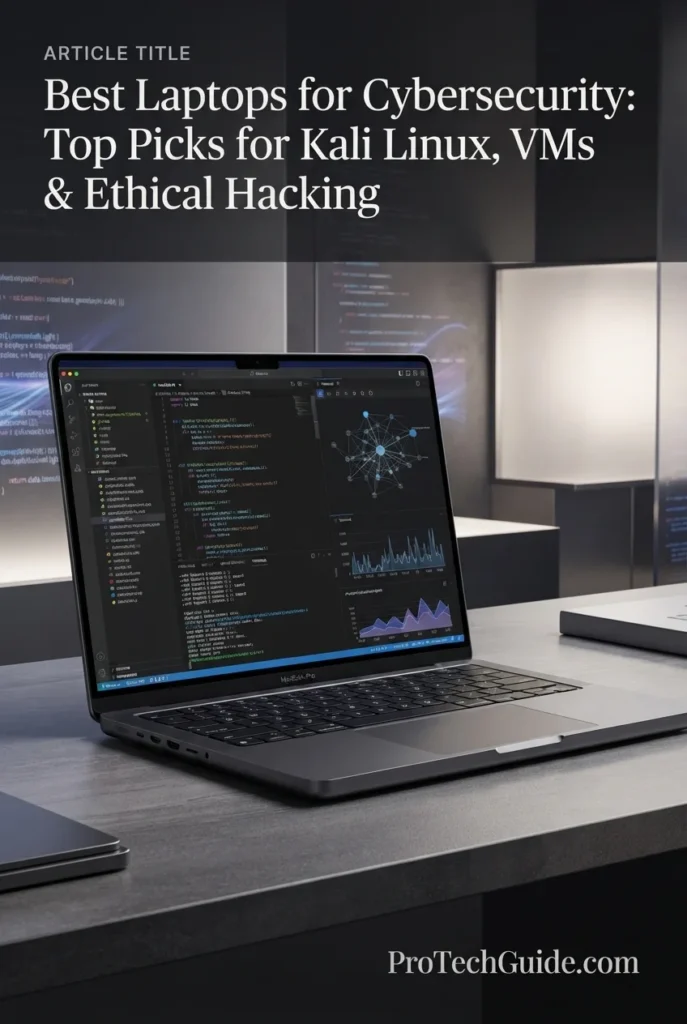
The Apple 14-inch MacBook Pro with the M5 Pro chip, 15-core CPU, 16-core GPU, 48GB of unified memory, and 1TB SSD is our Best Mac for Cybersecurity in 2026. Its powerful Apple Silicon architecture, generous memory capacity, fast SSD, premium 14-inch display, and portable design make it particularly well suited to security research, programming, scripting, development, network analysis, documentation, and professional cybersecurity workflows. However, users building x86-focused labs should carefully consider architecture compatibility before choosing macOS as their primary cybersecurity platform.
The Apple 14-inch MacBook Pro earns our Best Mac for Cybersecurity award because it combines powerful Apple Silicon performance with 48GB of unified memory, fast SSD storage, a premium display, and a highly portable professional design. It is particularly compelling for security professionals who already work comfortably within macOS and Unix-based development environments. Its main limitation is platform compatibility: certain cybersecurity workflows, virtual machines, drivers, and x86-specific security environments may require additional configuration or a different platform.
Compared with the Lenovo ThinkPad P14s Gen 6, the MacBook Pro offers a premium macOS and Apple Silicon experience with 48GB of unified memory, while the ThinkPad provides a more conventional x86-64 Windows/Linux platform that is generally easier to integrate into Kali Linux and x86-focused virtualization labs. Compared with the ASUS ROG Zephyrus G14, the MacBook Pro emphasizes portability, memory capacity, and professional macOS workflows rather than a dedicated NVIDIA GPU for workloads such as Hashcat. For users whose cybersecurity work depends heavily on Kali Linux VMs, x86 tooling, specialized drivers, or NVIDIA GPU acceleration, the Windows/Linux laptops in this guide remain the safer choice.
Key Features
The Apple M5 Pro with a 15-core CPU provides substantial processing capacity for cybersecurity-related development, scripting, source-code analysis, compilation, documentation, research, and professional multitasking. Its performance is especially valuable when security tools are combined with development environments, browsers, terminals, and large projects.
The 48GB of unified memory is one of this MacBook Pro configuration's strongest advantages for professional cybersecurity work. It provides considerable headroom for large codebases, browsers, terminals, Docker environments, development tools, datasets, and memory-intensive research workflows without the capacity constraints of many 16GB configurations.
macOS provides a Unix-based environment that can work well for Python, Bash, Git, SSH, Docker, development, scripting, and security research. However, the M5 Pro uses Apple Silicon rather than x86-64, so users should verify architecture compatibility for their specific cybersecurity tools, virtual machine images, operating systems, drivers, and lab environments. x86-focused Kali Linux or other security VMs may require emulation or architecture-specific images and can behave differently from equivalent x86 systems.
The MacBook Pro is particularly well suited to Python, Bash, Git, SSH, Docker, software development, automation, and source-code analysis. These workflows are common across cybersecurity research and security engineering, making the system a strong choice for professionals whose work emphasizes development and research rather than hardware-specific penetration-testing labs.
A macOS-based security environment can support a wide range of development and research workflows involving tools such as Burp Suite, Nmap, Wireshark, Python, Git, SSH, Docker, and browser-based security platforms. Before deploying a specific toolchain, users should verify native Apple Silicon support or the appropriate compatibility layer, particularly for specialized security utilities and third-party dependencies.
The 16-core integrated GPU provides substantial graphics and compute resources within Apple's unified architecture. However, cybersecurity professionals should not assume that software designed for NVIDIA CUDA will provide equivalent acceleration on Apple Silicon. For workloads such as GPU-accelerated password auditing, Windows/Linux laptops with supported NVIDIA GPUs remain the more straightforward choice.
The 1TB SSD provides fast storage for source code, security tools, Docker environments, datasets, documentation, research projects, and development files. Users maintaining several large virtual machines, operating-system images, packet captures, or extensive research datasets may benefit from additional external storage.
The 14-inch 3024×1964 display with a 120Hz refresh rate provides a high-resolution workspace for source code, terminals, documentation, browser-based security tools, dashboards, and research applications. Its compact size also keeps the MacBook Pro practical for mobile professional work.
The MacBook Pro combines fingerprint authentication, macOS, a backlit keyboard, and Apple's integrated hardware-software security architecture into a professional mobile platform. These features make it well suited to users who value device security, authentication, development, and professional productivity in the same system.
The compact 14-inch MacBook Pro design makes it particularly attractive to cybersecurity professionals who frequently move between offices, classrooms, client environments, and home labs. Its Apple Silicon platform is designed around efficient performance, making the system well suited to extended mobile development and research sessions.
Best for: cybersecurity professionals who prefer macOS, security research, Python and Bash development, Git, SSH, Docker, web security development, source-code analysis, documentation, and professional Unix-based workflows. Users who require extensive x86-64 Kali Linux virtualization, specialized wireless drivers, or NVIDIA GPU acceleration should choose one of the Windows/Linux systems in this guide instead.
Best Laptops for Cybersecurity in 2026
Ranked by CPU Performance, RAM Capacity, Virtualization, Kali Linux, Security Tools, GPU Acceleration, Connectivity & Overall Value
Choosing the best laptop for cybersecurity in 2026 requires more than comparing processor specifications. Security professionals need enough memory for virtual machines and isolated labs, strong CPU performance for security tools and development, fast storage for operating systems and research environments, reliable connectivity for networking equipment, and broad compatibility with Linux and virtualization platforms. We evaluated these laptops for cybersecurity-focused workloads including Kali Linux, Nmap, Wireshark, Burp Suite, Metasploit Framework, Ghidra, Docker, Python, virtual machines, penetration testing, security research, and GPU-accelerated workloads such as password auditing to help you choose the right laptop for your security workflow.
| Laptop | CPU & Key Specs | Best For | Why It Wins | Editor's Verdict |
|---|---|---|---|---|
Best Overall
Lenovo ThinkPad P14s Gen 6
Check Price | AMD Ryzen AI 9 HX PRO 370 64GB DDR5 1TB PCIe SSD Radeon 890M 14" WUXGA IPS | Kali Linux Multiple VMs Penetration Testing Security Professionals | The ThinkPad P14s Gen 6 delivers the strongest overall balance of CPU performance, memory capacity, portability, storage, business-class design, and cybersecurity connectivity in this lineup. Its 64GB of RAM provides substantial headroom for virtual machines, Docker environments, security tools, development, and demanding local labs, while its x86-64 platform and Ethernet connectivity make it a particularly versatile foundation for professional cybersecurity workflows. | Best Overall Laptop for Cybersecurity |
Best Premium Business
Lenovo ThinkPad X1 Carbon Gen 14
Check Price | Intel Core Ultra 7 365 vPro 32GB LPDDR5X 1TB PCIe Gen4 SSD 14" WUXGA Touch Windows 11 Pro | Mobile Security Professionals Business Cybersecurity Linux Users Frequent Travelers | The ThinkPad X1 Carbon Gen 14 combines professional cybersecurity capability with exceptional portability and business-focused features. Its 32GB of memory provides strong capacity for security tools, development, Docker, terminals, browsers, and moderate virtual machine workloads, while Thunderbolt 4 connectivity, Wi-Fi 7, Windows 11 Pro, and the lightweight ThinkPad platform make it particularly attractive for professionals working across multiple locations. | Best Premium Business Laptop for Cybersecurity |
Best Value
Lenovo ThinkPad T14 Gen 6
Check Price | Intel Core Ultra 5 225U 32GB DDR5 1TB PCIe NVMe SSD Integrated Intel Graphics 14" WUXGA IPS | Cybersecurity Students Kali Linux Security Tools IT Professionals | The ThinkPad T14 Gen 6 delivers the core hardware needed for serious cybersecurity work without moving into workstation-level pricing. Its 32GB of memory, 1TB SSD, 12-core processor, Ethernet connectivity, Thunderbolt 4 support, and professional ThinkPad platform make it particularly well suited to Kali Linux, Nmap, Wireshark, Burp Suite, Metasploit, Python, Docker, and moderate virtual machine workloads. | Best Value Laptop for Cybersecurity |
Best Workstation
HP ZBook Power G11 16
Check Price | Intel Core Ultra 9 185H 32GB DDR5 1TB SSD NVIDIA RTX A1000 6GB 16" WUXGA | Security Research Multiple VMs Reverse Engineering Professional Workstations | The ZBook Power G11 combines high-end CPU performance, dedicated NVIDIA professional graphics, 32GB of memory, fast SSD storage, and workstation-oriented connectivity in a larger 16-inch platform. It is particularly well suited to cybersecurity professionals working with virtual machines, reverse engineering, development, security research, and workloads that can benefit from dedicated GPU resources. | Best Mobile Workstation for Cybersecurity |
Best Premium
Dell XPS 14 Premium Laptop
Check Price | Intel Core Ultra 7 255H 16GB LPDDR5X 1TB PCIe NVMe SSD Intel Arc Graphics 14.5" 3.2K OLED Touch | Mobile Security Work Programming Web Security Premium Productivity | The Dell XPS 14 combines a powerful 16-core Intel processor with a premium 3.2K OLED touchscreen, fast SSD storage, Wi-Fi 7, Thunderbolt 4, fingerprint authentication, and Windows 11 Pro. It is particularly attractive for professionals who prioritize premium design and mobility while working with security tools, programming, network analysis, browser-based security platforms, and everyday research. Its 16GB memory configuration is less suitable for several demanding virtual machines simultaneously. | Best Premium Laptop for Cybersecurity |
Best GPU Performance
ASUS ROG Zephyrus G14
Check Price | AMD Ryzen AI 9 HX 370 32GB LPDDR5X 2TB SSD RTX 5070 Ti 12GB 14" 3K OLED 120Hz | Hashcat GPU-Accelerated Workloads Advanced Security Labs Power Users | The Zephyrus G14 brings a powerful dedicated NVIDIA GPU to a compact 14-inch platform, making it the strongest option in this lineup for cybersecurity workloads that can take advantage of GPU acceleration. Its RTX 5070 Ti with 12GB of GDDR7 is particularly relevant to password-auditing workloads such as Hashcat, while 32GB of memory, a 2TB SSD, and the Ryzen AI 9 HX 370 provide strong overall capacity for advanced security environments. | Best GPU Performance Laptop for Cybersecurity |
Best Performance Value
Lenovo Legion 5i
Check Price | Intel Core i7-14700HX 16GB DDR5 1TB SSD RTX 5070 8GB 15.1" WQXGA OLED 165Hz | GPU-Accelerated Security Penetration Testing Development Advanced Labs | The Lenovo Legion 5i combines a powerful HX-series Intel processor with dedicated RTX 5070 graphics and a high-resolution OLED display. It provides excellent CPU and GPU performance for development, security research, penetration testing, and GPU-accelerated workloads such as password auditing. Its main limitation is the standard 16GB RAM configuration, which makes a future memory upgrade particularly valuable for users running multiple demanding virtual machines. | Best Performance Value Laptop for Cybersecurity |
Best Mac
Apple 14-inch MacBook Pro M5 Pro
Check Price | Apple M5 Pro 15-Core CPU 48GB Unified Memory 1TB SSD 14" 3024×1964 120Hz | Security Research Python & Bash Development macOS Professionals | The MacBook Pro combines powerful Apple Silicon performance with 48GB of unified memory, fast SSD storage, a premium high-resolution display, and a highly portable professional design. It is particularly well suited to Python, Bash, Git, SSH, Docker, development, source-code analysis, and security research. However, Apple Silicon architecture can require additional consideration for x86-64 security environments, specialized drivers, virtualization images, and NVIDIA-dependent workloads. | Best Mac for Cybersecurity |
Recommended Next Reads
Finished comparing the best laptops for cybersecurity? Explore our related buying guides for AI workloads, programming, GPU performance, business computing, and professional laptop processors.
Whether you're building a Kali Linux lab, developing security tools, running GPU-accelerated workloads, working across professional environments, or comparing modern laptop processors, these guides can help you choose the right hardware for your cybersecurity workflow.
Best Laptops for AI & Machine Learning in 2026
Explore laptops designed for Python, TensorFlow, local AI, machine learning, GPU-accelerated workloads, and demanding computational environments that can also complement advanced cybersecurity research.
Explore AI & ML Laptops →8 Best Laptops for Programming in 2026
Compare laptops for Python, development environments, scripting, databases, multitasking, and professional software workflows that overlap directly with cybersecurity development.
Explore Programming Laptops → GPU PerformanceRTX 5060 vs RTX 5070 Ti vs RTX 5080 Laptop GPUs in 2026
Understand the differences between modern laptop GPUs and determine which level of graphics performance makes sense for GPU-accelerated workloads such as password auditing and advanced security research.
Compare Laptop GPUs → Processor ComparisonIntel Core Ultra 9 vs AMD Ryzen AI 9 in 2026
Compare two leading laptop processor platforms and understand how CPU performance, efficiency, AI capabilities, and core architecture affect demanding professional workloads.
Compare Laptop Processors → Professional ComputingBest Business Laptops in 2026
Explore professional laptops built around security, reliability, multitasking, portability, connectivity, and long-term business use — priorities that matter across many cybersecurity environments.
Explore Business Laptops → Software Development8 Best Laptops for Software Developers in 2026
Find laptops designed for coding, development environments, virtualized workflows, multitasking, and demanding software projects that complement cybersecurity and security engineering work.
Explore Developer Laptops → More Laptop GuidesBest Laptops by Use Case in 2026
Explore the complete ProTechGuide laptop collection organized by use case, including professional work, programming, AI, engineering, gaming, business, and other specialized workloads.
Explore All Laptop Guides →EDITOR'S FINAL RECOMMENDATIONS
After comparing these laptops across CPU performance, RAM capacity, virtualization, Linux compatibility, storage, GPU acceleration, networking, security tools, portability, professional usability, and long-term value, these are our final recommendations for cybersecurity professionals, students, penetration testers, security researchers, and advanced users in 2026. Whether your workflow centers on Kali Linux, virtual machines, network analysis, web security, reverse engineering, password auditing, or security development, there is an option here for your specific workload.
Lenovo ThinkPad P14s Gen 6
The best overall laptop for cybersecurity in 2026. The ThinkPad P14s Gen 6 combines the AMD Ryzen AI 9 HX PRO 370, 64GB of DDR5 memory, a 1TB SSD, Radeon 890M graphics, business-class ThinkPad design, and professional connectivity in a portable 14-inch platform. Its 64GB memory configuration gives it substantial headroom for Kali Linux, multiple virtual machines, Docker environments, security tools, development, and demanding local cybersecurity labs.
- ✓ AMD Ryzen AI 9 HX PRO 370
- ✓ 64GB DDR5 Memory
- ✓ 1TB PCIe NVMe SSD
- ✓ 14-inch WUXGA IPS Display
Lenovo ThinkPad X1 Carbon Gen 14 Aura Edition
The best premium business laptop for cybersecurity professionals who prioritize mobility, professional build quality, keyboard comfort, connectivity, and long-term everyday usability. Its Core Ultra 7 365 vPro processor, 32GB of memory, 1TB Gen4 SSD, Thunderbolt 4, Wi-Fi 7, and Windows 11 Pro provide a strong platform for Kali Linux environments, security tools, programming, Docker, network analysis, and moderate virtual machine workloads.
- ✓ Intel Core Ultra 7 365 vPro
- ✓ 32GB LPDDR5X Memory
- ✓ 1TB PCIe Gen4 SSD
- ✓ 14-inch WUXGA IPS Touchscreen
Lenovo ThinkPad T14 Gen 6
The best value choice for cybersecurity students, IT professionals, analysts, and practitioners who want professional hardware without moving into workstation-level pricing. With an Intel Core Ultra 5 225U, 32GB of DDR5 memory, a 1TB SSD, Ethernet, Thunderbolt 4, and Windows 11 Pro, it provides a well-balanced foundation for Kali Linux, Nmap, Wireshark, Burp Suite, Metasploit, Python, Docker, scripting, and moderate virtualization.
- ✓ Intel Core Ultra 5 225U
- ✓ 32GB DDR5 Memory
- ✓ 1TB PCIe NVMe SSD
- ✓ 14-inch WUXGA IPS Display
HP ZBook Power G11 16-inch
The workstation choice for cybersecurity professionals who need stronger sustained performance, dedicated professional graphics, and a larger platform for virtual machines, reverse engineering, development, and advanced security research. Its Core Ultra 9 185H, 32GB of DDR5 memory, 1TB SSD, and NVIDIA RTX A1000 6GB provide a stronger foundation for demanding local cybersecurity environments than conventional productivity laptops.
- ✓ Intel Core Ultra 9 185H
- ✓ 32GB DDR5 Memory
- ✓ 1TB SSD Storage
- ✓ NVIDIA RTX A1000 6GB
Dell XPS 14 Premium Laptop
The premium choice for cybersecurity professionals who value a high-end display, refined design, portability, and modern connectivity alongside strong Intel performance. Its Core Ultra 7 255H, 3.2K OLED touchscreen, 1TB SSD, Wi-Fi 7, Thunderbolt 4, and Windows 11 Pro make it particularly attractive for programming, web security, network analysis, documentation, and professional security work. Its 16GB memory configuration is the main limitation for users running several demanding virtual machines simultaneously.
- ✓ Intel Core Ultra 7 255H
- ✓ 16GB LPDDR5X Memory
- ✓ 1TB PCIe NVMe SSD
- ✓ 14.5-inch 3.2K OLED Touchscreen
ASUS ROG Zephyrus G14
The best laptop in this lineup for cybersecurity workloads that can benefit from dedicated GPU acceleration. Its Ryzen AI 9 HX 370, RTX 5070 Ti with 12GB of GDDR7 memory, 32GB of LPDDR5X memory, and 2TB SSD make it particularly well suited to GPU-accelerated password-auditing workloads such as Hashcat, advanced security labs, development, and demanding local research environments, all within a compact 14-inch design.
- ✓ AMD Ryzen AI 9 HX 370
- ✓ 32GB LPDDR5X Memory
- ✓ 2TB SSD Storage
- ✓ NVIDIA RTX 5070 Ti 12GB
Lenovo Legion 5i
The performance-focused choice for users who want substantial CPU and GPU capability for advanced cybersecurity labs without moving directly into workstation-class hardware. Its Intel Core i7-14700HX and RTX 5070 provide strong resources for development, security research, GPU-accelerated workloads, and penetration-testing environments. The standard 16GB RAM configuration is its main limitation for heavily virtualized workflows, although the platform supports memory expansion.
- ✓ Intel Core i7-14700HX
- ✓ 16GB DDR5 Memory
- ✓ 1TB SSD Storage
- ✓ NVIDIA RTX 5070 8GB
Apple 14-inch MacBook Pro M5 Pro
The best Mac for cybersecurity professionals who prefer Apple's platform and primarily work with programming, security research, source-code analysis, Python, Bash, Git, SSH, Docker, and macOS-compatible security tooling. The M5 Pro and 48GB of unified memory provide substantial performance and memory capacity. However, Apple Silicon architecture requires additional consideration for x86-64 virtual machines, specialized drivers, and security workflows that depend on NVIDIA GPU acceleration.
- ✓ Apple M5 Pro 15-Core CPU
- ✓ 48GB Unified Memory
- ✓ 1TB SSD Storage
- ✓ 14-inch 3024×1964 120Hz Display
Which cybersecurity laptop should you buy?
ThinkPad P14s Gen 6
ThinkPad X1 Carbon Gen 14
ThinkPad T14 Gen 6
HP ZBook Power G11
Dell XPS 14
ASUS ROG Zephyrus G14
Lenovo Legion 5i
MacBook Pro M5 Pro
- Choose the Lenovo ThinkPad P14s Gen 6 if you want the strongest overall combination of CPU performance, 64GB of memory, virtualization headroom, portability, business-class design, Ethernet connectivity, and compatibility with professional cybersecurity workflows.
- Choose the Lenovo ThinkPad X1 Carbon Gen 14 Aura Edition if mobility, professional productivity, keyboard quality, business-class features, and a lightweight 14-inch design are more important than maximum workstation performance.
- Choose the Lenovo ThinkPad T14 Gen 6 if you want the best balance of price, professional hardware, 32GB of RAM, 1TB of storage, Ethernet, Thunderbolt 4, and enough performance for Kali Linux, security tools, development, and moderate virtual machine workloads.
- Choose the HP ZBook Power G11 if your cybersecurity workflow involves multiple virtual machines, reverse engineering, security research, demanding development environments, or workloads that can benefit from dedicated professional GPU resources.
- Choose the Dell XPS 14 if premium design, OLED display quality, portability, Thunderbolt 4, Wi-Fi 7, and a refined professional experience are priorities. Its 16GB memory configuration makes it better suited to lighter virtualization than heavily virtualized security labs.
- Choose the ASUS ROG Zephyrus G14 if GPU acceleration is an important part of your cybersecurity workflow. Its RTX 5070 Ti with 12GB of VRAM makes it the strongest choice in this lineup for GPU-accelerated workloads such as Hashcat and password auditing.
- Choose the Lenovo Legion 5i if you want strong CPU and GPU performance for advanced cybersecurity labs, development, security research, and GPU-accelerated workloads while keeping the cost below many professional workstation configurations. Consider upgrading beyond 16GB of RAM if you plan to run several demanding virtual machines.
- Choose the Apple MacBook Pro with M5 Pro if you prefer macOS and your cybersecurity workflow centers on programming, Python, Bash, Git, SSH, Docker, source-code analysis, and compatible security research tools. For x86-64-specific environments, specialized drivers, or NVIDIA-dependent workloads, Windows or Linux hardware may provide broader compatibility.
EDITOR'S FINAL VERDICT
After comparing processor performance, RAM capacity, SSD storage, virtualization capability, Linux compatibility, cybersecurity tools, GPU acceleration, networking, connectivity, portability, professional usability, and long-term value, one conclusion stands out:The best laptop for cybersecurity is not necessarily the most expensive workstation or the laptop with the fastest GPU. It is the system that provides the right balance of CPU performance, memory capacity, storage, virtualization capability, Linux compatibility, networking options, portability, and reliability for the security workloads you actually perform.
Modern cybersecurity professionals can work across Kali Linux, Parrot Security, Nmap, Wireshark, Burp Suite, Metasploit Framework, Ghidra, Aircrack-ng, Hashcat, John the Ripper, sqlmap, Docker, Python, Bash, PowerShell, and multiple virtual machines. These workloads do not all stress hardware in the same way. Virtualization and multitasking benefit heavily from CPU performance and RAM capacity, while network analysis and security tooling rely on a balanced system with reliable connectivity. GPU acceleration becomes particularly important for workloads such as password auditing with tools like Hashcat.
For most serious cybersecurity users, 32GB of memory is the ideal baseline for long-term use, while 64GB is preferable for demanding multi-VM labs and heavier security research. A fast 1TB SSD is also a practical target because virtual machines, ISO images, snapshots, Docker environments, packet captures, and security datasets can consume storage quickly.- Choose the Lenovo ThinkPad P14s Gen 6 if you want the strongest overall combination of CPU performance, 64GB of memory, virtualization headroom, fast storage, professional connectivity, portability, and broad suitability for Kali Linux, security tools, development, Docker, and demanding cybersecurity labs.
- Choose the Lenovo ThinkPad X1 Carbon Gen 14 if portability, professional mobility, keyboard quality, business-class features, and a lightweight 14-inch design are more important than maximum workstation-level performance.
- Choose the Apple MacBook Pro with M5 Pro if your cybersecurity workflow centers on programming, Python, Bash, Git, SSH, Docker, source-code analysis, and macOS-compatible security research tools. For x86-64-specific environments, specialized drivers, or NVIDIA-dependent workloads, a Windows or Linux system may provide broader compatibility.
- Choose the HP ZBook Power G11 if you regularly work with multiple virtual machines, reverse engineering, demanding development environments, security research, or workloads that benefit from professional dedicated GPU resources.
Top Cybersecurity Laptop Recommendations (2026)
Lenovo ThinkPad P14s Gen 6
Our Editor's Choice for most cybersecurity professionals because it provides the strongest overall balance of performance, memory, storage, portability, professional connectivity, and virtualization capability. Its 64GB of RAM gives demanding security labs substantially more headroom than typical 16GB configurations, while the Ryzen AI 9 HX PRO 370 provides strong CPU performance for virtual machines, development, security tools, and multitasking.
- ✓ AMD Ryzen AI 9 HX PRO 370
- ✓ 64GB DDR5 Memory
- ✓ 1TB PCIe NVMe SSD
- ✓ 14-inch WUXGA IPS Display
Lenovo ThinkPad X1 Carbon Gen 14
The strongest choice for cybersecurity professionals who travel frequently or need a premium business laptop for security work across office, home, client, and field environments. Its Core Ultra 7 365 vPro, 32GB memory, 1TB Gen4 SSD, Thunderbolt 4, Wi-Fi 7, and professional ThinkPad design provide an excellent balance of mobility and cybersecurity capability.
- ✓ Intel Core Ultra 7 365 vPro
- ✓ 32GB LPDDR5X Memory
- ✓ 1TB PCIe Gen4 SSD
- ✓ 14-inch WUXGA IPS Touchscreen
ASUS ROG Zephyrus G14
The strongest option for cybersecurity workloads that can take advantage of dedicated GPU acceleration. Its Ryzen AI 9 HX 370, RTX 5070 Ti with 12GB of GDDR7 memory, 32GB of LPDDR5X memory, and 2TB SSD make it particularly compelling for GPU-accelerated password auditing with Hashcat and other advanced computational workloads.
- ✓ AMD Ryzen AI 9 HX 370
- ✓ 32GB LPDDR5X Memory
- ✓ 2TB SSD Storage
- ✓ NVIDIA RTX 5070 Ti 12GB
- ✓ You want the best overall laptop for professional cybersecurity
- ✓ You regularly run Kali Linux, security tools, Docker, development environments, or virtual machines
- ✓ You want 64GB of memory for demanding multi-VM security labs
- ✓ Ethernet connectivity, portability, and professional business-class design matter
- ✓ Portability and professional mobility are major priorities
- ✓ You want 32GB of memory in a premium 14-inch Windows laptop
- ✓ Keyboard quality, business-oriented design, and professional connectivity matter
- ✓ Your workloads focus primarily on security tools, programming, network analysis, and moderate virtualization
- ✓ Prefer 32GB of RAM for serious cybersecurity work and 64GB for demanding multi-VM labs
- ✓ Treat 16GB as a lighter-workload configuration rather than the ideal choice for extensive virtualization
- ✓ Prioritize a fast SSD with enough capacity for virtual machines, ISO images, snapshots, Docker environments, and security research
- ✓ Check Linux, virtualization, Wi-Fi adapter, and driver compatibility before building a specialized security lab
- ✓ Do not pay for a dedicated GPU unless your workload benefits from GPU acceleration, such as Hashcat and other parallel-computation workloads
A cybersecurity laptop is a professional tool that may be used across virtual machines, penetration-testing environments, network analysis, security research, development, reverse engineering, documentation, and isolated laboratory environments. Raw processor specifications matter, but memory capacity, virtualization support, storage, Linux compatibility, networking options, keyboard and display quality, portability, and long-term reliability can have an equally important impact on the quality of the security workflow.
Among the models evaluated in this guide, the Lenovo ThinkPad P14s Gen 6 delivers the strongest overall combination of CPU performance, 64GB of memory, 1TB storage, virtualization headroom, professional connectivity, portability, and business-class usability, making it our Editor's Choice for the best laptop for cybersecurity in 2026.The Lenovo ThinkPad X1 Carbon Gen 14 is the better choice for professionals who prioritize mobility and premium business usability, while the ASUS ROG Zephyrus G14 is the strongest option when GPU acceleration and workloads such as Hashcat are important. For heavier workstation-oriented environments, the HP ZBook Power G11 provides dedicated professional graphics and a larger platform for demanding security research and virtualization.For users who prefer macOS, the Apple MacBook Pro with M5 Pro is a powerful option for programming, security research, and Unix-oriented workflows, but Apple Silicon architecture means that x86-64-specific labs, specialized drivers, and NVIDIA-dependent workloads require additional consideration.
Compare current prices, memory and storage configurations, operating system options, warranty coverage, and availability before choosing the laptop that best matches your cybersecurity workflow.
Check Latest DealsEDITOR'S FAQ
Choosing the best laptop for cybersecurity requires more than comparing processor specifications. Security professionals, penetration testers, students, researchers, and IT specialists need to consider RAM capacity, CPU performance, SSD storage, virtualization support, Linux compatibility, networking options, GPU acceleration, portability, and the security tools they expect to use.These frequently asked questions address the most important buying decisions for cybersecurity in 2026, including how much RAM you need for Kali Linux and virtual machines, whether a dedicated GPU is necessary, which laptops are best for penetration testing, how much storage a security lab requires, and whether Windows, Linux, or macOS is the better platform for professional security work.
It provides an excellent combination of CPU performance, 64GB of memory, 1TB SSD storage, virtualization headroom, professional connectivity, portability, and business-class reliability. Its AMD Ryzen AI 9 HX PRO 370 processor and 64GB of RAM make it particularly well suited to Kali Linux, virtual machines, penetration testing, security research, Docker, development, and demanding multitasking.
- AMD Ryzen AI 9 HX PRO 370 with 12 cores and 24 threads.
- 64GB of DDR5 memory for demanding multitasking and virtual machines.
- 1TB PCIe NVMe SSD for operating systems, VMs, ISOs, snapshots, and security projects.
- 14-inch WUXGA IPS display with 500 nits and 100% sRGB.
- Professional connectivity including Ethernet, USB-C, USB-A, HDMI, and Thunderbolt 4/USB4.
For professionals who prioritize maximum portability, the Lenovo ThinkPad X1 Carbon Gen 14 is our preferred premium business alternative. Users who specifically need GPU acceleration for workloads such as Hashcat should consider the ASUS ROG Zephyrus G14, while the HP ZBook Power G11 is the stronger workstation-oriented option.
Check PriceCybersecurity workloads frequently involve several applications and environments running simultaneously. A security professional may have Kali Linux, a Windows virtual machine, Burp Suite, Wireshark, browser tabs, terminals, documentation, Docker containers, development tools, and other security utilities active at the same time.
- 16GB → Suitable for cybersecurity students, lighter Kali Linux environments, basic scripting, Nmap, Wireshark, Burp Suite, and moderate security workloads.
- 32GB → Recommended for professional cybersecurity work, Docker, development, penetration testing, security tools, and moderate virtual-machine workloads.
- 64GB or more → Best for demanding multi-VM labs, extensive security research, reverse engineering environments, large datasets, and heavy multitasking.
If you expect to run several virtual machines or build an advanced local cybersecurity laboratory, 64GB provides substantially more headroom. This is one of the main reasons the Lenovo ThinkPad P14s Gen 6 is our overall winner, with its 64GB configuration offering more memory than most conventional laptops in this category.
A single Kali Linux installation or virtual machine can run many common security tools on a 16GB system. Nmap, Wireshark, Burp Suite, Metasploit, sqlmap, Python, Bash, and other security applications can operate effectively when the overall workload remains moderate.
- 16GB is suitable for learning Kali Linux and performing lighter security assessments.
- 16GB works well for many individual penetration-testing tools.
- 16GB can handle scripting, network analysis, browser-based security tools, and moderate development workloads.
- 32GB provides substantially more headroom for simultaneous applications and virtual machines.
- 64GB is preferable for demanding multi-VM cybersecurity laboratories and advanced research.
In this guide, the Lenovo ThinkPad T14 Gen 6 and Lenovo ThinkPad X1 Carbon Gen 14 provide 32GB configurations, while the Lenovo ThinkPad P14s Gen 6 goes further with 64GB. The Dell XPS 14 and Lenovo Legion 5i configurations reviewed here include 16GB, making them better suited to lighter virtualization workloads unless the platform is upgraded where supported.
Check Best Value OptionMany common cybersecurity applications depend primarily on CPU performance, memory, storage, and networking rather than graphics processing. Tools such as Nmap, Wireshark, Burp Suite, Metasploit, sqlmap, Python, and many Linux-based security utilities do not require a high-end dedicated GPU.
- Integrated graphics → Sufficient for most Kali Linux, Nmap, Wireshark, Burp Suite, Metasploit, scripting, development, and network-analysis workloads.
- Dedicated GPU → Useful for GPU-accelerated password auditing, parallel-computation workloads, and other security applications that can take advantage of GPU resources.
- High-performance NVIDIA GPU → Particularly valuable for workloads such as Hashcat where GPU acceleration can be an important part of the workflow.
This is why the ASUS ROG Zephyrus G14 is our preferred GPU-focused cybersecurity laptop. Its RTX 5070 Ti with 12GB of GDDR7 memory provides substantially more dedicated GPU capability than the integrated graphics found in systems such as the ThinkPad P14s and T14.
However, you should not buy a gaming laptop solely because it has a powerful GPU. For virtualization, Linux development, network analysis, and general penetration testing, RAM, CPU performance, storage, and compatibility can be more important.
Cybersecurity professionals frequently work across multiple operating systems rather than relying on only one. Kali Linux and Parrot Security provide security-focused Linux environments, while Windows remains essential when testing Windows systems, Active Directory environments, enterprise applications, and Microsoft-based infrastructure.
- Linux → Excellent for Kali Linux, Parrot Security, command-line tools, scripting, penetration testing, network analysis, and security research.
- Windows → Strong choice for professionals who need Windows applications, enterprise security tools, Active Directory environments, PowerShell, and broad hardware compatibility.
- Windows + Linux VMs → An excellent approach for users who need both operating systems in the same cybersecurity laboratory.
For this reason, laptops with strong virtualization support and x86-64 hardware are particularly attractive for cybersecurity professionals who want to create isolated testing environments. The Lenovo ThinkPad P14s Gen 6, ThinkPad T14 Gen 6, and ThinkPad X1 Carbon Gen 14 are especially well suited to this type of workflow.
The M5 Pro provides strong CPU and GPU performance, while the 48GB unified memory configuration gives demanding development and security-research environments substantial memory headroom. macOS also provides a Unix-based environment that can be attractive for Python, Bash, Git, SSH, Docker, development, and security research.
- Strong platform for Python, Bash, Git, SSH, Docker, and development workflows.
- 48GB unified memory provides substantial multitasking headroom.
- Excellent CPU performance for development, analysis, and security research.
- Premium display, build quality, portability, and battery efficiency.
- Well suited to security professionals who prefer macOS and Unix-based workflows.
The primary limitation is Apple Silicon compatibility. Some cybersecurity laboratories, older tools, x86-64 virtual machines, specialized drivers, and hardware-dependent workflows may require additional configuration or an alternative Windows/Linux system. NVIDIA-dependent workloads are also better suited to systems with compatible dedicated NVIDIA graphics.
For users who want the broadest compatibility with conventional x86-64 cybersecurity laboratories, the Windows/Linux laptops in this guide remain the safer choice. For professionals already comfortable with macOS and ARM-compatible tooling, the Apple MacBook Pro M5 Pro is an excellent premium option.
Check MacBook Pro PriceCybersecurity storage requirements can grow quickly. A professional security environment may contain Kali Linux and Windows virtual machines, ISO images, snapshots, Docker containers, packet captures, security datasets, source code, penetration-testing projects, and multiple development environments.
- 512GB → Acceptable for students, basic Kali Linux installations, and users who rely heavily on external or cloud storage.
- 1TB → Recommended for most cybersecurity professionals and security students building a serious local environment.
- 2TB → Better for multiple virtual machines, large packet captures, Docker environments, security research, and extensive local projects.
- 4TB → Appropriate for unusually storage-intensive research environments and professionals maintaining very large local datasets.
A fast PCIe NVMe SSD is also important because operating systems, virtual machines, applications, development environments, and large files can generate substantial storage activity. For long-term use, 1TB is a much more comfortable baseline than a small 256GB or 512GB configuration.
The ASUS ROG Zephyrus G14 stands out in this guide with 2TB of SSD storage, while the ThinkPad P14s Gen 6, ThinkPad X1 Carbon Gen 14, ThinkPad T14 Gen 6, HP ZBook Power G11, Dell XPS 14, and Lenovo Legion 5i configurations reviewed here provide 1TB.
Cybersecurity professionals often work with terminals, browser windows, packet captures, code editors, virtual machines, documentation, and security dashboards simultaneously. Screen size therefore affects productivity, although portability can be equally important for consultants, students, field engineers, and professionals who travel frequently.
- 14-inch → Best for portability, consulting, travel, field work, university, remote work, and professionals who frequently move between locations.
- 16-inch → Better for long security sessions, multiple windows, code, packet analysis, virtual machines, documentation, and split-screen multitasking.
The ThinkPad P14s Gen 6, ThinkPad X1 Carbon Gen 14, ThinkPad T14 Gen 6, Dell XPS 14, and ASUS ROG Zephyrus G14 are particularly attractive for users who prioritize portability. The HP ZBook Power G11 and Lenovo Legion 5i provide larger displays for professionals who prefer more screen real estate.
Check Workstation OptionRunning multiple virtual machines is one of the most demanding common cybersecurity laptop workloads. A security professional may need Kali Linux alongside Windows, vulnerable test environments, servers, databases, development environments, or other isolated laboratory systems.
- 64GB of RAM provides strong headroom for multiple virtual machines and demanding multitasking.
- AMD Ryzen AI 9 HX PRO 370 provides strong multi-core CPU performance for virtualization and development.
- 1TB SSD provides practical local storage for virtual machines, ISO images, and snapshots.
- Professional Ethernet and USB-C connectivity are useful for cybersecurity laboratory equipment.
- x86-64 Windows/Linux hardware provides broad compatibility for conventional virtualization workflows.
For users who need dedicated GPU resources in addition to virtualization performance, the HP ZBook Power G11 and ASUS ROG Zephyrus G14 provide substantially more GPU capability. The ZBook is better aligned with workstation-oriented security research, while the G14 is particularly attractive for GPU-accelerated workloads such as Hashcat.
View ThinkPad P14sThere is no single laptop that is perfect for every cybersecurity professional. Your decision should be based on the tools you use, how many virtual machines you run, your RAM requirements, Linux compatibility, storage needs, networking requirements, portability, and whether your workflow benefits from dedicated GPU acceleration.
- Best Overall → Lenovo ThinkPad P14s Gen 6
- Best Premium Business → Lenovo ThinkPad X1 Carbon Gen 14
- Best Value → Lenovo ThinkPad T14 Gen 6
- Best Workstation → HP ZBook Power G11
- Best Premium Laptop → Dell XPS 14
- Best GPU Performance → ASUS ROG Zephyrus G14
- Best Performance Value → Lenovo Legion 5i
- Best Mac → Apple MacBook Pro M5 Pro
If you want the safest all-around recommendation for Kali Linux, penetration testing, ethical hacking, network analysis, Docker, development, and virtual machines, the Lenovo ThinkPad P14s Gen 6 remains our Editor's Choice. If portability is the priority, choose the ThinkPad X1 Carbon Gen 14. If GPU acceleration is important, the ASUS ROG Zephyrus G14 is the strongest choice, while the HP ZBook Power G11 is better suited to workstation-oriented security research and demanding professional environments.
Check Best Overall DealCYBERSECURITY LAPTOP BUYING GUIDE
Choosing a laptop for cybersecurity is not simply about finding the fastest processor or the most powerful gaming GPU. Security professionals, penetration testers, ethical hackers, students, researchers, and IT specialists need a system that can handle Kali Linux, virtual machines, network analysis, security tools, development environments, Docker containers, penetration-testing workflows, and isolated security laboratories while remaining reliable and practical for everyday professional use.The wrong laptop can become a daily limitation through insufficient RAM, inadequate storage, poor Linux compatibility, limited virtualization capability, weak connectivity, unnecessary GPU performance, or a configuration that does not match the security workloads you actually perform. Avoid these common mistakes before choosing your next cybersecurity laptop.
The best cybersecurity laptop is rarely the one with the most impressive specification sheet. For security professionals, CPU performance, memory capacity, SSD storage, virtualization support, Linux compatibility, networking options, keyboard quality, portability, and long-term reliability can have a greater impact on productivity than simply choosing the most powerful GPU available.For most serious cybersecurity users in 2026, we recommend targeting 32GB of memory, fast 1TB SSD storage, a modern multi-core processor, strong virtualization support, and reliable connectivity. A dedicated GPU should be considered an additional capability rather than a basic requirement, unless your workflow specifically benefits from GPU acceleration, such as password auditing with tools like Hashcat.
Choosing Only 8GB or 16GB of RAM
- Cybersecurity workloads often involve Kali Linux, virtual machines, browsers, terminals, Burp Suite, Wireshark, development tools, Docker containers, and other applications running simultaneously.
- Virtual machines can consume substantial memory, especially when running several operating systems or isolated security environments at the same time.
- Insufficient RAM can reduce multitasking responsiveness and become a major limitation as cybersecurity labs and research projects become more demanding.
Better decision: Choose 32GB of memory when possible for serious cybersecurity work. A 16GB configuration can still be appropriate for students and lighter penetration-testing workloads, while 64GB becomes significantly more valuable for demanding multi-VM laboratories, security research, reverse engineering, and heavy multitasking.
Buying a Dedicated GPU You Do Not Need
- Many common cybersecurity tools such as Nmap, Wireshark, Burp Suite, Metasploit, sqlmap, Python, and command-line security utilities rely primarily on CPU performance, memory, storage, and networking.
- Paying for unnecessary graphics performance can increase the laptop's price, weight, heat output, and power consumption.
- A powerful GPU does not automatically make a laptop better for virtualization, network analysis, penetration testing, or general security research.
Better decision: Prioritize CPU performance, RAM, SSD storage, virtualization capability, and connectivity first. Consider a dedicated GPU when your workflow specifically benefits from GPU acceleration, such as Hashcat and other parallel-computation security workloads.
Ignoring Linux, Virtualization and Driver Compatibility
- Cybersecurity professionals frequently use Kali Linux, Parrot Security, virtual machines, containers, and isolated laboratory environments.
- Not every laptop provides the same level of compatibility with Linux hardware, virtualization features, wireless adapters, or specialized security peripherals.
- A laptop that works perfectly as a conventional Windows productivity machine may still require additional configuration for a specialized cybersecurity laboratory.
Better decision: Check Linux compatibility, hardware virtualization support, storage configuration, networking options, and driver availability before purchasing. For Wi-Fi penetration testing, also verify the requirements of the wireless adapter you intend to use because Wi-Fi 7 capability alone does not guarantee monitor mode or packet injection support.
Choosing Too Little SSD Storage
- Cybersecurity environments can accumulate Kali Linux installations, virtual machines, ISO images, snapshots, Docker data, packet captures, source code, security tools, and research projects.
- A nearly full SSD makes virtual-machine management, software installation, and security research increasingly inconvenient.
- Large packet captures, multiple operating systems, and local security laboratories can require substantially more storage than ordinary office workloads.
Better decision: Target 1TB of SSD storage for professional cybersecurity work. A 512GB SSD can work for lighter environments, while 2TB or more is preferable for users maintaining multiple virtual machines, large security datasets, extensive Docker environments, or substantial local research projects.
Buying More Performance Than Your Security Workflow Requires
- Not every cybersecurity professional needs a workstation-class processor or a high-end dedicated NVIDIA GPU.
- Excess performance can increase purchase cost, weight, heat, and power consumption without providing a meaningful advantage for conventional penetration testing and network-analysis workloads.
- A balanced business laptop can provide better portability, battery efficiency, connectivity, and long-term value than a specification-heavy gaming or workstation system.
Better decision: Match hardware to the security workloads you actually perform. Choose a balanced 32GB system for most professional cybersecurity work and move toward a workstation such as the HP ZBook Power G11 when your workflow genuinely requires additional CPU, GPU, virtualization, or professional workstation capability.
Overlooking Networking and Physical Connectivity
- Cybersecurity laboratories can involve Ethernet connections, external storage, network equipment, additional displays, USB devices, and specialized security hardware.
- A laptop with limited ports can force professionals to depend on adapters and hubs during security assessments or laboratory work.
- Wireless specifications alone do not determine whether a laptop is appropriate for every Wi-Fi security workflow.
Better decision: Prioritize the connectivity your security laboratory actually requires. Ethernet can be particularly useful for network analysis and lab environments, while USB-A, USB-C, Thunderbolt 4, HDMI, and other modern ports provide flexibility for external equipment. For wireless penetration testing, use a compatible external adapter when the internal adapter does not provide the required capabilities.
Smart Buying Advice for Cybersecurity Professionals
You prioritize professional reliability, keyboard quality, portability, security features, business-class construction, strong connectivity, and long-term cybersecurity use. The Lenovo ThinkPad P14s Gen 6 is particularly attractive when you want 64GB of memory, strong CPU performance, Ethernet connectivity, fast storage, and substantial virtualization headroom in a relatively portable 14-inch system.
Your security workflow specifically benefits from dedicated GPU acceleration, particularly password-auditing workloads such as Hashcat. The ASUS ROG Zephyrus G14 is our preferred GPU-focused option because it combines the Ryzen AI 9 HX 370, RTX 5070 Ti with 12GB of GDDR7 memory, 32GB of RAM, and 2TB of SSD storage in a compact 14-inch design.
Key takeaway: The best cybersecurity laptop is not necessarily the fastest or most expensive machine. It is the laptop that provides the right balance of CPU performance, memory capacity, storage, virtualization capability, Linux compatibility, networking options, portability, and reliability for the security tools, virtual machines, and workloads you actually use.
After evaluating the laptops featured in this guide, these are our Editor's top recommendations for cybersecurity professionals, students, penetration testers, and security researchers in 2026:
- Best Overall Cybersecurity Laptop: Lenovo ThinkPad P14s Gen 6 — the strongest overall combination of AMD Ryzen AI 9 HX PRO 370 processing performance, 64GB memory, 1TB SSD storage, virtualization headroom, professional connectivity, portability, and business-class usability for Kali Linux, security tools, development, Docker, and demanding cybersecurity laboratories.
- Best Premium Business Cybersecurity Laptop: Lenovo ThinkPad X1 Carbon Gen 14 — an excellent choice for professionals who prioritize mobility, keyboard quality, business-class productivity, 32GB memory, Thunderbolt 4 connectivity, Wi-Fi 7, and a lightweight premium 14-inch design for security work across office, home, client, and field environments.
- Best GPU Laptop for Cybersecurity: ASUS ROG Zephyrus G14 — the strongest choice for security workloads that can benefit from dedicated GPU acceleration, particularly Hashcat and other parallel-computation workloads, while also providing 32GB of memory and 2TB of SSD storage.
- Best Professional Workstation: HP ZBook Power G11 — the right choice for professionals working with demanding virtual machines, security research, reverse engineering, development environments, and workloads that benefit from a dedicated professional NVIDIA RTX A1000 GPU.
Need help choosing your laptop?
Not sure which option fits your workflow? Get a personalized recommendation based on your budget, performance needs, and usage.
Get personalized recommendation⚡ Usually responds within 24 hours