
Explore Our Best Laptops by Use Case
This guide to Best Laptops for Data Analysis in 2026: 8 Top Picks for Excel, SQL, Python & Power BI is part of our curated laptop recommendations by use case. Explore more expert comparisons and buying guides designed to help you choose the right laptop for data analysis, business intelligence, Excel, SQL, Python, Power BI, data visualization, productivity, and other professional workloads.Best Laptops for Data Analysis in 2026: 8 Top Picks for Excel, SQL, Python & Power BI
The best laptop for data analysis in 2026 is not necessarily the most powerful or most expensive model. The right choice depends on the type of data you work with, the applications you use, how much multitasking you perform, and whether your workflow is centered on Excel, SQL, Power BI, Python, data visualization, or a combination of these tools.From large Excel workbooks and SQL databases to Power BI dashboards, Python notebooks, pandas, NumPy, statistical analysis, and business intelligence workflows, today's laptops can provide excellent analytical performance without requiring workstation-class hardware or a high-end dedicated GPU.
In this guide, we've selected the best laptops for data analysis in 2026 based on processor performance, RAM capacity, storage speed, display quality, multitasking capability, software compatibility, portability, thermals, battery life, and long-term value. We also considered the practical requirements of professional analysts who work with Excel, SQL, Power BI, Python, Jupyter, data visualization, and increasingly large datasets.The Dell Premium 16, previously known as the XPS 16, takes our top position for its combination of powerful Windows performance, 32GB of memory, fast storage, a large 4K OLED display, and versatile hardware. The Lenovo ThinkPad X1 Carbon Gen 14 Aura Edition is our preferred choice for professionals who prioritize portability and business-class productivity, while the Lenovo ThinkPad P1 Gen 8 provides workstation-class performance for demanding datasets and heavier analytical workloads. Mac users can turn to the Apple 14-inch MacBook Pro with the M5 Pro and 48GB of unified memory for demanding Python, SQL, and data-processing workflows, while the Lenovo ThinkBook 16 Gen 8 and Acer Swift Go 16 AI offer large-screen productivity and strong value.
Apple MacBook Pro 14-inch M5
Best MacBook for Python, SQL & Advanced Data Analysis
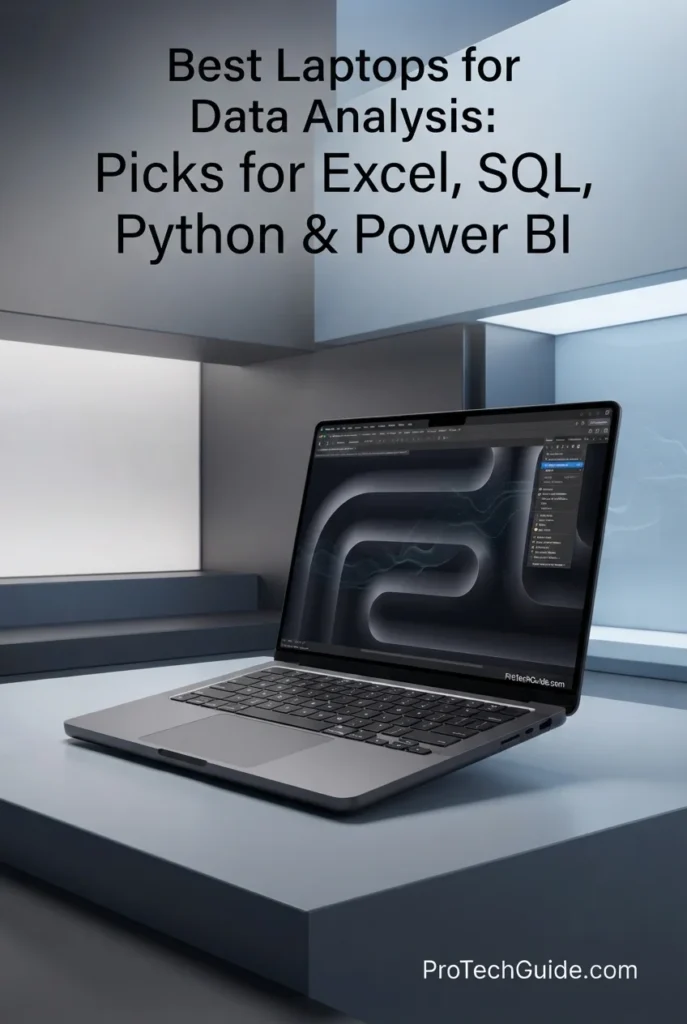
The Apple MacBook Pro 14-inch with the M5 Pro chip, 48GB of unified memory, and 1TB SSD is our top Mac recommendation for data analysis in 2026. Its 15-core CPU, 16-core GPU, high-bandwidth unified memory architecture, fast SSD, and premium 14.2-inch Liquid Retina XDR display provide an excellent platform for demanding analytical workflows including Python, SQL, Jupyter notebooks, pandas, NumPy, statistical analysis, data visualization, and large datasets. The 48GB memory configuration is particularly valuable for analysts who regularly work with multiple applications, large datasets, browsers, notebooks, databases, and analytical tools simultaneously.
The MacBook Pro 14 earns our Best MacBook for Data Analysis award because it combines high-end processing performance, 48GB of unified memory, fast storage, excellent portability, and one of the best laptop displays available. For analysts whose workflows center on Python, SQL, Jupyter, pandas, NumPy, statistics, and data visualization, it provides substantial performance headroom without requiring the size and weight of a traditional workstation.
Compared with Windows laptops such as the Lenovo ThinkPad X1 Carbon Gen 14 and Dell Premium 16, the MacBook Pro offers a particularly strong combination of memory capacity, power efficiency, premium display quality, and macOS-based analytical workflows. However, professionals who depend heavily on Microsoft Power BI Desktop should choose a Windows laptop instead, making the MacBook Pro a specialized recommendation rather than the universal choice for every data analyst.
Key Features
Lenovo ThinkPad X1 Carbon Gen 14 Aura Edition
Best Portable Windows Laptop for Excel, SQL, Power BI & Professional Data Analysis
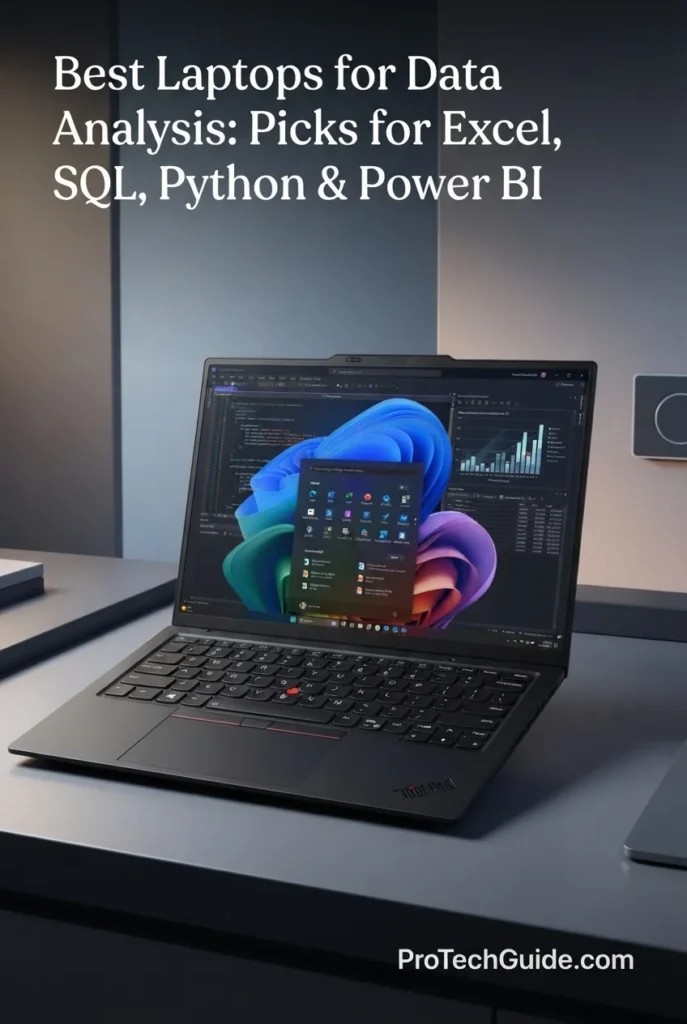
The Lenovo ThinkPad X1 Carbon Gen 14 Aura Edition with the Intel Core Ultra 7 365 vPro, 32GB of LPDDR5X memory, and 1TB PCIe Gen4 SSD is our top Windows laptop for data analysts in 2026. It combines strong processor performance, professional-grade memory capacity, Windows 11 Pro, a sharp 14-inch WUXGA IPS touchscreen, and an exceptionally portable ThinkPad design. For analysts working with Excel, SQL, Power BI, Python, business intelligence tools, dashboards, and large numbers of browser tabs and applications, it delivers an excellent balance of performance and mobility.
The ThinkPad X1 Carbon Gen 14 earns our Best Windows Laptop for Data Analysts award because it delivers one of the strongest combinations of portability, memory capacity, Windows compatibility, connectivity, and professional usability in this category. Its 32GB of RAM is particularly important for analysts who routinely combine Excel, Power BI, SQL, Python, browsers, and communication tools without wanting to move to a heavier workstation-class laptop.
Compared with the Dell Premium 16, the X1 Carbon sacrifices some display size and dedicated GPU capability in exchange for a significantly more portable business-oriented design. Compared with the Apple MacBook Pro 14, it offers the advantage of native Windows compatibility for Power BI Desktop and other Windows-focused enterprise tools. For professionals who spend much of their working day moving between locations, the X1 Carbon provides an especially compelling balance of analytical performance and mobility.
Key Features
Dell Premium 16 (Previously XPS 16)
Best Overall for Excel, SQL, Power BI, Python, Data Visualization & Professional Workloads
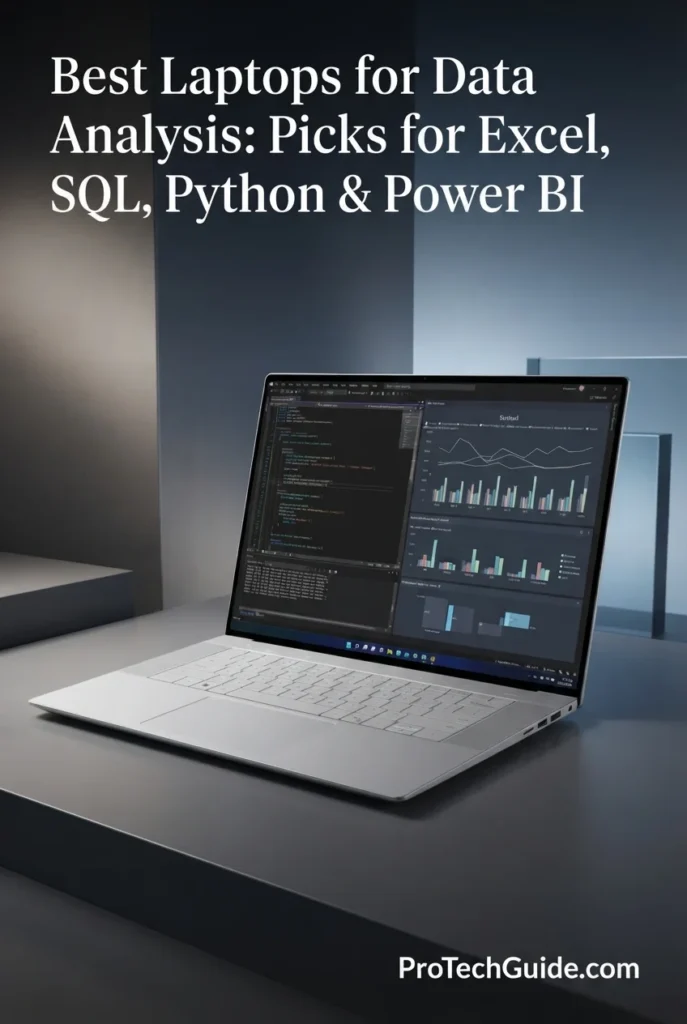
The Dell Premium 16, previously known as the XPS 16, is our Best Overall Laptop for Data Analysis in 2026. Its combination of a high-performance Intel Core Ultra 9 285H processor, 32GB of memory, 1TB PCIe NVMe SSD, dedicated NVIDIA graphics, Windows 11 Pro, and a large 16.3-inch 4K OLED touchscreen makes it exceptionally well suited to professional analytical workflows. For users working across Excel, SQL, Power BI, Python, data visualization, reporting, and demanding multitasking, the Premium 16 provides a particularly strong balance of computing power, screen real estate, connectivity, and long-term capability.
The Dell Premium 16 earns our Best Overall Laptop for Data Analysis award because it delivers the broadest combination of performance, screen size, display quality, Windows compatibility, memory capacity, storage, connectivity, and graphics capability among our eight selections. Most data analysts do not need a dedicated GPU, but having one gives this laptop additional versatility for visualization, GPU-accelerated applications, creative workloads, and more demanding professional tasks while the Core Ultra 9 and 32GB of RAM handle the majority of traditional analytical workloads.
Compared with the Lenovo ThinkPad X1 Carbon Gen 14, the Dell Premium 16 is less focused on extreme portability but offers a substantially larger 16.3-inch 4K OLED workspace and significantly more graphics capability. Compared with the Apple MacBook Pro 14, it provides native Windows compatibility for Power BI Desktop and a dedicated NVIDIA GPU. The Lenovo ThinkPad P1 Gen 8 remains the stronger choice for users specifically seeking a workstation-oriented configuration with 64GB of RAM and professional NVIDIA RTX graphics, but the Dell Premium 16 offers a more balanced solution for the broader range of data-analysis workflows.
Key Features
Lenovo ThinkPad P1 Gen 8
Best Workstation for Large Datasets, Heavy Multitasking, Python, SQL & Advanced Analytics
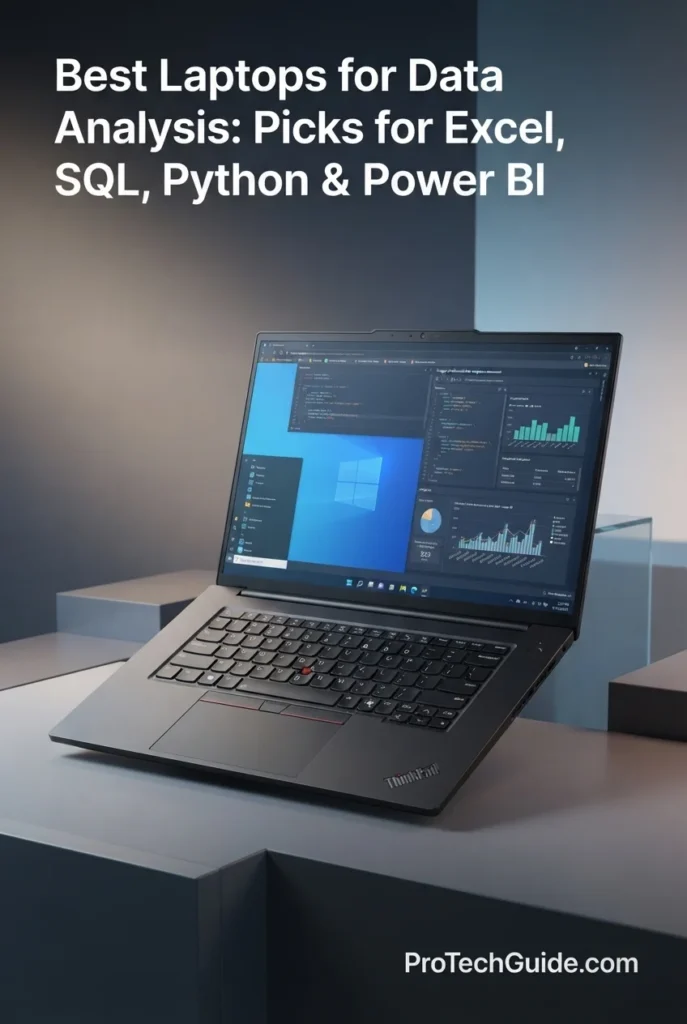
The Lenovo ThinkPad P1 Gen 8 with the Intel Core Ultra 9 285H, 64GB of memory, 2TB PCIe Gen4 SSD, and NVIDIA RTX PRO 2000 Blackwell graphics is our Best Professional Workstation for Data Analysis in 2026. Designed for demanding professional workloads, it combines a high-performance 16-core processor, unusually large memory capacity, substantial storage, professional NVIDIA graphics, and a high-resolution 16-inch display. For analysts working with large datasets, complex Python environments, advanced visualization, extensive multitasking, or analytical workflows that extend into technical and GPU-accelerated applications, the P1 provides considerably more headroom than a conventional productivity laptop.
The ThinkPad P1 Gen 8 earns our Best Professional Workstation for Data Analysis award because it provides the highest memory and storage capacity among our eight selections while also combining a powerful Core Ultra 9 processor with professional NVIDIA RTX PRO graphics. The 64GB RAM configuration is particularly valuable for analysts working with large datasets, multiple analytical environments, virtual machines, or extensive multitasking where 32GB may eventually become a limiting factor.
Compared with the Dell Premium 16, the ThinkPad P1 Gen 8 prioritizes workstation-oriented capability, memory capacity, storage, and professional NVIDIA graphics rather than mainstream versatility. The Dell remains our Best Overall choice because it provides a more balanced platform for the broader data-analysis market, while the P1 is the better choice when workloads justify 64GB of RAM and professional RTX graphics. Compared with the ThinkPad X1 Carbon Gen 14, the P1 is substantially more capable for heavy workloads but less focused on maximum portability.
Key Features
ASUS Zenbook 14 OLED
Best Portable Laptop for Excel, SQL, Python & Everyday Data Analysis
The ASUS Zenbook 14 OLED with the Intel Core Ultra 7 255H, 16GB of memory, 1TB SSD, and 14-inch WUXGA OLED touchscreen is our Best Portable Data Analysis Laptop in 2026. It is designed for analysts, students, consultants, business professionals, and remote workers who need a capable Windows laptop that is easy to carry between offices, meetings, classrooms, and home workspaces. Its combination of a 16-core processor, fast SSD, high-quality OLED display, Thunderbolt 4 connectivity, and lightweight design makes it particularly well suited to everyday Excel, SQL, Python, Power BI, and business intelligence workflows.
The ASUS Zenbook 14 OLED earns our Best Portable Data Analysis Laptop award because it strikes an excellent balance between performance, portability, display quality, and connectivity. The Core Ultra 7 255H provides considerably more processing capability than a basic office laptop, while the compact chassis makes it substantially easier to carry than larger 16-inch productivity and workstation models. Its 16GB memory configuration means it is best suited to moderate rather than exceptionally large datasets, but for students, consultants, business analysts, and mobile professionals, it provides a strong and practical analytical platform.
Compared with the Lenovo ThinkPad X1 Carbon Gen 14, the Zenbook 14 OLED offers a similarly portable Windows experience while placing greater emphasis on its OLED touchscreen and multimedia-oriented display experience. The ThinkPad remains our Best Windows Laptop for Data Analysts because its business-focused configuration and 32GB memory provide greater headroom for professional multitasking. Compared with the Dell Premium 16 and ThinkPad P1 Gen 8, the Zenbook is considerably more travel-friendly, but those larger systems offer substantially more memory and workstation-level performance for demanding datasets.
Key Features
HP OmniBook Ultra Flip
Best 2-in-1 for Data Analysis, Presentations, Touchscreen Productivity & Mobile Work
The HP OmniBook Ultra Flip with the Intel Core Ultra 7 258V, 32GB of memory, 1TB PCIe SSD, and 14-inch 2.8K OLED touchscreen is our Best 2-in-1 Laptop for Data Analysts in 2026. Its convertible design gives analysts more flexibility than a conventional laptop, allowing the system to transition between traditional keyboard-based work, tablet-style interaction, presentations, and touchscreen productivity. With 32GB of memory and Windows 11 Pro, it provides enough capacity for professional Excel, SQL, Power BI, Python, and business intelligence workflows while adding the versatility of an included Active Pen.
The HP OmniBook Ultra Flip earns our Best 2-in-1 Laptop for Data Analysts award because it adds meaningful flexibility to a capable professional Windows platform. The 32GB memory configuration gives it the capacity expected from a serious productivity laptop, while the high-resolution OLED touchscreen, convertible chassis, and included Active Pen make it particularly useful for analysts who regularly switch between data work, presentations, meetings, note-taking, and collaborative workflows.
Compared with the ASUS Zenbook 14 OLED, the OmniBook Ultra Flip provides a more flexible 2-in-1 design, twice the memory capacity, and an included Active Pen, making it better suited to professionals who combine analysis with presentations and touchscreen productivity. The Zenbook remains our Best Portable Data Analysis Laptop because of its straightforward lightweight laptop design and strong mobility focus. Compared with the Lenovo ThinkPad X1 Carbon Gen 14, the OmniBook offers greater touchscreen and convertible flexibility, while the ThinkPad remains the stronger choice for traditional business productivity and maximum professional laptop efficiency.
Key Features
Lenovo ThinkBook 16 Gen 8
Best Large-Screen Laptop for Excel, Power BI, SQL & Professional Data Analysis
The Lenovo ThinkBook 16 Gen 8 with the Intel Core Ultra 7 255H, 32GB of DDR5 memory, 1TB PCIe NVMe SSD, and 16-inch WUXGA IPS display is our Best Large-Screen Productivity Laptop for Data Analysis in 2026. Its spacious 16-inch 16:10 display provides a practical advantage for analysts who spend hours working with large Excel spreadsheets, Power BI dashboards, SQL environments, Python notebooks, and multiple applications side by side. Combined with 32GB of RAM, Windows 11 Pro, and extensive connectivity, it delivers a well-balanced platform for professional data analysis without the size or cost of a dedicated workstation.
The Lenovo ThinkBook 16 Gen 8 earns our Best Large-Screen Productivity Laptop for Data Analysis award because its 16-inch display and 32GB memory configuration directly address two of the most important practical requirements for professional analysts: workspace and multitasking capacity. Rather than focusing on workstation-class graphics performance, the ThinkBook 16 delivers the hardware and connectivity that matter most for spreadsheet-heavy, dashboard-oriented, and business intelligence workflows.
Compared with the ASUS Zenbook 14 OLED, the ThinkBook 16 provides a substantially larger workspace and twice the memory capacity, making it better suited to analysts who spend most of their time at a desk working with large spreadsheets, dashboards, and multiple applications. The Zenbook remains the better choice when portability is the priority. Compared with the Lenovo ThinkPad X1 Carbon Gen 14, the ThinkBook 16 offers a larger display and a more productivity-focused form factor, while the X1 Carbon remains the stronger option for professionals who prioritize maximum portability and business-class mobility.
Key Features
Acer Swift Go 16 AI — Core Ultra 7 355, 32GB RAM, 1TB SSD
Best Value Laptop for Excel, Power BI, SQL, Python & Everyday Data Analysis
The Acer Swift Go 16 AI with the Intel Core Ultra 7 355, 32GB of LPDDR5X memory, 1TB PCIe 4.0 SSD, and 16-inch WUXGA OLED touchscreen is our Best Value Laptop for Data Analysis in 2026. It combines the memory capacity expected from a professional data-analysis laptop with a large 16-inch OLED display, modern connectivity, a lightweight design, and a capable Intel Core Ultra processor. For analysts who want strong everyday performance without moving into workstation-class pricing, the Swift Go 16 AI offers an attractive balance of productivity, portability, and features.
The Acer Swift Go 16 AI earns our Best Value for Data Analysis award because it delivers many of the specifications professional analysts actually need without moving into the much more expensive workstation category. Its 32GB memory, 1TB SSD, 16-inch OLED touchscreen, modern Core Ultra processor, extensive connectivity, and lightweight design make it particularly compelling for users who want a capable all-around analytical laptop while keeping portability and overall value in balance.
Compared with the Lenovo ThinkBook 16 Gen 8, the Swift Go 16 AI offers a more premium OLED touchscreen experience and a notably lighter design, while the ThinkBook remains particularly attractive for traditional business productivity and extensive wired connectivity. Compared with the ASUS Zenbook 14 OLED, the Acer provides twice the memory capacity and a larger 16-inch workspace, making it better suited to analysts who regularly work with larger spreadsheets and dashboards. The Zenbook remains the better choice for users who prioritize a smaller 14-inch form factor. Compared with the HP OmniBook Ultra Flip, the Acer provides a larger display and strong portability, while the HP is the better option for users who specifically want a convertible 2-in-1 design and included Active Pen.
Key Features
Best Laptops for Data Analysis in 2026
Ranked by CPU Performance, RAM Capacity, Excel, SQL, Power BI, Python, Display Quality, Portability & Overall Value
Choosing the best laptop for data analysis in 2026 requires more than comparing processor specifications. Analysts need enough memory for large spreadsheets and datasets, strong CPU performance for calculations and data transformation, fast storage for projects and applications, a comfortable display for dashboards and reports, reliable connectivity, and broad software compatibility. We evaluated these laptops based on real-world data-analysis workloads including Excel, SQL, Power BI, Python, Jupyter notebooks, data visualization, business intelligence, multitasking, reporting, and professional productivity to help you choose the right laptop for your analytical workflow.
```| Laptop | CPU & Key Specs | Best For | Why It Wins | Editor's Verdict |
|---|---|---|---|---|
Best MacBook
Apple MacBook Pro 14-inch
Check Price | M5 Pro 15-Core CPU 48GB Unified Memory 1TB SSD 14.2" Liquid Retina XDR | Python Users SQL Professionals Advanced Data Analysis Mac Users | The MacBook Pro combines exceptional processing performance, 48GB of unified memory, fast SSD storage, an excellent professional display, and outstanding efficiency. It is particularly well suited to Python, SQL, Jupyter, pandas, NumPy, statistics, and advanced data-processing workflows on macOS. | Best MacBook for Data Analysis |
Best Windows Laptop
Lenovo ThinkPad X1 Carbon Gen 14
Check Price | Intel Core Ultra 7 365 32GB LPDDR5X 1TB PCIe Gen4 SSD 14" WUXGA Touch Windows 11 Pro | Business Analysts Consultants Frequent Travelers Windows Professionals | The ThinkPad X1 Carbon Gen 14 combines strong professional performance with exceptional portability and business-focused features. Its 32GB of memory provides excellent multitasking capacity for Excel, SQL, Power BI, Python, and Microsoft 365 while its compact design makes it ideal for professionals who work across multiple locations. | Best Portable Windows Laptop for Data Analysts |
Best Overall
Dell Premium 16
Check Price | Intel Core Ultra 9 32GB LPDDR5X 1TB PCIe NVMe SSD RTX 5060 8GB 16.3" 4K OLED | Professional Analysts Power BI Users Data Visualization Heavy Multitasking | The Dell Premium 16 offers one of the strongest combinations of CPU performance, memory capacity, storage, display quality, and Windows compatibility in this lineup. Its large 16.3-inch 4K OLED display is particularly useful for dashboards, data visualization, spreadsheets, and multi-window workflows, while the dedicated GPU adds flexibility for graphics-intensive and GPU-accelerated workloads. | Best Overall Laptop for Data Analysis |
Best Workstation
Lenovo ThinkPad P1 Gen 8
Check Price | Intel Core Ultra 9 285H 64GB LPDDR5X 2TB PCIe Gen4 SSD RTX PRO 2000 Blackwell 16" WQUXGA | Large Datasets Heavy Multitasking Advanced Analytics Professional Workstations | The ThinkPad P1 Gen 8 provides substantially more memory and storage headroom than a conventional productivity laptop. Its 64GB of RAM, 2TB SSD, powerful Core Ultra 9 processor, and professional NVIDIA graphics make it particularly well suited to analysts working with demanding datasets, virtual machines, advanced visualization, and computationally intensive workflows. | Best Professional Workstation for Data Analysis |
Best Portable
ASUS Zenbook 14 OLED
Check Price | Intel Core Ultra 7 255H 16GB LPDDR5X 1TB PCIe SSD 14" WUXGA OLED Touch Windows 11 Pro | Students Mobile Analysts Everyday Data Analysis Frequent Travelers | The Zenbook 14 OLED delivers a strong combination of portability, display quality, processor performance, and fast storage. Its compact 14-inch design makes it particularly attractive to users who regularly travel while still needing enough performance for Excel, SQL, Python, Power BI, and everyday analytical workloads. | Best Portable Data Analysis Laptop |
Best 2-in-1
HP OmniBook Ultra Flip
Check Price | Intel Core Ultra 7 258V 32GB LPDDR5X 1TB PCIe NVMe SSD 14" 2.8K OLED Touch Windows 11 Pro | Presentations Touchscreen Productivity Consultants Mobile Professionals | The OmniBook Ultra Flip combines professional Windows performance with a flexible convertible design. Its 32GB of memory, high-resolution OLED touchscreen, Active Pen support, and compact form factor make it particularly useful for analysts who combine data analysis with presentations, meetings, note-taking, collaboration, and mobile productivity. | Best 2-in-1 Laptop for Data Analysts |
Best Large-Screen
Lenovo ThinkBook 16 Gen 8
Check Price | Intel Core Ultra 7 255H 32GB DDR5 1TB PCIe NVMe SSD 16" WUXGA IPS Windows 11 Pro | Excel Users Power BI Users Financial Analysts Office Professionals | The ThinkBook 16 Gen 8 prioritizes practical productivity with a large 16-inch 16:10 display, 32GB of memory, strong CPU performance, and extensive connectivity. It is particularly effective for analysts who spend long hours working with large spreadsheets, dashboards, reports, and multiple applications. | Best Large-Screen Productivity Laptop for Data Analysis |
Best Value
Acer Swift Go 16 AI
Check Price | Intel Core Ultra 7 355 32GB LPDDR5X 1TB PCIe 4.0 SSD 16" WUXGA OLED Touch Windows 11 Pro | Students Business Analysts Mobile Professionals Value Buyers | The Swift Go 16 AI delivers an impressive combination of 32GB memory, 1TB SSD storage, a large OLED touchscreen, modern Intel Core Ultra processing, Thunderbolt connectivity, and a lightweight design. It is an excellent option for users who want strong everyday data-analysis capabilities without stepping up to workstation-class hardware. | Best Value Laptop for Data Analysis |
Recommended Next Reads
Finished comparing the best laptops for data analysis? Explore our related buying guides for data science, Python development, AI workloads, business productivity, and laptop performance.
Whether you're working with Excel and Power BI today, moving into Python and data science, exploring machine learning, or simply looking for the right processor, display, or price range, these guides can help you choose your next laptop with greater confidence.
Best Laptops for Data Science in 2026
Explore laptops designed for Python, machine learning, AI, statistics, data processing, and increasingly demanding data-science workloads.
Explore Data Science Laptops →Best Laptops for AI & Machine Learning in 2026
Compare laptops for Python, TensorFlow, local AI, machine learning, GPU-accelerated workloads, and demanding AI development.
Explore AI & ML Laptops → Programming & PythonBest Laptops for Programming in 2026
Find powerful laptops for coding, Python, development environments, multitasking, databases, and professional software development.
Explore Programming Laptops → Processor ComparisonIntel Core Ultra 9 vs AMD Ryzen AI 9 in 2026
Compare two leading laptop processor platforms and understand which one makes more sense for performance, productivity, AI, and professional workloads.
Compare Laptop Processors → Display QualityBest OLED Laptops in 2026
Explore the best OLED laptops for productivity, data visualization, professional work, content creation, and users who want a premium display.
Explore OLED Laptops → Budget & ValueBest Laptops Under $1500 in 2026
Looking for strong performance without workstation-level pricing? Compare some of the best laptops available around the $1,500 price point.
Explore Laptops Under $1500 → Professional WorkBest Business Laptops in 2026
Explore laptops built around professional productivity, security, multitasking, portability, reliability, and long-term business use.
Explore Business Laptops →EDITOR'S FINAL RECOMMENDATIONS
After comparing laptops across processor performance, RAM capacity, Excel workloads, SQL, Power BI, Python, data visualization, storage, display quality, portability, software compatibility, thermals, connectivity, and long-term value, these are our final recommendations for data analysts in 2026. Whether you work primarily with spreadsheets and business intelligence, build Python-based analytical workflows, manage large datasets, or need a highly portable professional system, there is an option here for your specific workload.
Dell Premium 16 (Previously XPS 16)
The best overall laptop for professional data analysis in 2026. The Dell Premium 16 combines high-end Windows performance, 32GB of memory, fast SSD storage, a large high-resolution OLED display, Windows 11 Pro, and dedicated RTX graphics. It provides an excellent balance of Excel, SQL, Power BI, Python, data visualization, multitasking, and long-term professional capability.
- ✓ Intel Core Ultra 9 285H
- ✓ 32GB LPDDR5X Memory
- ✓ 1TB PCIe NVMe SSD
- ✓ 16.3-inch 4K OLED Display
Lenovo ThinkPad X1 Carbon Gen 14 Aura Edition
The best Windows laptop for analysts who prioritize portability, professional productivity, keyboard quality, business-class features, and long-term usability. Its Core Ultra 7 processor and 32GB of memory provide more than enough capacity for Excel, SQL, Power BI, Python, and everyday professional data analysis without the size and weight of a workstation.
- ✓ Intel Core Ultra 7 365 vPro
- ✓ 32GB LPDDR5X Memory
- ✓ 1TB PCIe Gen4 SSD
- ✓ 14-inch WUXGA IPS Touchscreen
Apple MacBook Pro 14-inch M5 Pro
The best MacBook for data analysts who primarily use Python, SQL, Jupyter, pandas, NumPy, statistics, and other macOS-compatible analytical tools. With an M5 Pro processor and 48GB of unified memory, it offers exceptional performance and memory capacity for demanding data-processing workflows while maintaining the advantages of Apple's premium mobile platform.
- ✓ Apple M5 Pro Chip
- ✓ 48GB Unified Memory
- ✓ 1TB SSD Storage
- ✓ Liquid Retina XDR Display
Lenovo ThinkPad P1 Gen 8
The workstation choice for analysts who routinely work with large datasets, demanding multitasking environments, advanced data visualization, virtual machines, or workloads that benefit from professional GPU acceleration. Its 64GB of memory and 2TB SSD provide substantially more headroom than conventional productivity laptops.
- ✓ Intel Core Ultra 9 285H
- ✓ 64GB LPDDR5 Memory
- ✓ 2TB PCIe Gen4 SSD
- ✓ NVIDIA RTX PRO 2000 Blackwell
ASUS Zenbook 14 OLED
The best choice for analysts who prioritize portability and everyday productivity. Its compact 14-inch design, OLED touchscreen, Core Ultra 7 processor, 16GB of memory, and 1TB SSD provide a strong platform for Excel, SQL, Python, Power BI, and general analytical work while remaining easy to carry between home, office, university, and client locations.
- ✓ Intel Core Ultra 7 255H
- ✓ 16GB LPDDR5X Memory
- ✓ 1TB PCIe NVMe SSD
- ✓ 14-inch WUXGA OLED Touchscreen
HP OmniBook Ultra Flip
The most versatile option for analysts who combine data work with presentations, meetings, note-taking, and touchscreen productivity. Its 32GB memory, 2.8K OLED touchscreen, convertible design, and included Active Pen make it particularly useful for professionals who want more flexibility than a conventional laptop can provide.
- ✓ Intel Core Ultra 7 258V
- ✓ 32GB LPDDR5X Memory
- ✓ 1TB PCIe NVMe SSD
- ✓ 14-inch 2.8K OLED Touchscreen
Lenovo ThinkBook 16 Gen 8
The productivity specialist for analysts who spend most of their day working with spreadsheets, Power BI dashboards, SQL tools, reports, and multiple windows. Its 16-inch 16:10 display provides more workspace than compact laptops, while 32GB of DDR5 memory and extensive connectivity make it a strong professional productivity platform.
- ✓ Intel Core Ultra 7 255H
- ✓ 32GB DDR5 Memory
- ✓ 1TB PCIe NVMe SSD
- ✓ 16-inch WUXGA IPS Display
Acer Swift Go 16 AI
The value-focused choice for analysts who want 32GB of memory, a large OLED display, modern processor performance, and strong connectivity without moving into workstation pricing. Its lightweight design also makes it an attractive option for students, professionals, freelancers, and everyday business users working with Excel, SQL, Power BI, and Python.
- ✓ Intel Core Ultra 7 355
- ✓ 32GB LPDDR5X Memory
- ✓ 1TB PCIe 4.0 SSD
- ✓ 16-inch WUXGA OLED Touchscreen
Which data analysis laptop should you buy?
Dell Premium 16
ThinkPad X1 Carbon Gen 14
MacBook Pro M5 Pro
ThinkPad P1 Gen 8
ASUS Zenbook 14 OLED
HP OmniBook Ultra Flip
ThinkBook 16 Gen 8
Acer Swift Go 16 AI
- Choose the Dell Premium 16 if you want the strongest overall combination of Windows performance, memory, display quality, storage, multitasking capability, and versatility for professional data analysis.
- Choose the Lenovo ThinkPad X1 Carbon Gen 14 if portability, business-class productivity, keyboard quality, and professional mobility are more important than workstation-level performance.
- Choose the Apple MacBook Pro with M5 Pro if your workflow centers on Python, SQL, Jupyter, pandas, NumPy, statistics, and other macOS-compatible analytical tools. If you depend on Power BI Desktop, choose Windows instead.
- Choose the Lenovo ThinkPad P1 Gen 8 if you regularly work with large datasets, heavy multitasking, virtual machines, advanced visualization, or other demanding analytical workloads that justify workstation-class hardware.
- Choose the ASUS Zenbook 14 OLED if portability is your priority and your typical workload consists of Excel, SQL, Python, Power BI, and everyday data analysis. Its 16GB configuration is best suited to moderate workloads rather than exceptionally large datasets.
- Choose the HP OmniBook Ultra Flip if you want a versatile 2-in-1 that combines professional data analysis with presentations, meetings, touchscreen interaction, and stylus-based productivity.
- Choose the Lenovo ThinkBook 16 Gen 8 if your workflow revolves around Excel, Power BI dashboards, spreadsheets, reports, SQL tools, and multitasking across a large 16-inch workspace.
- Choose the Acer Swift Go 16 AI if you want strong value with 32GB of memory, a large OLED display, modern processor performance, and enough capability for everyday professional data analysis.
EDITOR'S FINAL VERDICT
After comparing processor performance, RAM capacity, SSD storage, Excel workloads, SQL, Power BI, Python, data visualization, display quality, portability, software compatibility, connectivity, thermals, and long-term value, one conclusion stands out:The best laptop for data analysis is not necessarily the most powerful workstation or the laptop with the largest GPU. It is the system that provides the right balance of processing performance, memory capacity, storage, display quality, software compatibility, portability, and reliability for the analytical workloads you actually perform.
Modern data analysts can work across large Excel workbooks, SQL databases, Power BI dashboards, Python environments, Jupyter notebooks, pandas, NumPy, statistical tools, business intelligence platforms, browser-based applications, and increasingly demanding datasets. These workflows benefit primarily from strong CPU performance, sufficient RAM, fast SSD storage, and effective multitasking rather than from a high-end dedicated GPU.
For most professional data analysts, 32GB of memory is the ideal target for long-term use, while 16GB remains suitable for moderate workloads. Fast SSD storage, a comfortable display, reliable connectivity, and broad software compatibility are equally important when the laptop will be used for hours of analytical work every day.- Choose the Dell Premium 16 if you want the strongest overall combination of CPU performance, 32GB of memory, fast storage, a large high-resolution OLED display, Windows compatibility, and versatility for Excel, SQL, Power BI, Python, and professional multitasking.
- Choose the Lenovo ThinkPad X1 Carbon Gen 14 if portability, keyboard quality, business-class productivity, and professional mobility are more important than maximum workstation performance.
- Choose the Apple MacBook Pro with M5 Pro if your workflow is centered on Python, SQL, Jupyter, pandas, NumPy, statistics, and other macOS-compatible analytical tools. If Power BI Desktop is essential to your workflow, a Windows laptop is the safer choice.
- Choose the Lenovo ThinkPad P1 Gen 8 if you regularly work with large datasets, heavy multitasking, virtual machines, advanced visualization, or other workloads that justify workstation-class hardware and 64GB of memory.
Top Data Analysis Laptop Recommendations (2026)
Dell Premium 16
Our Editor's Choice for most professional data analysts because it combines powerful Windows performance, 32GB of memory, fast 1TB SSD storage, a large 16.3-inch high-resolution OLED display, and dedicated graphics. It provides substantial headroom for Excel, SQL, Power BI, Python, data visualization, and demanding multitasking.
- ✓ Intel Core Ultra 9 285H
- ✓ 32GB LPDDR5X Memory
- ✓ 1TB PCIe NVMe SSD
- ✓ 16.3-inch 4K OLED Display
Lenovo ThinkPad X1 Carbon Gen 14
The strongest choice for analysts who spend significant time traveling or moving between office, home, and client locations. Its 32GB memory configuration, Core Ultra 7 processor, professional keyboard, and compact 14-inch design provide an excellent balance of analytical performance and mobility.
- ✓ Intel Core Ultra 7 365 vPro
- ✓ 32GB LPDDR5X Memory
- ✓ 1TB PCIe Gen4 SSD
- ✓ 14-inch WUXGA IPS Touchscreen
Apple MacBook Pro 14-inch M5 Pro
The best Mac option for demanding data-analysis workflows that are compatible with macOS. Its M5 Pro processor and 48GB of unified memory provide substantial performance and memory headroom for Python, SQL, Jupyter, pandas, NumPy, statistical analysis, and professional multitasking.
- ✓ Apple M5 Pro Chip
- ✓ 48GB Unified Memory
- ✓ 1TB SSD Storage
- ✓ Liquid Retina XDR Display
- ✓ You want the best overall laptop for professional data analysis
- ✓ You regularly work with Excel, Power BI, SQL, Python, and multiple applications simultaneously
- ✓ You want 32GB of memory and a large premium display
- ✓ You prefer Windows and want additional GPU versatility for visualization and other workloads
- ✓ Portability and professional mobility are major priorities
- ✓ You want 32GB of memory in a compact Windows laptop
- ✓ Keyboard quality and business-oriented design matter
- ✓ Your workloads are primarily Excel, SQL, Power BI, Python, and professional productivity
- ✓ Prefer 32GB of RAM for demanding professional workloads and long-term use
- ✓ Consider 16GB acceptable for moderate analysis, students, and lighter workflows
- ✓ Prioritize a fast SSD with enough capacity for datasets, applications, and analytical projects
- ✓ Choose Windows if Power BI Desktop is an essential part of your workflow
- ✓ Do not pay for a dedicated GPU unless your workload actually benefits from GPU acceleration, advanced visualization, or other demanding graphics workloads
A data analysis laptop is a professional tool that may be used for thousands of hours across spreadsheets, databases, dashboards, Python environments, reports, meetings, and business intelligence workflows. Raw processor specifications matter, but memory capacity, display quality, keyboard comfort, software compatibility, storage, portability, and long-term reliability can have an equally important impact on everyday productivity.
Among the models evaluated in this guide, the Dell Premium 16 delivers the strongest overall combination of performance, 32GB of memory, storage, display quality, Windows compatibility, and versatility, making it our Editor's Choice for the best laptop for data analysis in 2026.The Lenovo ThinkPad X1 Carbon Gen 14 is the better choice for analysts who prioritize mobility and business-class productivity, while the Apple MacBook Pro with M5 Pro is the strongest Mac option for Python, SQL, Jupyter, and other macOS-compatible analytical workflows. For exceptionally demanding workloads, the Lenovo ThinkPad P1 Gen 8 provides the additional memory and workstation-class hardware needed for substantially heavier analytical environments.
Compare current prices, configurations, memory, storage, warranty coverage, and availability before choosing the laptop that best matches your data analysis workflow.
Check Latest DealsEDITOR'S FAQ
Choosing the best laptop for data analysis requires more than comparing processor specifications. Analysts need to consider RAM capacity, CPU performance, SSD storage, display size, software compatibility, portability, multitasking capability, and the type of analytical workloads they expect to perform.These frequently asked questions address the most important buying decisions, from determining how much RAM you need for Excel and Power BI to choosing between Windows and macOS, understanding whether a dedicated GPU is necessary, and selecting the right laptop for Python, SQL, business intelligence, and large datasets.
It provides an excellent combination of processor performance, 32GB of memory, fast SSD storage, a large high-resolution OLED display, Windows 11 Pro, and dedicated graphics. This makes it particularly versatile for Excel, SQL, Power BI, Python, data visualization, and demanding multitasking.
- Strong Intel Core Ultra processing performance.
- 32GB of memory for professional multitasking.
- 1TB SSD for applications, datasets, and analytical projects.
- Large 16.3-inch high-resolution OLED display.
- Windows compatibility for Excel, Power BI Desktop, SQL, and Python environments.
For analysts who prioritize portability instead, the Lenovo ThinkPad X1 Carbon Gen 14 is our preferred Windows alternative, while the Apple MacBook Pro M5 Pro is our top choice for macOS-based analytical workflows.
Check PriceData analysis often involves more than one application running at the same time. An analyst may have Excel, Power BI, SQL tools, Python, Jupyter notebooks, browser tabs, communication applications, and cloud services open simultaneously.
- 16GB → Suitable for students, light analysis, moderate Excel workbooks, SQL, Python, and everyday Power BI workloads.
- 32GB → Recommended for professional analysts, larger spreadsheets, Power BI models, Python environments, heavy multitasking, and long-term use.
- 64GB or more → Best for very large datasets, virtual machines, demanding analytical environments, advanced visualization, and workstation-class workloads.
If you expect your analytical workload to grow over the next several years, 32GB is the safer long-term configuration. The Lenovo ThinkPad P1 Gen 8 takes this further with 64GB of memory for particularly demanding workloads.
An analyst working with moderate Excel files, SQL databases, Python scripts, Jupyter notebooks, and smaller Power BI models can work comfortably with 16GB when the number of simultaneously active applications is reasonable.
- 16GB is suitable for moderate Excel and SQL workloads.
- 16GB works well for many Python and Jupyter workflows.
- 16GB can handle everyday Power BI projects.
- 32GB is preferable for large Power BI models and heavier multitasking.
- 64GB becomes valuable when working with very large datasets or virtual machines.
In this guide, the ASUS Zenbook 14 represents the 16GB option for analysts who prioritize portability, while the 32GB configurations of the Dell Premium 16, ThinkPad X1 Carbon, HP OmniBook Ultra Flip, ThinkBook 16, and Acer Swift Go 16 provide more professional headroom.
Check Portable OptionExcel, SQL, Power BI, Python, pandas, NumPy, statistical analysis, and many business intelligence workflows rely primarily on CPU performance, memory capacity, and fast storage rather than a high-end graphics processor.
- Integrated graphics → Sufficient for most Excel, SQL, Python, Power BI, and standard data visualization workloads.
- Dedicated GPU → Useful for advanced visualization, GPU-accelerated applications, AI workloads, creative applications, and other graphics-intensive tasks.
- Workstation GPU → Justified when your workflow combines data analysis with demanding visualization, virtual machines, engineering, AI, or other professional workloads.
This is why the Dell Premium 16 and Lenovo ThinkPad P1 Gen 8 include dedicated graphics but are not recommended simply because of their GPUs. Their additional graphics capability provides versatility rather than being a requirement for conventional data analysis.
The decision largely depends on the software in your workflow. Windows provides broad compatibility with Microsoft's professional ecosystem, including the native Power BI Desktop application.
- Windows → Best for Power BI Desktop, Microsoft-centric business environments, Excel-heavy workflows, and broad enterprise software compatibility.
- macOS → Excellent for Python, SQL, Jupyter, pandas, NumPy, statistics, programming, and many data-processing workflows.
- MacBook Pro → Particularly attractive when demanding analytical work is compatible with macOS and you value Apple's hardware efficiency and ecosystem.
Our Apple MacBook Pro M5 Pro is therefore the best MacBook in this guide, but analysts whose workflow depends on Power BI Desktop should choose one of the Windows systems instead.
Check MacBook ProThe M5 Pro provides strong processing performance, while the 48GB unified memory configuration gives demanding analytical environments substantial memory headroom. The combination is particularly attractive for analysts who also use development tools and multiple applications simultaneously.
- Excellent platform for Python and Jupyter notebooks.
- Strong performance for pandas, NumPy, and statistical workflows.
- 48GB unified memory provides substantial multitasking headroom.
- Premium display and excellent overall build quality.
- Strong battery efficiency for mobile professional work.
The primary limitation is software compatibility. Power BI Desktop is designed for Windows, so analysts who depend on the native desktop application should choose a Windows laptop instead.
Check MacBook Pro PriceAnalytical workloads can involve datasets, Python environments, applications, Power BI files, Excel workbooks, reports, local databases, virtual environments, and other professional files. Storage requirements can therefore grow faster than expected.
- 512GB → Acceptable for students and analysts who rely heavily on cloud storage.
- 1TB → Recommended for most professional analysts.
- 2TB → Better for large local datasets, extensive projects, virtual machines, and professionals who maintain substantial local storage.
- 4TB → Appropriate for exceptionally large local datasets and storage-intensive professional workflows.
A fast PCIe NVMe SSD also helps reduce application and project loading times. For long-term professional use, 1TB provides a much more comfortable balance than choosing the smallest available storage configuration.
- 14-inch → Best for analysts who travel frequently, work remotely, or move between office locations and meetings.
- 16-inch → Better for Excel, Power BI, dashboards, reports, SQL tools, and split-screen multitasking.
A larger 16-inch 16:10 display can provide noticeably more usable workspace when comparing spreadsheets, dashboards, browser windows, and analytical applications side by side.
The Lenovo ThinkBook 16 Gen 8 and Acer Swift Go 16 AI are particularly attractive for analysts who value screen space, while the ThinkPad X1 Carbon Gen 14 and ASUS Zenbook 14 are better suited to professionals who prioritize portability.
Check Large-Screen OptionIts Core Ultra 9 285H processor, 64GB of memory, 2TB SSD, and NVIDIA RTX PRO 2000 Blackwell graphics provide significantly more hardware headroom than a conventional productivity laptop.
- 64GB of memory for demanding multitasking and large datasets.
- 2TB SSD for substantial local data storage.
- High-performance Core Ultra 9 processor.
- Professional NVIDIA RTX PRO 2000 Blackwell graphics.
- Large high-resolution 16-inch display.
It is overkill for many analysts working primarily with ordinary Excel, SQL, and Power BI workloads. However, it becomes much more compelling when data analysis is combined with advanced visualization, virtual machines, AI workloads, or other demanding professional applications.
View ThinkPad P1There is no single laptop that is perfect for every data analyst. Your choice should be based on the applications you use, dataset sizes, memory requirements, portability needs, and whether you depend on Windows-specific software.
- Best Overall → Dell Premium 16
- Best Windows Laptop → Lenovo ThinkPad X1 Carbon Gen 14
- Best MacBook → Apple MacBook Pro M5 Pro
- Best Workstation → Lenovo ThinkPad P1 Gen 8
- Best Portable → ASUS Zenbook 14 OLED
- Best 2-in-1 → HP OmniBook Ultra Flip
- Best Large-Screen → Lenovo ThinkBook 16 Gen 8
- Best Value → Acer Swift Go 16 AI
If you want the safest all-around recommendation for professional Excel, SQL, Power BI, Python, data visualization, and multitasking, the Dell Premium 16 remains our Editor's Choice. If mobility is more important, choose the ThinkPad X1 Carbon. If your workflow is centered on macOS-compatible Python and SQL tools, the MacBook Pro M5 Pro is the strongest Mac option.
Check Best Overall DealDATA ANALYSIS LAPTOP BUYING GUIDE
Choosing a laptop for data analysis is not simply about finding the fastest processor or the most expensive configuration. Analysts need a system that can handle large spreadsheets, SQL queries, Power BI models, Python environments, dashboards, browser multitasking, data visualization, and professional applications while remaining comfortable and reliable over several years.The wrong laptop can become a daily source of frustration through insufficient RAM, limited storage, poor display quality, weak software compatibility, excessive weight, or unnecessary hardware that provides little benefit for your actual workload. Avoid these common mistakes before choosing your next data analysis laptop.
The best data analysis laptop is rarely the one with the most impressive specification sheet. For analysts, memory capacity, CPU performance, SSD storage, display quality, software compatibility, keyboard comfort, portability, and long-term reliability can have a greater impact on productivity than simply choosing the most powerful GPU available.For most professional analysts in 2026, we recommend targeting 32GB of memory, fast SSD storage, a modern multi-core processor, and a quality display. A dedicated GPU is not necessary for most Excel, SQL, Power BI, Python, and business intelligence workloads, so it should be treated as an additional capability rather than a basic requirement.
Choosing Only 8GB or 16GB of RAM
- Data analysis often involves Excel, Power BI, SQL tools, Python, browser tabs, and other applications running simultaneously.
- Large spreadsheets and Power BI models can consume substantially more memory than ordinary office workloads.
- Insufficient memory can reduce multitasking responsiveness and create limitations as analytical projects become more demanding.
Better decision: Choose 32GB of memory when possible for professional data analysis. A 16GB configuration can still be appropriate for students and moderate workloads, while 64GB becomes valuable for very large datasets, virtual machines, and demanding professional environments.
Buying a Dedicated GPU You Do Not Need
- Most Excel, SQL, Power BI, Python, pandas, NumPy, and statistical workloads do not require a high-end dedicated GPU.
- Paying for unnecessary graphics performance can increase the laptop's price, weight, heat, and power consumption.
- CPU performance and RAM capacity are generally more important for traditional data analysis workloads.
Better decision: Prioritize CPU performance, RAM, and SSD storage first. Consider a dedicated GPU when your workflow also involves advanced visualization, GPU-accelerated applications, AI workloads, creative applications, or other graphics-intensive tasks.
Ignoring Power BI Desktop Compatibility
- Microsoft Power BI Desktop is an important tool for many professional analysts and business intelligence workflows.
- Not every operating system provides the same level of compatibility with professional Microsoft applications.
- Choosing a Mac without checking software requirements first can create unnecessary workflow limitations.
Better decision: Choose Windows if Power BI Desktop is an essential part of your workflow. macOS remains an excellent platform for Python, SQL, Jupyter, pandas, NumPy, statistics, and many other analytical tools, but software compatibility should be checked before choosing a MacBook.
Choosing Too Little SSD Storage
- Data analysis projects can accumulate datasets, Python environments, applications, reports, Power BI files, and local databases.
- A nearly full SSD can make storage management increasingly inconvenient over time.
- Large analytical projects can require substantially more local storage than ordinary office documents.
Better decision: Target 1TB of SSD storage for professional data analysis. A 512GB SSD can work for lighter workloads and cloud-focused users, while 2TB or more is preferable for large local datasets, virtual machines, and storage-intensive projects.
Buying More Performance Than Your Workflow Requires
- Not every analyst needs a workstation-class Core Ultra 9 processor or professional NVIDIA graphics.
- Excess performance can increase purchase cost without providing a meaningful productivity advantage for ordinary Excel, SQL, and Power BI workloads.
- A balanced laptop can provide better portability, battery efficiency, and overall value than a specification-heavy workstation.
Better decision: Match hardware to the size and complexity of your datasets. Choose a balanced 32GB laptop for most professional analysis and move to a workstation such as the ThinkPad P1 Gen 8 only when your workload genuinely requires additional memory, storage, processing, or GPU capability.
Overlooking Display Size and Workspace
- Analysts can spend hours comparing spreadsheets, dashboards, SQL queries, reports, and browser windows.
- A small display can make split-screen multitasking more difficult.
- Large Excel workbooks and Power BI dashboards benefit from additional horizontal and vertical workspace.
Better decision: Choose a 14-inch laptop when portability is the priority and a 16-inch model when workspace and multitasking matter more. If you primarily work at a desk, consider pairing the laptop with an external monitor.
Smart Buying Advice for Data Analysts
You prioritize professional productivity, keyboard quality, reliability, portability, security features, and long-term business use. The Lenovo ThinkPad X1 Carbon Gen 14 is particularly attractive when you want a highly portable Windows system with 32GB of memory and strong professional features.
Your analytical workflow is compatible with macOS and you prioritize Python, SQL, Jupyter, pandas, NumPy, statistics, battery efficiency, premium construction, and Apple's ecosystem. The MacBook Pro M5 Pro is our preferred Mac option for demanding analytical workloads.
Key takeaway: The best data analysis laptop is not necessarily the fastest or most expensive machine. It is the laptop that provides the right balance of CPU performance, memory capacity, storage, display quality, software compatibility, portability, and reliability for the datasets and applications you actually use.
After evaluating the laptops featured in this guide, these are our Editor's top recommendations for data analysts in 2026:
- Best Overall Data Analysis Laptop: Dell Premium 16 — the strongest overall combination of Windows performance, 32GB memory, fast storage, a large high-resolution OLED display, and versatility for Excel, SQL, Power BI, Python, data visualization, and professional multitasking.
- Best Windows Laptop for Data Analysts: Lenovo ThinkPad X1 Carbon Gen 14 — an excellent choice for professionals who prioritize portability, keyboard quality, business-class productivity, 32GB memory, and long-term mobile work.
- Best MacBook for Data Analysis: Apple MacBook Pro 14-inch M5 Pro — the strongest Mac option for Python, SQL, Jupyter, pandas, NumPy, statistics, and other macOS-compatible analytical workflows, with 48GB of unified memory for demanding multitasking.
- Best Professional Workstation: Lenovo ThinkPad P1 Gen 8 — the right choice for analysts working with large datasets, heavy multitasking, virtual machines, advanced visualization, and other demanding workloads that justify workstation-class hardware.
Need help choosing your laptop?
Not sure which option fits your workflow? Get a personalized recommendation based on your budget, performance needs, and usage.
Get personalized recommendation⚡ Usually responds within 24 hours