
Explore Our Best Laptops by Use Case
This guide to Best Laptops for Teachers in 2026: 8 Top Picks for Every Classroom is part of our curated laptop recommendations by use case. Explore more expert comparisons and buying guides designed to help you choose the right laptop for teaching, classroom productivity, lesson planning, grading, online education, professional work, and other specialized workloads.Best Laptops for Teachers in 2026: 8 Top Picks for Every Classroom
The best laptop for teachers in 2026 is not necessarily the most powerful or most expensive model. The right choice depends on how you teach, where you work, how much time you spend writing and grading, and whether your daily workflow revolves around Microsoft 365, Google Classroom, video conferencing, presentations, research, or a combination of these tasks.From lesson planning and grading assignments to managing browser tabs, creating presentations, joining Google Meet or Microsoft Teams calls, and working across multiple educational platforms, today's laptops can deliver an excellent teaching experience without requiring workstation-class hardware or dedicated graphics.
In this guide, we've selected the best laptops for teachers in 2026 based on processor performance, memory capacity, storage, battery life, portability, display quality, keyboard comfort, webcam capabilities, connectivity, software compatibility, build quality, and long-term value. We also considered the practical demands of teachers who move between classrooms, work from home, prepare lessons, grade assignments, present content, and increasingly use AI-powered productivity tools.The Apple 2026 MacBook Air 13-inch with M5 takes our top position for its combination of performance, portability, battery efficiency, 16GB of unified memory, 1TB SSD storage, and a compact design that fits naturally into a teacher's daily workflow. The Microsoft Surface Laptop 13.8-inch is our preferred Windows choice for educators who want a premium touchscreen laptop with Snapdragon X2 Elite performance and Copilot+ PC capabilities, while the Lenovo ThinkPad T14 Gen 7 provides a more business-focused platform for professors and professional educators who prioritize durability, security, connectivity, and long-term productivity.For teachers who want a flexible touchscreen device, the Lenovo Yoga 7i 2-in-1 14-inch combines a convertible design with an OLED display and Windows productivity. The HP OmniBook 5 14-inch is designed around efficient AI PC performance and long battery-focused workflows, while the ASUS Zenbook 14 OLED is an excellent choice for educators who place greater emphasis on display quality and portable productivity. The Acer Chromebook Plus Spin 514 brings a ChromeOS-based 2-in-1 option for teachers whose work is centered on Google Classroom and web-based tools, while the Apple 2026 MacBook Neo 13-inch provides a more affordable path into the Mac ecosystem.
Apple MacBook Air 13
Best Overall Laptop for Classroom Productivity, Lesson Planning & Teaching
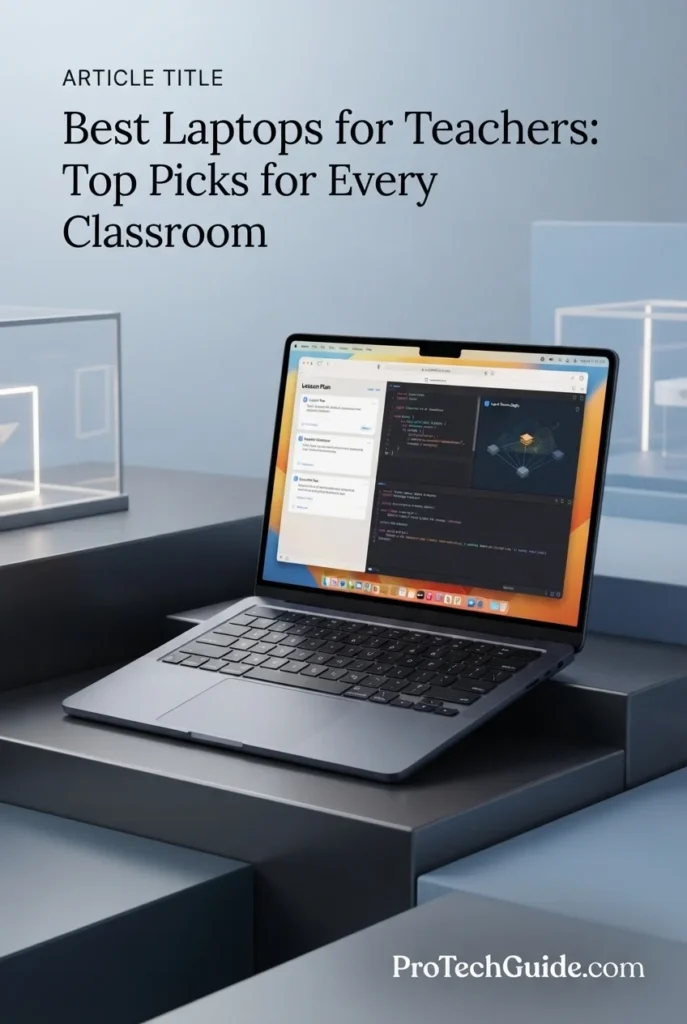
The Apple 2026 MacBook Air 13-inch with the M5 chip, 16GB of unified memory, and 1TB SSD is our Best Overall Laptop for Teachers in 2026. Its combination of M5 performance, efficient unified memory architecture, fast storage, 13.6-inch Liquid Retina display, 12MP Center Stage camera, and compact design creates a particularly well-balanced platform for lesson planning, grading, presentations, research, video conferencing, browser-based teaching platforms, and everyday classroom productivity. The 16GB memory configuration provides useful headroom for teachers who regularly work across multiple browser tabs, documents, spreadsheets, presentation software, communication tools, and educational applications simultaneously.
The MacBook Air earns our Best Overall Laptop for Teachers award because it delivers an unusually strong balance of performance, portability, battery-focused mobility, storage, display quality, camera capability, and everyday usability. For educators whose workflows center on lesson planning, grading, presentations, research, video calls, cloud platforms, and general productivity, it provides more than enough capability without the size or complexity of a traditional workstation-class laptop.
Compared with Windows alternatives such as the Microsoft Surface Laptop 13.8-inch and Lenovo ThinkPad T14 Gen 7, the MacBook Air offers a particularly attractive combination of compact design, Apple Silicon performance, 16GB unified memory, 1TB storage, and macOS productivity. However, teachers who depend on Windows-specific educational, administrative, or institutional software should consider a Windows laptop instead, making the MacBook Air the strongest overall choice rather than a universal recommendation for every school or academic environment.
Key Features
Microsoft Surface Laptop 13.8-inch
Best Windows Laptop for Microsoft 365, Touchscreen Productivity & AI
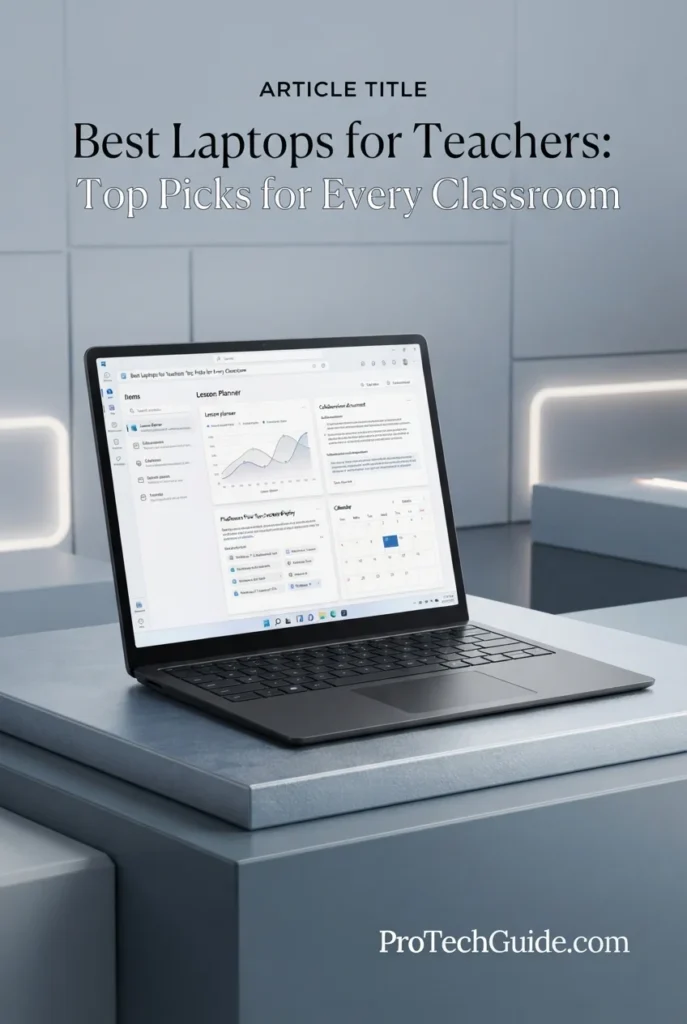
The Microsoft Surface Laptop (2026) 13.8-inch with the Snapdragon X2 Elite processor, 16GB of LPDDR5X memory, and 512GB SSD is our Best Windows Laptop for Teachers in 2026. Its 12-core Snapdragon X2 Elite platform, touchscreen display, Copilot+ PC capabilities, 16GB memory, fast SSD storage, and compact premium design create a strong Windows environment for lesson planning, grading, Microsoft 365, presentations, research, video conferencing, browser multitasking, and AI-assisted productivity. The combination is particularly attractive to educators who want a modern Windows laptop that can handle a busy teaching workflow while remaining highly portable.
The Surface Laptop earns our Best Windows Laptop for Teachers award because it combines a modern Snapdragon X2 Elite platform, 16GB of memory, a responsive 13.8-inch touchscreen, Copilot+ PC capabilities, practical connectivity, and a highly portable design. For educators whose daily workflows revolve around Windows productivity, Microsoft 365, browser-based teaching platforms, presentations, communication, and AI-assisted tools, it offers a particularly well-balanced premium Windows experience.
Compared with the Apple 2026 MacBook Air 13-inch with M5, the Surface Laptop provides a more direct Windows environment and touchscreen experience, making it especially attractive to teachers whose schools or institutions rely heavily on Microsoft software and Windows-based systems. The Lenovo ThinkPad T14 Gen 7 is a stronger alternative for educators who prioritize business-class features, professional manageability, and a more traditional enterprise-oriented design, while the Surface Laptop is better positioned around premium mobility and everyday Windows productivity.
Key Features
Lenovo ThinkPad T14 Gen 7
Best Professional Laptop for Teaching, Administration & Academic Work
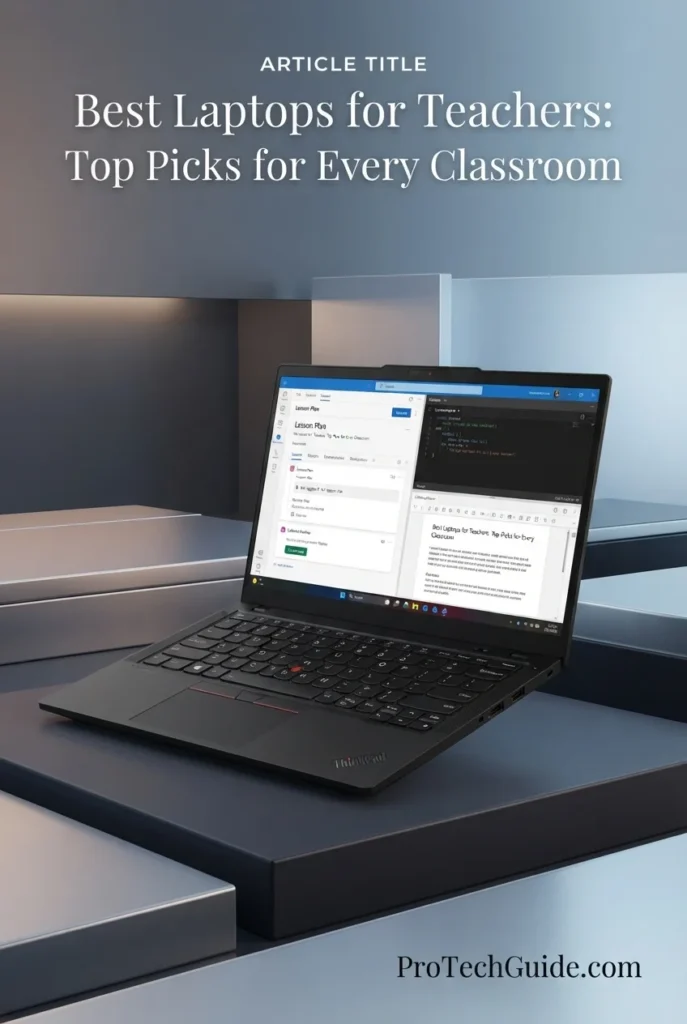
The Lenovo 2026 ThinkPad T14 Gen 7 with the Intel Core Ultra 7 365 vPro processor, 32GB LPDDR5X memory, and 1TB PCIe Gen4 SSD is our Best Professional Laptop for Teachers in 2026. Its business-focused platform, Windows 11 Pro, 14-inch WUXGA IPS touchscreen, 5MP RGB+IR camera, Thunderbolt 4 connectivity, and enterprise-oriented security and manageability make it particularly well suited to educators who combine classroom teaching with administrative, academic, research, and professional responsibilities. The 32GB memory configuration also provides substantial headroom for demanding multitasking across lesson planning, grading, presentations, browser-based educational platforms, video conferencing, Microsoft 365, research, and institutional applications.
The ThinkPad T14 Gen 7 earns our Best Professional Laptop for Teachers award because it focuses on the complete professional education workflow rather than simply maximizing consumer specifications. Its Core Ultra 7 365 vPro processor, 32GB memory, 1TB SSD, Windows 11 Pro, 5MP RGB+IR camera, touchscreen, and extensive connectivity make it especially compelling for educators who move between teaching, administration, meetings, research, and institutional work throughout the day.
Compared with the Apple 2026 MacBook Air 13-inch with M5, the ThinkPad T14 Gen 7 offers a more enterprise-oriented Windows environment, Windows 11 Pro, vPro capabilities, greater memory capacity, and a broader selection of traditional professional connectivity. Compared with the Microsoft Surface Laptop (2026) 13.8-inch, the ThinkPad is better positioned for educators who prioritize business-class manageability, professional security, wired networking, and institutional workflows, while the Surface remains an attractive choice for teachers who place greater emphasis on premium consumer mobility and touchscreen-first Windows productivity.
Key Features
Lenovo Yoga 7i 2-in-1 14-inch
Best Convertible Laptop for Interactive Teaching & Classroom Flexibility
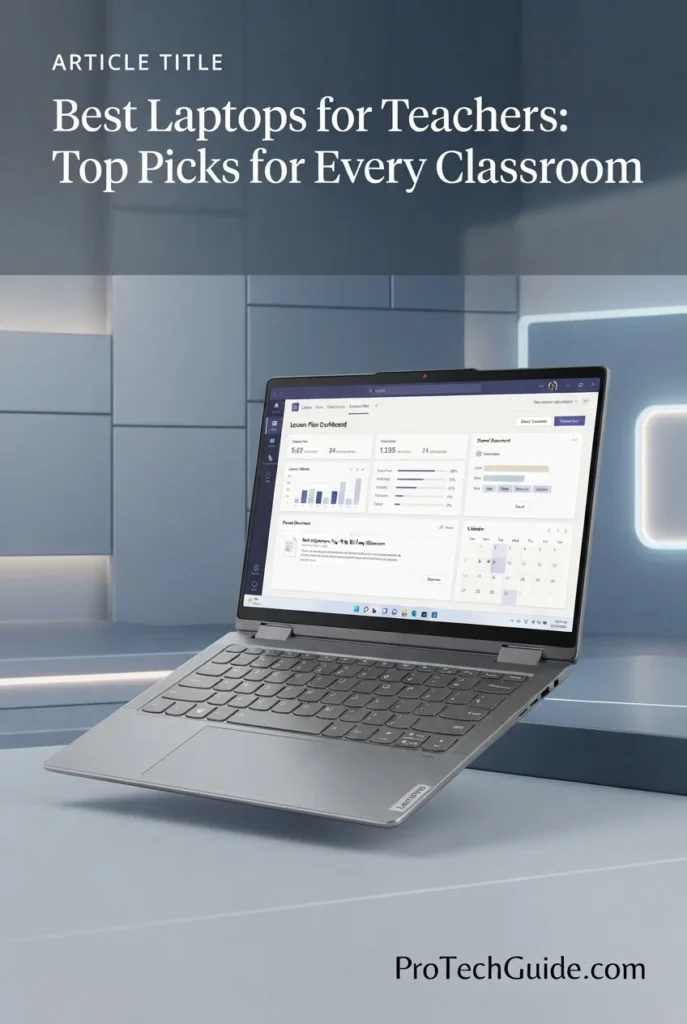
The Lenovo Yoga 7i 2-in-1 14-inch with the Intel Core Ultra 5 322 processor, 16GB LPDDR5X memory, 1TB SSD, and WUXGA OLED touchscreen is our Best 2-in-1 Laptop for Teachers in 2026. Its convertible design allows educators to move between traditional laptop productivity and more interactive touchscreen-oriented use, while the OLED display, integrated Intel graphics, backlit keyboard, fingerprint reader, and Wi-Fi 7 provide a versatile platform for lesson planning, presentations, classroom content, grading, research, video conferencing, and everyday teaching. The included docking station adds a separate 1TB storage component, giving this configuration additional flexibility without treating that accessory storage as internal laptop capacity.
The Yoga 7i 2-in-1 earns our Best 2-in-1 Laptop for Teachers award because it focuses on flexibility rather than simply conventional laptop performance. Its convertible touchscreen design, OLED display, 16GB LPDDR5X memory, 1TB internal SSD, fingerprint reader, backlit keyboard, and modern connectivity make it particularly attractive to educators who want one device that can adapt between lesson preparation, presentations, interactive classroom use, and traditional productivity.
Compared with the Microsoft Surface Laptop (2026) 13.8-inch, the Yoga 7i offers a more flexible convertible form factor and OLED touchscreen experience, making it better suited to educators who want to interact more directly with classroom content. Compared with the Lenovo ThinkPad T14 Gen 7, the Yoga 7i prioritizes versatility and interactive use rather than enterprise-oriented professional features and vPro manageability. The included docking station also adds a separate 1TB storage component, but this should be considered accessory storage rather than additional internal SSD capacity.
Key Features
HP OmniBook 5 14-inch Next Gen AI PC
Best Battery-Focused Laptop for Teaching, Lesson Planning & Mobile Classroom Work
The HP OmniBook 5 14-inch Next Gen AI PC with the Snapdragon X Plus X1P-42-100 processor, 16GB of LPDDR5X memory, 1TB PCIe Gen4 NVMe SSD, and 14-inch OLED display is our battery-focused recommendation for teachers in 2026. Its 8-core Snapdragon X Plus processor, integrated Qualcomm Adreno GPU, 45 TOPS Qualcomm Hexagon NPU, 16GB memory, and efficient Windows 11 Home platform create a strong combination for lesson planning, grading, Microsoft 365, browser-based teaching tools, video conferencing, document management, and everyday classroom productivity. The configuration is particularly attractive to educators who spend long days moving between classrooms, meetings, home workspaces, and campus environments and therefore place a high priority on extended battery endurance and efficient mobile performance.
The HP OmniBook 5 earns our Best Battery-Focused Laptop for Teachers award because it combines an efficient Snapdragon X Plus platform, 16GB of memory, 1TB of fast storage, a high-quality OLED display, and a design built around extended mobile use. For teachers who spend the day moving between classrooms, meetings, campus locations, and home workspaces, its combination of battery endurance, portability, and everyday productivity makes it a particularly compelling choice.
Compared with more performance-oriented laptops such as the Apple MacBook Air 13-inch with M5 and Lenovo ThinkPad T14 Gen 7, the HP OmniBook 5 is positioned more specifically around efficient mobile teaching and extended battery-focused use. Its Snapdragon architecture also means teachers should verify compatibility with any specialized Windows applications they depend on before purchasing, while educators whose workflows are primarily based on Microsoft 365, browser applications, web-based education platforms, documents, presentations, and video conferencing can take strong advantage of its efficient platform.
Key Features
ASUS Zenbook 14 OLED Laptop
Best OLED Laptop for Lesson Planning, Presentations & Everyday Teaching
The ASUS Zenbook 14 OLED with the AMD Ryzen AI 9 465 processor, 16GB of LPDDR5X memory, 512GB PCIe Gen 4 SSD, and 14-inch WUXGA OLED touchscreen is our top OLED recommendation for teachers in 2026. Its 10-core, 20-thread Ryzen AI 9 465 processor, integrated AMD Radeon graphics, up to 50 TOPS of NPU performance, fast LPDDR5X memory, and vibrant OLED display create a versatile platform for lesson planning, grading, presentations, Microsoft 365, browser-based education tools, video conferencing, research, and everyday classroom productivity. The touchscreen and premium OLED panel are particularly valuable for educators who regularly work with visual teaching materials and presentations.
The ASUS Zenbook 14 OLED earns our Best OLED Laptop for Teachers award because it combines strong Ryzen AI processing, 16GB of fast LPDDR5X memory, a responsive 14-inch OLED touchscreen, 512GB PCIe Gen 4 storage, and a compact professional design. For educators who place particular value on display quality for presentations, lesson materials, visual content, and extended productivity sessions, the OLED touchscreen gives this Zenbook a distinct advantage.
Compared with the HP OmniBook 5 14, the Zenbook 14 OLED places greater emphasis on processing performance, touchscreen interaction, and premium OLED display quality, while the HP is more specifically positioned around extended battery endurance. Compared with the Apple MacBook Air 13-inch with M5, the ASUS offers Windows 11 Pro, touchscreen interaction, and broad Windows software compatibility, making it particularly attractive to teachers who prefer Windows-based classroom and professional workflows.
Key Features
Acer Chromebook Plus Spin 514 2-in-1
Best Chromebook for Google Classroom, Cloud-Based Teaching & Flexible Classroom Work
The Acer Chromebook Plus Spin 514 2-in-1 with a 10-core Intel Core i5-1334U processor, 8GB LPDDR5 memory, 512GB SSD, and 14-inch WUXGA IPS touchscreen is our Best Chromebook for Teachers in 2026. Its convertible design, ChromeOS environment, responsive Intel processor, 100% sRGB touchscreen display, FHD webcam, Wi-Fi 6E, and versatile USB-C, USB-A, and HDMI connectivity make it particularly well suited to teachers who rely on Google Classroom, web-based educational platforms, online documents, presentations, video conferencing, and cloud-centered classroom workflows. The touchscreen and 2-in-1 form factor also provide useful flexibility when moving between traditional laptop work and more interactive classroom use.
The Acer Chromebook Plus Spin 514 earns our Best Chromebook for Teachers award because it combines the simplicity of ChromeOS with a capable 10-core Intel processor, 8GB LPDDR5 memory, a generous 512GB SSD, a 14-inch touchscreen, and a flexible 2-in-1 design. For educators whose workflows are centered on Google Workspace, web applications, cloud services, and online teaching platforms, it offers an unusually versatile Chromebook configuration without moving into the complexity of a traditional Windows laptop.
Compared with Windows laptops such as the Lenovo Yoga 7i 2-in-1 and HP OmniBook 5, the Acer Chromebook Plus Spin 514 is better suited to teachers who primarily work inside ChromeOS and browser-based education ecosystems. The Windows alternatives provide broader desktop software compatibility, while the Acer's strengths are its ChromeOS simplicity, touchscreen flexibility, 2-in-1 form factor, and strong connectivity for cloud-centered classroom workflows.
Key Features
Apple MacBook Neo 13
Best Budget Mac for Everyday Teaching, Lesson Planning & Student Work
The Apple 2026 MacBook Neo 13-inch with the A18 Pro chip, 8GB of unified memory, and 512GB SSD is our Best Budget Mac for Teachers in 2026. Its compact aluminum design, Liquid Retina display, 1080p FaceTime HD camera, Touch ID, and up to 16 hours of battery life make it particularly attractive for teachers who want a straightforward Mac for lesson planning, presentations, documents, email, web research, video calls, and everyday classroom productivity. Apple Intelligence also adds AI-assisted capabilities for supported writing and productivity workflows, while the 512GB SSD provides useful local storage for teaching materials and professional files.
The MacBook Neo earns our Best Budget Mac for Teachers award because it delivers the core Mac experience in a compact and more accessible configuration. The A18 Pro chip, 8GB unified memory, 512GB SSD, Liquid Retina display, long battery life, 1080p camera, and Apple Intelligence support create a balanced platform for teachers whose workloads center on everyday productivity rather than demanding professional applications.
Compared with the Apple MacBook Air 13-inch with M5, the MacBook Neo is positioned as the more budget-focused option, with less memory and a more basic overall configuration. The MacBook Air is the stronger choice for teachers who regularly multitask heavily or want greater performance headroom, while the MacBook Neo makes more sense for educators who primarily need a portable Mac for lesson planning, documents, presentations, communication, web-based teaching, and everyday classroom work.
Key Features
Best Laptops for Teachers in 2026
Ranked by Teaching Performance, Multitasking, Battery Life, Display Quality, Portability, Classroom Connectivity & Overall Value
Choosing the best laptop for teachers in 2026 requires more than comparing processor specifications. Educators need a comfortable keyboard for lesson planning and grading, enough memory for browser-based multitasking and productivity applications, reliable battery life for full school days, a quality display for presentations and classroom content, a capable webcam and microphone setup for online teaching, and dependable connectivity for projectors, displays, peripherals, and classroom networks. We evaluated these laptops around real teaching workflows including lesson planning, grading, Microsoft 365, Google Classroom, Google Workspace, presentations, video conferencing, browser multitasking, AI-assisted productivity, remote teaching, and everyday classroom work to help you choose the right laptop for your teaching environment.
| Laptop | CPU & Key Specs | Best For | Why It Wins | Editor's Verdict |
|---|---|---|---|---|
Best OverallApple 2026 MacBook Air 13-inchCheck Price | Apple M5 16GB Unified Memory 1TB SSD 13.6" Liquid Retina Display 12MP Center Stage Camera Wi-Fi 7 | Everyday Teachers Lesson Planning Classroom Productivity Hybrid Teaching | The MacBook Air combines strong everyday performance, 16GB of unified memory, 1TB of fast storage, a high-quality Liquid Retina display, a 12MP Center Stage camera, and excellent portability. It is particularly well suited to teachers who move between lesson planning, grading, presentations, browser multitasking, video calls, and everyday productivity while wanting a polished macOS experience. | Best Overall Laptop for Teachers |
Best Windows LaptopMicrosoft Surface Laptop 13.8-inchCheck Price | Snapdragon X2 Elite 16GB RAM 512GB SSD 13.8" Touchscreen 120Hz Display Windows 11 Home | Windows Teachers Microsoft 365 Mobile Educators AI-Assisted Productivity | The Surface Laptop combines Snapdragon X2 Elite processing with 16GB of memory, a responsive 13.8-inch touchscreen, 512GB SSD storage, and a lightweight premium design. It is particularly attractive to teachers who want Windows compatibility, Microsoft 365 productivity, touchscreen interaction, strong mobility, and Copilot+ PC capabilities in one streamlined system. | Best Windows Laptop for Teachers |
Best ProfessionalLenovo 2026 ThinkPad T14 Gen 7Check Price | Intel Core Ultra 7 365 vPro 32GB LPDDR5X 1TB PCIe Gen4 SSD 14" WUXGA IPS Touch 5MP RGB+IR Camera Windows 11 Pro | Professional Teachers Academic Administration Microsoft 365 Heavy Multitasking | The ThinkPad T14 Gen 7 provides a particularly strong professional platform for educators who combine classroom teaching with administrative and academic responsibilities. Its 32GB of memory, 1TB SSD, 14-inch WUXGA touchscreen, 5MP RGB+IR camera, business-focused Windows 11 Pro environment, and extensive connectivity make it well suited to demanding professional teaching workflows. | Best Professional Laptop for Teachers |
Best 2-in-1Lenovo Yoga 7i 2-in-1 14-inchCheck Price | Intel Core Ultra 5 322 16GB LPDDR5X 1TB Internal SSD 14" WUXGA OLED Touch Wi-Fi 7 Windows 11 Home | Interactive Teaching Presentations Touchscreen Productivity Flexible Classrooms | The Yoga 7i 2-in-1 combines a convertible design with a 14-inch WUXGA OLED touchscreen, 16GB LPDDR5X memory, and a 1TB internal SSD. Its flexible form factor makes it particularly useful for teachers who move between conventional laptop work, touchscreen interaction, presentations, and collaborative classroom activities. The included docking station also adds a separate 1TB storage component. | Best 2-in-1 Laptop for Teachers |
Best Battery-FocusedHP OmniBook 5 14-inchCheck Price | Snapdragon X Plus X1P-42-100 16GB LPDDR5X 1TB PCIe Gen4 SSD 14" OLED 1920 × 1200 Qualcomm Adreno GPU Windows 11 Home | Full School Days Mobile Teachers Lesson Planning Battery-Focused Users | The HP OmniBook 5 emphasizes mobility and endurance with its Snapdragon X Plus platform, 16GB LPDDR5X memory, 1TB SSD, and 14-inch OLED display. Its long battery-life positioning makes it particularly attractive to teachers who move throughout the school day and want a system capable of handling lesson planning, browser multitasking, communication, and classroom productivity without constantly searching for a charger. | Best Battery-Focused Laptop for Teachers |
Best OLEDASUS Zenbook 14 OLEDCheck Price | AMD Ryzen AI 9 465 16GB LPDDR5X 512GB PCIe Gen4 SSD 14" WUXGA OLED Touch 1080p IR Camera Windows 11 Pro | Visual Presentations Lesson Planning AI Productivity Premium Displays | The Zenbook 14 OLED combines a powerful Ryzen AI 9 465 processor with 16GB LPDDR5X memory, a 14-inch WUXGA OLED touchscreen, 512GB PCIe Gen4 SSD storage, and a 1080p IR camera. Its display quality and compact premium design make it especially appealing to teachers who create presentations, work with visual educational content, and want a high-quality screen for everyday classroom productivity. | Best OLED Laptop for Teachers |
Best ChromebookAcer Chromebook Plus Spin 514 2-in-1Check Price | Intel Core i5-1334U 10-Core CPU 8GB LPDDR5 512GB SSD 14" WUXGA IPS Touch ChromeOS | Google Classroom Google Workspace Cloud-Based Teaching 2-in-1 Classroom Work | The Acer Chromebook Plus Spin 514 combines a 10-core Intel Core i5-1334U processor with 8GB LPDDR5 memory, 512GB SSD storage, a 14-inch WUXGA IPS touchscreen, and a convertible design. Its ChromeOS environment makes it particularly well suited to teachers who rely heavily on Google Classroom, Google Workspace, browser-based educational platforms, cloud services, and online collaboration. | Best Chromebook for Teachers |
Best Budget MacApple 2026 MacBook Neo 13-inchCheck Price | Apple A18 Pro 8GB Unified Memory 512GB SSD 13" Liquid Retina Display 1080p FaceTime HD Camera Touch ID | Budget-Conscious Teachers Everyday Teaching Lesson Planning Portable Productivity | The MacBook Neo delivers the core Mac experience in a more accessible configuration, combining the A18 Pro chip, 8GB unified memory, 512GB SSD storage, a 13-inch Liquid Retina display, 1080p camera, Touch ID, and up to 16 hours of battery life. It is especially attractive to teachers who primarily need a compact Mac for lesson planning, documents, presentations, communication, web-based teaching, and everyday classroom productivity. | Best Budget Mac for Teachers |
Recommended Next Reads
Finished comparing the best laptops for teachers? Explore our related education, remote work, Microsoft Office, business, productivity, and portable display laptop guides to better understand the hardware requirements behind lesson planning, grading, presentations, video calls, classroom multitasking, Microsoft 365, Google Workspace, and modern teaching workflows.
Whether you're preparing lessons, grading assignments, creating presentations, managing spreadsheets, teaching remotely, working across Microsoft 365 and Google Workspace, or moving between classrooms and home, these guides can help you compare the CPU performance, memory capacity, battery life, display quality, portability, connectivity, and overall value required for different education and professional productivity workflows.
Best Laptops for Remote Work in 2026
Explore laptops selected for video calls, Microsoft 365, cloud applications, multitasking, communication, portability, and demanding work-from-home and hybrid teaching workflows.
Explore Remote Work Laptops →Best Laptops for Excel & Microsoft Office in 2026
Compare laptops for Excel, Word, PowerPoint, Microsoft 365, spreadsheets, document management, multitasking, grading, reporting, and everyday professional productivity.
Explore Office Laptops →Education & Academic WorkBest Laptops for Students in 2026
Explore laptops selected for research, coursework, presentations, web applications, video calls, productivity, portability, and everyday academic workflows.
Explore Student Laptops →Business & Professional WorkBest Business Laptops in 2026
Compare professional laptops for Microsoft 365, communication, multitasking, security, portability, reliability, and demanding workplace productivity workflows.
Explore Business Laptops →Classroom Productivity SetupBest Tech Accessories for Productivity in 2026
Explore productivity-focused technology for connectivity, organization, external displays, multitasking, and building a more effective teaching and professional workstation.
Explore Productivity Accessories →Displays & Mobile WorkBest Portable Monitors in 2026
Compare portable USB-C displays for teachers who need extra screen space for lesson planning, grading, presentations, multitasking, and working across different classrooms or locations.
Explore Portable Monitors →Professional Management & ProductivityBest Business Laptops for Small Business Owners in 2026
Explore laptops selected for Microsoft 365, financial management, business applications, communication, multitasking, productivity, and the technology needs of professional work.
Explore Small Business Laptops →EDITOR'S FINAL RECOMMENDATIONS
After comparing laptops across classroom productivity, lesson planning, grading, Microsoft 365, Google Workspace, video conferencing, browser multitasking, battery life, display quality, portability, keyboard comfort, classroom connectivity, software compatibility, and long-term value, these are our final recommendations for teachers in 2026. Whether you need an all-around classroom laptop, a professional Windows system, a flexible 2-in-1, exceptional battery life, a Chromebook, or a more affordable Mac, there is an option here for your specific teaching workflow.
Apple 2026 MacBook Air 13-inch with M5
The best overall laptop for teachers in 2026. The MacBook Air combines the M5 chip, 16GB of unified memory, 1TB SSD storage, a high-quality Liquid Retina display, a 12MP Center Stage camera, Wi-Fi 7, and a highly portable design. It provides an excellent balance for lesson planning, grading, presentations, browser multitasking, video calls, Microsoft 365, Google Workspace, and everyday classroom productivity.
- ✓ Apple M5 Chip
- ✓ 16GB Unified Memory
- ✓ 1TB SSD Storage
- ✓ 13.6-inch Liquid Retina Display
Microsoft Surface Laptop 13.8-inch
The best Windows laptop for teachers who prioritize portability, touchscreen productivity, Microsoft 365, classroom mobility, and modern AI capabilities. Its Snapdragon X2 Elite processor, 16GB of RAM, 512GB SSD, 13.8-inch 120Hz touchscreen, premium aluminum construction, and Copilot+ PC positioning make it a strong choice for teachers moving between classrooms, meetings, and home.
- ✓ Snapdragon X2 Elite 12-Core Processor
- ✓ 16GB RAM
- ✓ 512GB SSD Storage
- ✓ 13.8-inch 2304x1536 Touchscreen
Lenovo 2026 ThinkPad T14 Gen 7
The professional choice for teachers who want business-class durability, extensive connectivity, strong multitasking capability, and a productivity-focused design. With 32GB of memory, a 1TB SSD, a 14-inch WUXGA touchscreen, a 5MP RGB+IR camera, Windows 11 Pro, Thunderbolt 4, HDMI 2.1, Ethernet, and a 75Wh battery, it is particularly well suited to educators who combine classroom teaching with administration and professional work.
- ✓ Intel Core Ultra 7 365 vPro
- ✓ 32GB LPDDR5X Memory
- ✓ 1TB PCIe Gen4 SSD
- ✓ 14-inch WUXGA IPS Touchscreen
Lenovo Yoga 7i 2-in-1 14-inch WUXGA OLED
The most versatile option for teachers who combine traditional laptop work with touchscreen interaction, presentations, classroom demonstrations, and flexible positioning. Its 14-inch WUXGA OLED touchscreen, 16GB of memory, 1TB internal SSD, convertible design, fingerprint reader, and included docking station make it particularly useful for educators who want more flexibility than a conventional laptop provides.
- ✓ Intel Core Ultra 5 322
- ✓ 16GB LPDDR5X Memory
- ✓ 1TB Internal SSD
- ✓ 14-inch WUXGA OLED Touchscreen
HP OmniBook 5 14-inch Next Gen AI PC
The battery-focused choice for teachers who spend long days moving between classrooms, meetings, offices, and home. Its Snapdragon X Plus processor, 16GB of memory, 1TB SSD, 14-inch OLED display, Qualcomm NPU, and Windows 11 Home create a balanced platform for lesson planning, grading, browser multitasking, video conferencing, and mobile teaching workflows.
- ✓ Snapdragon X Plus X1P-42-100
- ✓ 16GB LPDDR5X Memory
- ✓ 1TB PCIe Gen4 NVMe SSD
- ✓ 14-inch 1920x1200 OLED Display
ASUS Zenbook 14 OLED Laptop
The best choice for teachers who place a premium on display quality while maintaining a compact and highly portable design. Its Ryzen AI 9 465 processor, 16GB of memory, 512GB SSD, 14-inch WUXGA OLED touchscreen, 1080p IR webcam, 75Wh battery, and Windows 11 Pro make it a strong option for presentations, visual teaching materials, video calls, lesson preparation, and everyday productivity.
- ✓ AMD Ryzen AI 9 465
- ✓ 16GB LPDDR5X Memory
- ✓ 512GB PCIe Gen4 SSD
- ✓ 14-inch WUXGA OLED Touchscreen
Acer Chromebook Plus Spin 514 2-in-1
The best Chromebook for teachers who primarily work with Google Classroom, Google Workspace, browser-based teaching tools, documents, presentations, email, and cloud applications. Its convertible 14-inch touchscreen, Intel Core i5 processor, 8GB of memory, 512GB SSD, backlit keyboard, and ChromeOS platform provide a practical combination for educators whose workflows are centered on Google's education ecosystem.
- ✓ Intel Core i5-1334U 10-Core Processor
- ✓ 8GB LPDDR5 Memory
- ✓ 512GB SSD Storage
- ✓ 14-inch WUXGA IPS Touchscreen
Apple 2026 MacBook Neo 13-inch with A18 Pro
The budget-oriented Mac choice for teachers who want the simplicity of macOS and Apple's ecosystem without moving to the higher price tier of the MacBook Air. Its A18 Pro chip, 8GB of unified memory, 512GB SSD, 13-inch Liquid Retina display, 1080p FaceTime HD camera, Touch ID, and up to 16 hours of battery life provide a compact platform for lesson planning, documents, presentations, browsing, video calls, and everyday classroom work.
- ✓ Apple A18 Pro Chip
- ✓ 8GB Unified Memory
- ✓ 512GB SSD Storage
- ✓ 13-inch Liquid Retina Display
Which teacher laptop should you buy?
MacBook Air M5
Surface Laptop
ThinkPad T14 Gen 7
Lenovo Yoga 7i
HP OmniBook 5
ASUS Zenbook 14 OLED
Acer Chromebook Plus Spin 514
MacBook Neo
- Choose the Apple MacBook Air 13-inch with M5 if you want the strongest overall combination of everyday performance, portability, battery-focused design, display quality, camera capability, storage, and classroom productivity.
- Choose the Microsoft Surface Laptop if you prefer Windows and want a lightweight premium system with a touchscreen, strong multitasking capability, Microsoft 365 compatibility, and modern Copilot+ PC features.
- Choose the Lenovo ThinkPad T14 Gen 7 if you need a professional Windows laptop with 32GB of memory, extensive connectivity, Windows 11 Pro, Ethernet, a high-quality camera, and the flexibility to handle both teaching and administrative workloads.
- Choose the Lenovo Yoga 7i 2-in-1 if touchscreen interaction, presentations, classroom demonstrations, and flexible laptop-to-tablet use are central to your teaching workflow. Its 1TB internal SSD should be considered separately from the additional 1TB storage included with its docking station.
- Choose the HP OmniBook 5 if battery-focused mobility is your priority and you regularly move between classrooms, meetings, home, and other teaching environments. Its Snapdragon X Plus platform and 1TB SSD provide a strong foundation for everyday productivity.
- Choose the ASUS Zenbook 14 OLED if display quality is especially important for presentations, visual teaching materials, and content creation while you still want a compact and portable Windows laptop.
- Choose the Acer Chromebook Plus Spin 514 if your teaching workflow is primarily based around Google Classroom, Google Workspace, browser applications, cloud documents, presentations, and other ChromeOS-friendly education tools.
- Choose the Apple MacBook Neo 13-inch with A18 Pro if you want the most affordable Mac-oriented option in this guide for everyday teaching, documents, presentations, web browsing, video calls, and general classroom productivity. Its 8GB unified memory makes it better suited to moderate workloads than exceptionally heavy multitasking.
EDITOR'S FINAL VERDICT
After comparing processor performance, memory capacity, SSD storage, battery life, display quality, keyboard comfort, webcam quality, portability, classroom connectivity, Microsoft 365, Google Workspace, video conferencing, presentation workflows, multitasking, operating system compatibility, and long-term value, one conclusion stands out:The best laptop for teachers is not necessarily the most powerful computer or the laptop with the most advanced specifications. It is the system that provides the right balance of performance, battery life, portability, display quality, camera and microphone capability, connectivity, software compatibility, comfort, and reliability for the teaching workflows you actually perform every day.
Modern teachers work across lesson-planning applications, Microsoft Word and PowerPoint, Excel gradebooks, Google Classroom, Google Docs and Slides, web-based education platforms, learning management systems, video conferencing, browser tabs, digital presentations, cloud storage, email, and increasingly AI-assisted productivity tools. These workflows benefit primarily from responsive everyday performance, sufficient memory, fast storage, dependable battery life, a comfortable keyboard, a quality display, and reliable connectivity rather than from workstation-class graphics hardware.
For most teachers, 16GB of memory is the ideal target for long-term use, while 8GB can remain suitable for lighter Chromebook or basic classroom workflows. Fast SSD storage, a comfortable display, a capable webcam, reliable wireless connectivity, and all-day mobility are equally important when the laptop will be used for hours of teaching, planning, grading, and communication every day.- Choose the Apple MacBook Air 13-inch with M5 if you want the strongest overall combination of everyday performance, portability, display quality, battery-focused design, camera capability, storage, and classroom productivity.
- Choose the Microsoft Surface Laptop if Windows compatibility, touchscreen productivity, Microsoft 365, portability, and modern Copilot+ PC features are your priorities.
- Choose the Lenovo ThinkPad T14 Gen 7 if you want a professional Windows laptop with 32GB of memory, extensive connectivity, Windows 11 Pro, Ethernet, a 5MP camera, and the flexibility to handle both classroom teaching and administrative work.
- Choose the Lenovo Yoga 7i 2-in-1 if touchscreen interaction, presentations, classroom demonstrations, and flexible laptop-to-tablet use are central to your teaching workflow.
Top Teacher Laptop Recommendations (2026)
Apple MacBook Air 13-inch with M5
Our Editor's Choice for most teachers because it delivers the strongest overall combination of everyday performance, portability, display quality, storage, camera capability, and classroom productivity. With 16GB of unified memory and a 1TB SSD, it provides substantial headroom for lesson planning, grading, presentations, browser multitasking, Microsoft 365, Google Workspace, video calls, and everyday teaching workflows.
- ✓ Apple M5 Chip
- ✓ 16GB Unified Memory
- ✓ 1TB SSD Storage
- ✓ 13.6-inch Liquid Retina Display
Microsoft Surface Laptop 13.8-inch
The strongest Windows choice for teachers who spend significant time moving between classrooms, meetings, home, and school. Its Snapdragon X2 Elite processor, 16GB of RAM, touchscreen display, lightweight premium design, and Copilot+ PC positioning provide an excellent balance of mobility, productivity, classroom interaction, and modern Windows capabilities.
- ✓ Snapdragon X2 Elite 12-Core Processor
- ✓ 16GB RAM
- ✓ 512GB SSD Storage
- ✓ 13.8-inch 2304x1536 Touchscreen
Lenovo ThinkPad T14 Gen 7
The best professional option for educators who combine classroom teaching with administration, meetings, document-heavy workflows, and demanding multitasking. Its 32GB of memory, 1TB SSD, Windows 11 Pro, 5MP RGB+IR camera, Thunderbolt 4, HDMI 2.1, Ethernet, and 75Wh battery give it substantial flexibility for professional education environments.
- ✓ Intel Core Ultra 7 365 vPro
- ✓ 32GB LPDDR5X Memory
- ✓ 1TB PCIe Gen4 SSD
- ✓ 14-inch WUXGA IPS Touchscreen
- ✓ You want the best overall laptop for teaching and everyday classroom productivity
- ✓ You regularly work with lesson plans, presentations, documents, browser tabs, video calls, and cloud applications
- ✓ You want 16GB of memory, 1TB storage, and a high-quality portable display
- ✓ You prefer macOS and want a lightweight laptop that fits easily into a mobile teaching workflow
- ✓ Windows compatibility and Microsoft 365 are major priorities
- ✓ You want a lightweight laptop with a touchscreen for classroom and presentation use
- ✓ You want 16GB of RAM and modern Copilot+ PC capabilities
- ✓ You regularly move between classrooms, home, meetings, and other teaching locations
- ✓ Prefer 16GB of memory for comfortable long-term teaching, multitasking, and productivity
- ✓ Consider 8GB acceptable primarily for lighter Chromebook and browser-based education workflows
- ✓ Prioritize a fast SSD with enough capacity for lesson materials, presentations, documents, applications, and local files
- ✓ Check operating-system compatibility if your school requires Windows-only software, specialized education applications, or Microsoft-specific tools
- ✓ Prioritize battery life, webcam quality, keyboard comfort, and connectivity if you spend most of your day moving between classrooms or teaching remotely
A teacher's laptop is a professional tool that may be used for thousands of hours across lesson planning, grading, presentations, video conferences, documents, spreadsheets, research, classroom management, and communication. Raw processor specifications matter, but battery life, keyboard comfort, display quality, webcam performance, storage, portability, software compatibility, and long-term reliability can have an equally important impact on everyday teaching productivity.
Among the models evaluated in this guide, the Apple MacBook Air 13-inch with M5 delivers the strongest overall combination of performance, 16GB of unified memory, 1TB storage, portability, display quality, camera capability, and everyday classroom versatility, making it our Editor's Choice for the best laptop for teachers in 2026.The Microsoft Surface Laptop is the better choice for teachers who prioritize Windows, touchscreen productivity, Microsoft 365, and mobility, while the Lenovo ThinkPad T14 Gen 7 is the stronger professional choice for educators who need more memory, extensive connectivity, Windows 11 Pro, and greater headroom for administrative workloads. The Lenovo Yoga 7i 2-in-1 stands out when touchscreen interaction, presentations, and classroom flexibility are more important than a conventional laptop design.
Compare current prices, configurations, memory, storage, warranty coverage, operating-system compatibility, and availability before choosing the laptop that best matches your teaching environment and classroom workflow.
Check Latest DealsEDITOR'S FAQ
Choosing the best laptop for teachers requires more than comparing processor specifications. Educators need a reliable computer that can handle lesson planning, grading, presentations, Microsoft 365, Google Classroom, browser-based teaching platforms, video conferencing, cloud storage, and everyday classroom multitasking without becoming unnecessarily heavy or expensive.These frequently asked questions address the most important buying decisions for teachers in 2026, including how much RAM you need, whether Windows or macOS is better for teaching, whether a Chromebook is enough for classroom work, how important battery life is, whether a touchscreen or 2-in-1 design is worthwhile, and which laptop is best for different teaching environments.
It offers an excellent balance of performance, portability, battery efficiency, display quality, camera capability, connectivity, and everyday usability. The 13.6-inch Liquid Retina display, 16GB of unified memory, 1TB SSD, 12MP Center Stage camera, Wi-Fi 7, and Touch ID make it particularly well suited to modern teaching workflows.
- 16GB of unified memory for lesson planning, grading, browser multitasking, and productivity applications.
- 1TB SSD for documents, presentations, teaching materials, applications, and local files.
- 12MP Center Stage camera for video conferencing and remote teaching.
- Compact 13.6-inch design that is easy to carry between classrooms, meetings, and home.
- Strong platform for productivity, presentations, cloud applications, and everyday educational work.
For teachers who specifically need Windows and Microsoft 365 compatibility, the Microsoft Surface Laptop is our preferred Windows alternative. Teachers who need a more business-oriented professional system should consider the Lenovo ThinkPad T14 Gen 7, while the Lenovo Yoga 7i is the stronger choice for those who want touchscreen and 2-in-1 flexibility.
Check PriceTeaching workloads often involve several applications and browser tabs at the same time. A teacher may have a learning management system, Google Classroom, Microsoft Word, PowerPoint, Excel, email, cloud storage, video conferencing, research tabs, and presentation materials open simultaneously.
- 8GB → Suitable for lighter classroom workflows, web applications, Google Workspace, email, documents, and Chromebook-based teaching.
- 16GB → Recommended for most teachers using Microsoft 365, Google Workspace, presentations, video calls, browser multitasking, grading, and everyday productivity.
- 32GB → Useful for teachers who routinely run heavier multitasking workloads, advanced applications, large files, or professional workloads beyond normal classroom tasks.
For most educators buying a new laptop in 2026, 16GB provides the best balance of performance, longevity, and value. The Lenovo ThinkPad T14 Gen 7 in this guide provides 32GB for teachers who want additional professional multitasking headroom.
A teacher using Microsoft 365, Google Workspace, Google Classroom, presentation software, email, browser tabs, video conferencing, cloud storage, and grading tools can generally work comfortably with 16GB when the workload remains within normal classroom use.
- 16GB works well for lesson planning and document creation.
- 16GB is suitable for PowerPoint, Word, Excel, and Microsoft 365.
- 16GB provides comfortable multitasking across browser tabs and classroom platforms.
- 16GB is well suited to video conferencing and remote teaching workflows.
- 32GB is mainly beneficial when teaching workflows involve unusually demanding professional applications or extensive multitasking.
The Apple MacBook Air, Microsoft Surface Laptop, Lenovo Yoga 7i, HP OmniBook 5, and ASUS Zenbook 14 in this guide all use 16GB-class configurations, making them strong choices for teachers who want a balanced long-term productivity laptop.
Check MacBook AirMicrosoft 365 remains central to many teaching environments, particularly for teachers who regularly use Word, Excel, PowerPoint, Outlook, Teams, OneDrive, and other Windows productivity tools. The Surface Laptop combines Windows 11 with a premium 13.8-inch touchscreen, 16GB of RAM, a 512GB SSD, and a lightweight design.
- Windows 11 → Familiar environment for teachers using Windows-based school systems.
- 16GB RAM → Suitable for Microsoft 365, browser multitasking, presentations, and communication tools.
- 13.8-inch touchscreen → Useful for interactive classroom work and flexible navigation.
- Copilot+ PC → Adds modern AI-oriented Windows capabilities to the teaching workflow.
- Portable design → Well suited to educators who move between classrooms and work locations.
Teachers working in organizations where Windows software compatibility is a priority should generally choose the Surface Laptop, ThinkPad T14 Gen 7, or another Windows system before choosing a MacBook or Chromebook.
Check Surface LaptopThe Apple MacBook Air with M5 is particularly attractive for educators who prioritize portability, battery efficiency, a high-quality display, a strong camera system, and a premium everyday productivity experience. It is well suited to lesson planning, documents, presentations, browser-based teaching platforms, video calls, email, cloud storage, and general classroom productivity.
- Excellent portable design for moving between classrooms and home.
- 16GB unified memory provides comfortable multitasking for teaching workflows.
- 12MP Center Stage camera is well suited to video conferencing and remote teaching.
- 1TB SSD provides substantial local storage for teaching materials and applications.
- macOS provides a polished environment for teachers already invested in Apple's ecosystem.
The main consideration is software compatibility. Before choosing a MacBook, teachers should confirm that any school-specific applications, testing platforms, administrative systems, and other required software work correctly with macOS.
Check MacBook Air PriceThe Acer Chromebook Plus Spin 514 is the Chromebook recommendation in this guide because it combines a convertible touchscreen design with a 14-inch WUXGA display, 8GB of memory, 512GB of storage, Wi-Fi 6E, and ChromeOS. This makes it particularly practical for educators working primarily through Google's education ecosystem.
- Google Classroom → Well suited to browser-based classroom management and assignments.
- Google Workspace → Works naturally with Docs, Sheets, Slides, Drive, and other cloud-based tools.
- 2-in-1 design → The convertible touchscreen provides additional flexibility in classroom environments.
- 8GB memory → Appropriate for typical browser-focused educational workflows.
- 512GB storage → Provides more local storage than many basic Chromebook configurations.
A Chromebook is less appropriate when a teacher depends on Windows-only desktop applications or specialized software that requires Windows or macOS. In those situations, a Windows laptop such as the Surface Laptop or ThinkPad T14 Gen 7 is the safer choice.
Check ChromebookThe Lenovo Yoga 7i 2-in-1 is our top choice for teachers who want this flexibility. Its 14-inch WUXGA OLED touchscreen, convertible design, fingerprint reader, backlit keyboard, and Windows 11 Home make it a strong fit for classroom environments where interaction and portability matter.
- Touchscreen interaction can be useful for presentations and classroom navigation.
- Convertible design provides more flexibility than a traditional clamshell laptop.
- 14-inch 16:10 OLED display provides a strong viewing experience for teaching content.
- 16GB memory is well suited to everyday educational multitasking.
- 1TB internal SSD provides substantial storage for teaching files and applications.
The included docking station adds a separate 1TB storage solution, but this should not be confused with the laptop's internal 1TB SSD. For teachers who want one device that can adapt to different classroom and home setups, the Yoga 7i is one of the most flexible options in this guide.
Check Yoga 7i- 13-inch → Best for teachers who move frequently between classrooms, meetings, home, and school.
- 14-inch → The strongest all-around size for balancing workspace and portability.
- 15-inch or larger → Better when screen space is more important than compactness and the laptop will spend most of its time on a desk.
The MacBook Air and MacBook Neo provide compact 13-inch-class options, while the Surface Laptop, ThinkPad T14 Gen 7, Yoga 7i, HP OmniBook 5, ASUS Zenbook 14, and Acer Chromebook Plus Spin 514 offer 14-inch-class displays. This makes the 13- to 14-inch range particularly strong for teachers who need to carry their laptop throughout the school day.
For most educators, a good 14-inch display offers the best compromise between lesson-planning workspace, presentation visibility, browser multitasking, and portability.
Check 14-Inch OptionOnline teachers need more than raw processing performance. A good remote-teaching laptop should combine a capable camera, reliable connectivity, comfortable multitasking, portability, battery efficiency, and enough memory for video conferencing alongside teaching materials and browser applications.
- 12MP Center Stage camera for video calls and remote teaching.
- 16GB unified memory for simultaneous video conferencing, browser tabs, documents, and teaching platforms.
- 1TB SSD for lesson materials, recordings, applications, and local files.
- Compact design for teachers who work from multiple locations.
- Wi-Fi 7 for modern wireless connectivity.
The Microsoft Surface Laptop is another excellent option for teachers who prefer Windows, while the Lenovo ThinkPad T14 Gen 7 is particularly attractive for educators who prioritize professional connectivity, security-oriented features, and business-class hardware.
Check MacBook AirThere is no single laptop that is perfect for every educator. A teacher working primarily with Microsoft 365 may benefit more from Windows, while a Google Workspace-focused educator may prefer a Chromebook. Teachers who move constantly between classrooms may prioritize portability, while those who value interactive displays may prefer a 2-in-1.
- Best Overall → Apple MacBook Air 13-inch with M5
- Best Windows Laptop → Microsoft Surface Laptop 13.8-inch
- Best Professional Laptop → Lenovo ThinkPad T14 Gen 7
- Best 2-in-1 → Lenovo Yoga 7i 2-in-1
- Best Battery-Focused → HP OmniBook 5 14-inch
- Best OLED → ASUS Zenbook 14 OLED
- Best Chromebook → Acer Chromebook Plus Spin 514 2-in-1
- Best Budget Mac → Apple MacBook Neo 13-inch with A18 Pro
If you want the safest all-around recommendation for lesson planning, grading, presentations, browser multitasking, video calls, cloud applications, and everyday classroom productivity, the MacBook Air M5 remains our Editor's Choice. If you require Windows and Microsoft 365 compatibility, choose the Surface Laptop. If you want professional business-oriented hardware, the ThinkPad T14 Gen 7 is the stronger fit. For touchscreen flexibility, choose the Yoga 7i, while Google Workspace-focused educators can save money and simplify their workflow with the Acer Chromebook Plus Spin 514.
Check Best Overall DealTEACHER LAPTOP BUYING GUIDE
Choosing a laptop for teaching is not simply about finding the fastest processor or the most expensive configuration. Educators need a dependable system that can handle lesson planning, grading, presentations, Microsoft 365, Google Classroom, browser multitasking, video conferencing, cloud applications, classroom displays, and everyday productivity while remaining comfortable to carry and reliable throughout the school year.The wrong laptop can become a daily source of frustration through insufficient memory, poor battery life, limited connectivity, weak camera quality, incompatible software, excessive weight, or unnecessary hardware that provides little benefit for actual classroom work. Avoid these common mistakes before choosing your next teaching laptop.
The best laptop for teachers is rarely the one with the most impressive specification sheet. For educators, battery life, memory capacity, keyboard comfort, portability, display quality, webcam performance, connectivity, operating-system compatibility, and long-term reliability can have a greater impact on productivity than simply choosing the most powerful processor or GPU available.For most teachers in 2026, we recommend targeting 16GB of memory, fast SSD storage, a modern processor, a quality display, and dependable wireless connectivity. A dedicated GPU is generally unnecessary for normal teaching workloads, so educators should prioritize the features they will actually use for lesson planning, grading, presentations, video calls, classroom management, and everyday productivity.
Choosing Only 8GB of RAM for Heavy Multitasking
- Teachers frequently have lesson plans, browser tabs, Google Classroom, Microsoft 365, email, presentations, video conferencing, and cloud storage open simultaneously.
- Modern browser-based teaching platforms can consume significant memory when many tabs and applications remain active.
- Insufficient memory can reduce responsiveness and become increasingly limiting as teaching workflows become more demanding.
Better decision:Choose 16GB of memory when possible for a new teacher laptop in 2026. An 8GB configuration can still work for lighter browser-based workflows, particularly on a Chromebook, while 32GB is useful for educators with unusually demanding multitasking or professional workloads beyond normal classroom use.
Buying a Dedicated GPU You Do Not Need
- Most lesson planning, grading, Microsoft 365, Google Workspace, presentations, email, video conferencing, and classroom management applications do not require a high-end dedicated GPU.
- Paying for unnecessary graphics performance can increase the laptop's price, weight, heat, and power consumption.
- For ordinary teaching workflows, memory capacity, CPU responsiveness, battery life, and portability are generally more important.
Better decision:Prioritize CPU performance, RAM, SSD storage, battery life, display quality, and connectivity first. A dedicated GPU only becomes important when teaching workflows also involve demanding creative applications, 3D work, video production, engineering software, or other graphics-intensive tasks.
Ignoring Operating System and Software Compatibility
- Teachers may depend on school-specific applications, testing platforms, administrative tools, Microsoft software, Google services, or specialized educational programs.
- Not every operating system provides the same compatibility with professional or institution-specific software.
- Choosing a MacBook or Chromebook without checking school requirements first can create unnecessary limitations.
Better decision:Choose Windows when your school environment depends heavily on Windows applications or Microsoft-centric software. A MacBook is an excellent option when your required applications are compatible with macOS, while a Chromebook is particularly attractive for teachers whose work is centered on Google Classroom, Google Workspace, and browser-based services.
Underestimating Battery Life
- Teachers may spend an entire school day moving between classrooms, meetings, presentations, and administrative tasks.
- A laptop with weak real-world battery endurance can become inconvenient when outlets are not immediately available.
- Frequent charging can reduce the practical mobility of an otherwise excellent classroom laptop.
Better decision:Treat battery efficiency as a core buying criterion rather than an optional feature. The Apple MacBook Air M5, Microsoft Surface Laptop, and HP OmniBook 5 are particularly attractive choices for teachers who place a high priority on mobile productivity and long periods away from a power outlet.
Buying More Performance Than Your Teaching Workflow Requires
- Most teachers do not need workstation-class processors or dedicated graphics simply to create lessons, grade assignments, browse the web, and run presentations.
- Excess performance can increase purchase cost without providing a meaningful productivity advantage for ordinary classroom work.
- A lighter and more efficient laptop can often provide a better overall teaching experience than a specification-heavy machine.
Better decision:Match hardware to your actual teaching workload. For most educators, a modern processor with 16GB of memory and a fast SSD provides an excellent balance of responsiveness and value. Move toward higher-end professional hardware only when your teaching responsibilities genuinely involve demanding applications beyond standard classroom productivity.
Overlooking Webcam, Keyboard, and Connectivity Quality
- Teachers can spend hours typing lesson plans, grading assignments, communicating with students, and participating in video meetings.
- Remote and hybrid teaching makes camera and microphone quality much more important than it was in traditional classroom-only workflows.
- Projectors, external displays, docks, USB accessories, Ethernet, and other classroom equipment can make port selection important.
Better decision:Evaluate the complete teaching experience, not just processor specifications. Look for a comfortable keyboard, capable webcam and microphone system, useful USB and display connections, reliable Wi-Fi, and convenient compatibility with the equipment you use at school and at home.
Smart Buying Advice for Teachers
You rely on Microsoft 365, Windows-based school systems, institution-specific applications, external displays, classroom peripherals, or software that requires Windows compatibility. The Microsoft Surface Laptop is our preferred Windows option for teachers who want a premium and portable system, while the Lenovo ThinkPad T14 Gen 7 is better suited to educators who prioritize professional business-class hardware and connectivity.
Choose the MacBook Air M5 when you want a premium portable laptop for lesson planning, presentations, video calls, cloud applications, and everyday productivity within a macOS-compatible environment. Choose the Acer Chromebook Plus Spin 514 when your teaching workflow is primarily based on Google Classroom, Google Workspace, browser applications, and cloud services.
Key takeaway:The best teaching laptop is not necessarily the fastest or most expensive machine. It is the laptop that provides the right balance of performance, memory, battery life, display quality, keyboard comfort, camera capability, connectivity, software compatibility, portability, and reliability for the applications and teaching environment you actually use.
After evaluating the laptops featured in this guide, these are our Editor's top recommendations for teachers in 2026:
- Best Overall Laptop for Teachers:Apple 2026 MacBook Air 13-inch with M5 — the strongest overall combination of portability, performance, battery efficiency, display quality, camera capability, 16GB unified memory, and 1TB storage for everyday teaching workflows.
- Best Windows Laptop for Teachers:Microsoft Surface Laptop 13.8-inch — an excellent choice for educators who prioritize Windows, Microsoft 365, touchscreen interaction, portability, and modern AI-oriented features.
- Best Professional Laptop for Teachers:Lenovo ThinkPad T14 Gen 7 — the strongest choice for educators who prioritize professional productivity, 32GB of memory, business-oriented connectivity, keyboard quality, durability, and long-term use.
- Best 2-in-1 Laptop for Teachers:Lenovo Yoga 7i 2-in-1 — the right choice for educators who want a flexible touchscreen design, OLED display, 16GB memory, 1TB internal SSD, and the ability to adapt the laptop to different classroom and home environments.
Need help choosing your laptop?
Not sure which option fits your workflow? Get a personalized recommendation based on your budget, performance needs, and usage.
Get personalized recommendation⚡ Usually responds within 24 hours