
Explore Our Best Laptop Comparisons
This RTX 5060 vs RTX 5070 Laptop: Which GPU Should You Buy in 2026? guide is part of our curated laptop comparison and component recommendations at ProTechGuide. Explore more expert comparisons and buying guides designed to help you evaluate gaming laptops, graphics performance, GPU tiers, value, and the hardware that matters most when choosing your next system.RTX 5060 vs RTX 5070 Laptop: Which GPU Should You Buy in 2026?
The difference between an RTX 5060 Laptop and an RTX 5070 Laptop is more nuanced than the GPU names suggest. The RTX 5070 offers a higher performance tier, but the real-world advantage depends heavily on the laptop's power limit, cooling system, processor, display resolution, and overall configuration.For gamers deciding between these two NVIDIA Blackwell GPUs, the key question is not simply which graphics card is faster. It is whether the additional performance of the RTX 5070 justifies the higher price for the games you play, the resolution you target, the level of ray tracing you use, and how long you plan to keep the laptop.
In this guide, we've compared the RTX 5060 Laptop GPU and RTX 5070 Laptop GPU from a practical buying perspective, focusing on the factors that actually influence laptop performance. We examine their architecture, CUDA core counts, 8GB GDDR7 memory, TGP ranges, ray-tracing capabilities, DLSS 4 support, 1080p and 1600p gaming potential, and the importance of choosing a well-powered laptop rather than relying on the GPU name alone.We've also selected eight RTX 5060 and RTX 5070 laptops representing different buying priorities, from value-focused systems to premium and highly portable machines. This makes it easier to see how the same GPU tier can behave differently depending on the laptop around it—and when stepping up from an RTX 5060 to an RTX 5070 actually makes sense.
Lenovo Legion 5i Gen 10 — RTX 5060
A High-Performance RTX 5060 Laptop for 1600p Gaming & Demanding Workloads
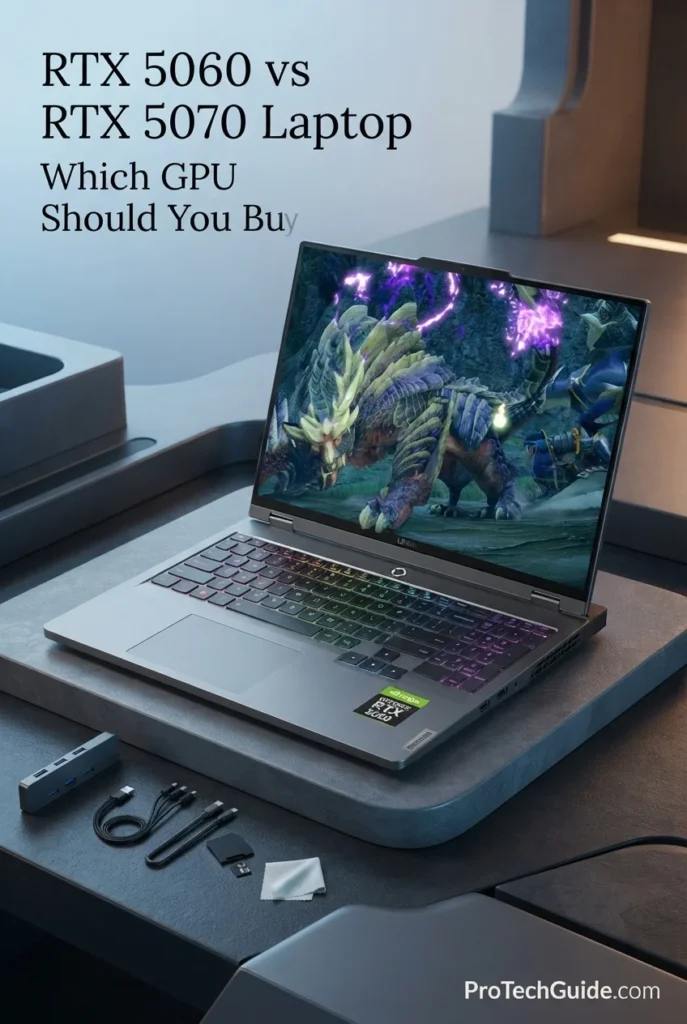
The Lenovo Legion 5i Gen 10 with the Intel Core Ultra 9 275HX, NVIDIA GeForce RTX 5060 8GB GDDR7, 32GB DDR5 memory, and 2TB PCIe SSD is our Best RTX 5060 Overall for 2026. Its combination of a high-end 24-core processor, dedicated Blackwell graphics, generous memory capacity, fast storage, and a 16-inch WQXGA 2560 × 1600 240Hz IPS display creates a particularly well-rounded platform for gamers who want strong RTX 5060 performance without stepping immediately into the RTX 5070 tier. The configuration also includes Windows 11 Pro, Wi-Fi 7, a 24-zone RGB keyboard, and a broad selection of connectivity options, making it suitable for both demanding gaming and intensive everyday computing.
The Lenovo Legion 5i Gen 10 earns our Best RTX 5060 Overall award because it avoids the compromises found in many entry-level RTX 5060 configurations. The combination of the Core Ultra 9 275HX, 32GB RAM, 2TB SSD, and 16-inch 240Hz WQXGA display creates a balanced high-performance system around the RTX 5060, giving buyers a substantial amount of hardware beyond the GPU itself.
Compared with the RTX 5070 laptops in this guide, the Legion 5i represents the more value-oriented side of the comparison while retaining a premium performance-oriented configuration. Its appeal is strongest when the price difference between a comparable RTX 5060 and RTX 5070 system is significant. Buyers should still evaluate the specific RTX 5070 alternative carefully, because GPU performance depends on the complete laptop design—including power limits, cooling, processor, and display—not simply the GPU name.
Key Features
Lenovo Legion Pro 5i Gen 10 — RTX 5070
The Strongest Direct Step Up from RTX 5060 for 1600p Gaming
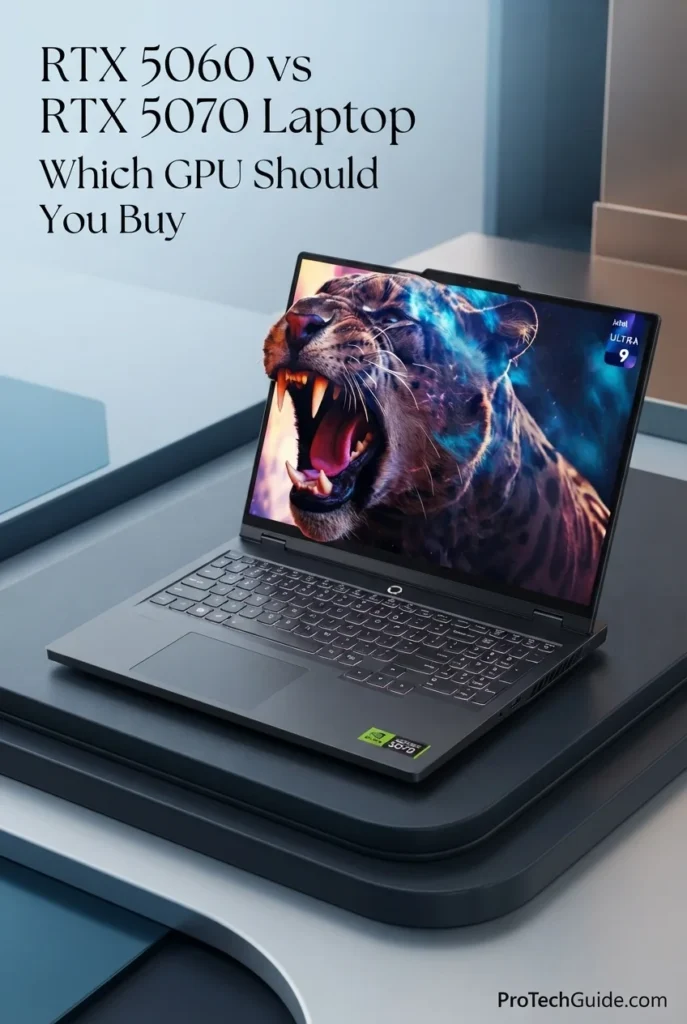
The Lenovo Legion Pro 5i Gen 10 with the Intel Core Ultra 9 275HX, NVIDIA GeForce RTX 5070, 32GB DDR5 memory, and 2TB SSD is our Best Direct RTX 5070 Upgrade for 2026. It is particularly compelling for buyers comparing an RTX 5060 laptop with a higher-tier system and looking for additional GPU headroom without moving into a completely different class of hardware. The combination of the RTX 5070, high-performance 24-core processor, 32GB of memory, 2TB of storage, and 16-inch 2560 × 1600 OLED display creates a premium gaming platform designed for demanding 1600p gaming, high graphics settings, ray tracing, and long-term performance.
The Lenovo Legion Pro 5i Gen 10 earns our Best Direct RTX 5070 Upgrade award because it makes the move beyond RTX 5060 especially straightforward. Rather than pairing the higher-tier GPU with a modest supporting configuration, this system combines the RTX 5070 with the same class of Core Ultra 9 275HX processor, 32GB of memory, and generous 2TB storage that serious performance-focused buyers are likely to value. Its 1600p OLED display also provides an appropriate target for a more capable laptop GPU.
Compared directly with the Lenovo Legion 5i Gen 10 with RTX 5060 featured above, the Legion Pro 5i changes the central GPU tier while retaining a similarly performance-oriented platform. That makes it one of the clearest examples in this guide of what buyers should evaluate when considering the RTX 5060 versus RTX 5070 upgrade. The RTX 5070 is the more capable GPU, but its value ultimately depends on the price gap and the specific laptop's power delivery, cooling, and overall configuration rather than the GPU name alone.
Key Features
ASUS TUF Gaming A16 — RTX 5060
A High-Value RTX 5060 Laptop for 1080p Gaming & Competitive Performance
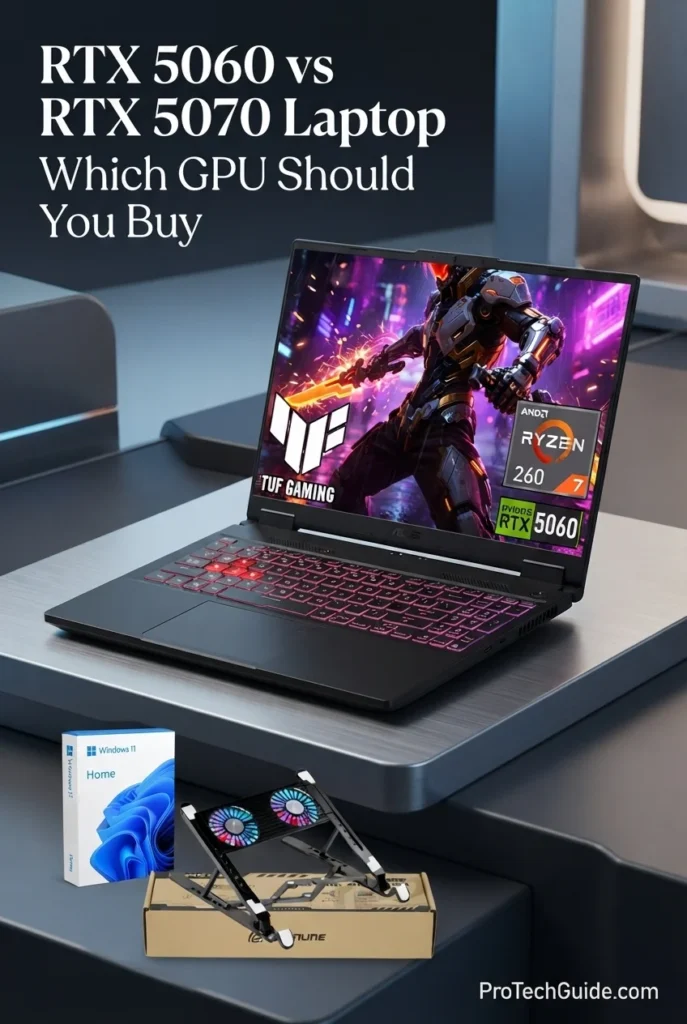
The ASUS TUF Gaming A16 with AMD Ryzen 7 260, NVIDIA GeForce RTX 5060, 64GB DDR5 memory, and a 2TB SSD is our Best RTX 5060 Value recommendation for 2026. Its combination of an RTX 5060 Laptop GPU with 8GB GDDR7, a 16-inch FHD+ 165Hz display, G-SYNC support, MUX Switch with NVIDIA Advanced Optimus, and substantial memory and storage makes it particularly compelling for buyers who want strong 1080p gaming performance without moving to a more expensive RTX 5070 system. The selected configuration also adds meaningful headroom for demanding multitasking, large game libraries, content creation, and everyday professional workloads, while ASUS's TUF cooling and MIL-STD-810H-tested design reinforce its role as a durable, performance-focused value option.
The ASUS TUF Gaming A16 earns our Best RTX 5060 Value award because it focuses on the part of the market where the RTX 5060 makes the most sense: strong mainstream gaming performance supported by a fast 165Hz display, G-SYNC, MUX/Advanced Optimus, capable Ryzen 7 processing, and an unusually generous 64GB/2TB configuration. It delivers a well-rounded gaming platform without requiring buyers to pay for the substantially higher tier of hardware associated with premium RTX 5070 systems.
Compared with the Lenovo Legion 5i Gen 10 with RTX 5060, the ASUS TUF Gaming A16 is particularly attractive when its value-oriented configuration and 64GB/2TB bundle are priced competitively. Compared with an RTX 5070 laptop, however, the RTX 5060 remains the more sensible choice when the goal is to control cost and primarily game at 1920 × 1200. Buyers targeting heavier 1600p gaming, more demanding ray tracing, or greater long-term GPU headroom should consider stepping up to RTX 5070 instead.
Key Features
ASUS TUF Gaming A16 — RTX 5070
A High-Value RTX 5070 Laptop for High-Refresh-Rate Gaming
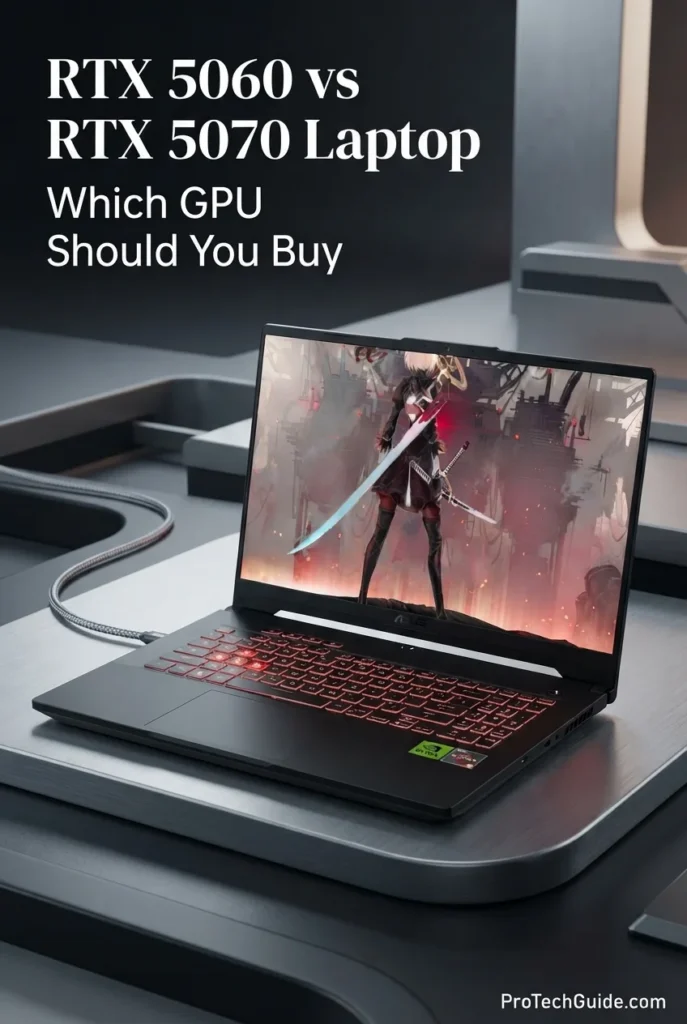
The ASUS TUF Gaming A16 with the AMD Ryzen 9 270, NVIDIA GeForce RTX 5070 Laptop GPU, 32GB DDR5 memory, and 1TB PCIe SSD is our Best RTX 5070 Value recommendation for 2026. Its 115W RTX 5070 implementation, 8GB of GDDR7, 16-inch FHD+ 165Hz G-SYNC display, MUX Switch with NVIDIA Advanced Optimus, and capable Ryzen 9 processor create a particularly strong combination for buyers who want RTX 5070-class performance without moving into the price and size of premium gaming laptops. The selected configuration also provides 32GB of DDR5 memory, Wi-Fi 6E, Thunderbolt 4, RGB backlighting, and a 90Wh battery, making it a well-rounded platform for gaming, content creation, engineering workloads, and demanding everyday use.
The ASUS TUF Gaming A16 earns our Best RTX 5070 Value award because it focuses on what matters most when stepping up from RTX 5060: a properly powered RTX 5070, strong CPU support, a fast 165Hz G-SYNC display, MUX/Advanced Optimus, and enough memory and storage for demanding modern workloads. Its 115W GPU implementation is especially important because this comparison is not simply about the RTX 5070 badge; power delivery, cooling, and the surrounding system determine how effectively the GPU can perform.
Compared with the ASUS TUF Gaming A16 with RTX 5060, this configuration represents the more performance-focused choice for buyers willing to spend more for additional GPU headroom. Both systems use the same general A16 design philosophy and a 16-inch high-refresh-rate display, but the RTX 5070 configuration raises the graphics tier and uses a 115W implementation. Compared with premium RTX 5070 laptops such as the ASUS ROG Zephyrus G16, the TUF A16 gives up display resolution and premium positioning in exchange for a more value-oriented configuration, making it the stronger choice when gaming performance per dollar matters more than luxury features.
Key Features
Acer Nitro V 16S AI — RTX 5060
A Budget-Friendly RTX 5060 Laptop for 180Hz Gaming
The Acer Nitro V 16S AI with AMD Ryzen 7 260, GeForce RTX 5060 Laptop GPU, 32GB DDR5 memory, and a 1TB PCIe Gen4 NVMe SSD is our Best Budget RTX 5060 for 2026. Its 16-inch WUXGA 180Hz IPS display, 8GB of GDDR7 graphics memory, Ryzen AI NPU, dual-fan cooling system, and practical gaming connectivity create a well-balanced platform for high-refresh-rate 1080p-class gaming, esports, everyday productivity, and entry-level content creation. The combination is particularly compelling for buyers who want the RTX 5060 feature set without moving into a larger premium gaming-laptop budget, although its RTX 5060 configuration is designed around a lower-power implementation than the highest-powered RTX 5060 laptops.
The Acer Nitro V 16S AI earns our Best Budget RTX 5060 award because it delivers a strong combination of RTX 5060 graphics, 32GB DDR5 memory, 1TB Gen4 storage, and a 180Hz 16-inch display in a value-focused gaming platform. It is particularly attractive for buyers who prioritize a complete out-of-the-box configuration over premium materials or maximum RTX 5060 power. Its lower-power GPU implementation also reinforces an important point in this comparison: the RTX 5060 name alone does not determine laptop performance, so buyers should consider the GPU's power configuration alongside the rest of the system.
Compared with higher-powered RTX 5060 laptops such as the Lenovo Legion 5i Gen 10 and ASUS TUF Gaming A16, the Nitro V 16S AI is better positioned as a budget-conscious alternative rather than a maximum-performance RTX 5060 system. Its strongest advantages are the 32GB RAM, 1TB Gen4 SSD, 180Hz display, and practical gaming feature set. For shoppers deciding between an RTX 5060 and RTX 5070 laptop, it also represents the kind of configuration where price can matter more than simply choosing the higher GPU tier: if the system is substantially less expensive, the RTX 5060 can remain the more rational choice for 1080p-class gaming and high-refresh-rate esports.
Key Features
Acer Nitro V 16 — RTX 5070
A Value-Focused RTX 5070 Laptop for High-Refresh-Rate Gaming
The Acer Nitro V 16 with the Intel Core 9 270H, GeForce RTX 5070 Laptop GPU, 32GB DDR5 memory, and 1TB PCIe Gen4 SSD is our Best Budget RTX 5070 for 2026. Its 16-inch WUXGA 180Hz IPS display, 8GB of GDDR7 graphics memory, 100% sRGB coverage, 400-nit brightness, Thunderbolt 4 connectivity, and gaming-focused design create a compelling platform for high-refresh-rate gaming and demanding everyday workloads. What makes this configuration particularly interesting in our RTX 5060 vs RTX 5070 comparison is its 75W RTX 5070 implementation: it delivers the benefits of the higher GPU tier while illustrating why the GPU model alone cannot predict laptop performance.
The Acer Nitro V 16 earns our Best Budget RTX 5070 award because it puts an RTX 5070, 32GB of DDR5 memory, 1TB of Gen4 storage, and a 180Hz 16-inch display into a value-focused gaming platform. Its greatest strength is not maximum RTX 5070 performance, but the ability to access the RTX 5070 feature set at a lower system tier. The 75W GPU configuration is an important part of that equation, making this laptop particularly compelling when its price is meaningfully below higher-powered RTX 5070 alternatives.
Compared with the ASUS TUF Gaming A16 — RTX 5070, which uses a 115W RTX 5070 configuration, the Nitro V 16 is positioned as the more budget-oriented option rather than the faster implementation of the GPU. The ASUS offers considerably more GPU power headroom, while the Acer combines its 75W RTX 5070 with 32GB of DDR5, 1TB Gen4 storage, and a 180Hz WUXGA display. For buyers comparing RTX 5060 and RTX 5070 laptops, this makes the Nitro V 16 an especially useful reminder that TGP can matter almost as much as the GPU name when evaluating laptop graphics performance.
Key Features
ASUS ROG Zephyrus G16 — RTX 5070
A Premium RTX 5070 Laptop for 1600p Gaming, OLED Visuals & Portable Performance
The ASUS ROG Zephyrus G16 with the Intel Core Ultra 9 285H, GeForce RTX 5070 8GB GDDR7, 16GB DDR5, and 2TB SSD is our Best Premium RTX 5070 laptop for 2026. Its combination of high-end Blackwell graphics, a 16-inch 2560×1600 OLED display, 240Hz refresh rate, G-SYNC support, 100% DCI-P3 color coverage, premium connectivity, and an exceptionally thin chassis makes it a different kind of RTX 5070 machine. Rather than focusing only on maximum GPU wattage, the Zephyrus G16 is designed for buyers who want strong 1600p gaming performance together with a premium display, portable design, and serious creative-work capability.
The Zephyrus G16 earns our Best Premium RTX 5070 award because it approaches the RTX 5070 laptop category from a premium mobility perspective. Instead of competing solely on raw GPU power, it combines an RTX 5070 with a 16-inch 2560×1600 OLED 240Hz display, G-SYNC, 100% DCI-P3 coverage, powerful Intel Core Ultra 9 processing, extensive connectivity, and a remarkably thin design. It is particularly compelling for buyers who want one machine that can handle high-refresh-rate gaming while also functioning as a premium creative and professional laptop.
Compared with the ASUS TUF Gaming A16 with RTX 5070, the Zephyrus G16 is the more premium choice, emphasizing OLED image quality, portability, design, and professional connectivity rather than simply maximizing GPU power. The TUF A16 has a higher 115W RTX 5070 configuration, making it the more performance-focused value option, while the Zephyrus G16 offers a more refined overall package. Compared with the Acer Nitro V 16 RTX 5070, the Zephyrus sits clearly higher in the premium segment, with a substantially more advanced OLED display and a thinner, more portable chassis.
Key Features
Razer Blade 14 — RTX 5070
A Premium RTX 5070 Laptop for Portable 1600p Gaming & OLED Performance
The Razer Blade 14 with the AMD Ryzen AI 9 365, GeForce RTX 5070, 32GB LPDDR5X memory, and 1TB SSD is our Best Thin & Portable RTX 5070 laptop for 2026. It combines serious Blackwell graphics performance with a compact 14-inch chassis, a 3K 2880×1800 OLED display, 120Hz refresh rate, 100% DCI-P3 color coverage, and a premium aluminum unibody design. Its RTX 5070 can operate at up to 100W plus 15W Dynamic Boost, giving this unusually compact system a much stronger performance profile than its size suggests. The result is a premium mobile gaming and creator platform for users who want RTX 5070 capability without carrying a conventional 16-inch gaming laptop.
The Razer Blade 14 earns our Best Thin & Portable RTX 5070 award because it delivers a rare combination of dedicated RTX 5070 graphics, premium OLED quality, high-end AMD processing, and genuine ultraportable design. Its 14-inch form factor and approximately 1.63kg weight make it substantially easier to carry than larger RTX 5070 gaming systems, while the 100W GPU plus Dynamic Boost configuration gives it considerably more performance headroom than its slim profile might suggest. For buyers who value mobility as much as gaming capability, this is one of the most distinctive RTX 5070 laptops in 2026.
Compared with the ASUS ROG Zephyrus G16 RTX 5070, the Razer Blade 14 is smaller and lighter, making it the better choice for frequent travel, while the Zephyrus G16 provides a larger 16-inch 2560×1600 OLED 240Hz workspace. Compared with the ASUS TUF Gaming A16 RTX 5070, the Blade 14 prioritizes portability and premium construction, while the TUF A16's 115W RTX 5070 configuration is more aggressively focused on sustained GPU performance. This makes the Blade 14 a specialized recommendation for buyers who want RTX 5070 power in a genuinely mobile package rather than simply the highest performance per dollar.
Key Features
RTX 5060 vs RTX 5070 Laptop: The Best Gaming Laptops Compared
Compared by GPU Tier, TGP, CPU Performance, Display Resolution, Memory, Storage, Gaming Focus & Overall Value
Choosing between an RTX 5060 and RTX 5070 laptop in 2026 is not simply a matter of picking the higher GPU number. Real-world laptop performance depends on how much power the GPU receives, the cooling system, the processor, memory configuration, display resolution, and the price of the complete machine. We evaluated these eight laptops specifically through the lens of the RTX 5060 vs RTX 5070 decision, highlighting where each configuration makes the most sense for 1080p, 1600p, high-refresh-rate gaming, ray tracing, portability, and long-term value.
| Laptop | GPU & Key Specs | Best For | Why It Wins | Editor's Verdict |
|---|---|---|---|---|
Best RTX 5060 Overall
Lenovo Legion 5i Gen 10 — RTX 5060
Check Price
| RTX 5060 8GB GDDR7 Core Ultra 9 275HX 32GB DDR5 2TB PCIe SSD 16" WQXGA 240Hz | 1600p Gaming High-Refresh Gaming Demanding Workloads Best Overall RTX 5060 | The Legion 5i gives the RTX 5060 a particularly strong platform with a high-end Core Ultra 9 275HX processor, 32GB of DDR5 memory, 2TB of storage, and a 2560x1600 240Hz display. It is the RTX 5060 configuration to choose when you want a balanced system rather than simply the lowest-cost laptop carrying the GPU. | Best Overall RTX 5060 Laptop |
Best RTX 5070 Upgrade
Lenovo Legion Pro 5i Gen 10 — RTX 5070
Check Price
| RTX 5070 8GB GDDR7 Core Ultra 9 275HX 32GB DDR5 2TB SSD 16" 2560x1600 OLED 165Hz | 1600p Gaming Ray Tracing Premium Gaming RTX 5060 Upgraders | The Legion Pro 5i is the most direct step up from the RTX 5060 Legion 5i in this comparison. It combines the RTX 5070 with the same high-end Core Ultra 9 275HX platform, 32GB of DDR5 memory, 2TB of storage, and a 2560x1600 OLED display, making it an especially compelling choice when the goal is to move up a GPU tier without compromising the rest of the system. | Best Direct RTX 5060-to-5070 Upgrade |
Best RTX 5060 Value
ASUS TUF Gaming A16 — RTX 5060
Check Price
| RTX 5060 Ryzen 7 260 64GB DDR5 2TB SSD 16" FHD+ 165Hz G-SYNC | 1080p Gaming Competitive Gaming Value Buyers High-Refresh Gaming | The TUF Gaming A16 focuses on practical gaming value, pairing the RTX 5060 with a Ryzen 7 260, 64GB of DDR5 memory, 2TB of SSD storage, and a 165Hz G-SYNC display. Its 1920x1200 resolution also keeps the RTX 5060 focused on a workload where this GPU tier makes considerable sense. | Best Value RTX 5060 Gaming Laptop |
Best RTX 5070 Value
ASUS TUF Gaming A16 — RTX 5070
Check Price
| RTX 5070 8GB GDDR7 115W TGP Ryzen 9 270 32GB DDR5 16" FHD+ 165Hz G-SYNC | High-Refresh Gaming Ray Tracing 1080p Gaming Maximum RTX 5070 Value | The TUF A16 is one of the clearest examples of why laptop GPU power matters. Its RTX 5070 is specified at 115W, while the system pairs it with a Ryzen 9 270, 32GB of DDR5 memory, and a 165Hz G-SYNC display. For buyers prioritizing GPU performance and value over a premium chassis, this is one of the strongest RTX 5070 configurations in the lineup. | Best Value RTX 5070 Laptop |
Best Budget RTX 5060
Acer Nitro V 16S AI — RTX 5060
Check Price
| RTX 5060 8GB GDDR7 Up to 85W in selected configuration Ryzen 7 260 32GB DDR5 16" WUXGA 180Hz | Budget Gaming 1080p Gaming High-Refresh Gaming First Gaming Laptop | The Nitro V 16S AI delivers the RTX 5060 in a more budget-conscious platform while still providing 32GB of DDR5 memory, a 1TB Gen4 SSD, and a 180Hz WUXGA display. Its selected configuration is particularly attractive for buyers who want RTX 5060-class gaming without moving into the price and hardware level of premium gaming systems. | Best Budget RTX 5060 Laptop |
Best Budget RTX 5070
Acer Nitro V 16 — RTX 5070
Check Price
| RTX 5070 8GB GDDR7 75W TGP Core 9 270H 32GB DDR5-5600 16" WUXGA 180Hz | Budget RTX 5070 1080p Gaming High-Refresh Gaming GPU Upgrade Value | The Nitro V 16 brings the RTX 5070 into a more accessible gaming-laptop design, with 32GB of DDR5-5600 memory, a 1TB Gen4 SSD, and a 180Hz 1920x1200 display. Its 75W RTX 5070 also makes it an important comparison point: the GPU name is higher than the RTX 5060, but its lower power target shows why TGP must be considered when comparing laptop implementations. | Best Budget RTX 5070 Laptop |
Best Premium RTX 5070
ASUS ROG Zephyrus G16 — RTX 5070
Check Price
| RTX 5070 8GB GDDR7 Core Ultra 9 285H 16GB DDR5 2TB SSD 16" 2560x1600 OLED 240Hz | Premium Gaming 1600p Gaming OLED Gaming Creators & Professionals | The ROG Zephyrus G16 approaches the RTX 5070 from a premium-system perspective, pairing the GPU with a 2560x1600 240Hz OLED display, Core Ultra 9 285H processor, 2TB SSD, and a thin premium chassis. It is the stronger choice for buyers who value display quality, portability, and overall refinement alongside RTX 5070 performance. | Best Premium RTX 5070 Laptop |
Best Thin & Portable
Razer Blade 14 — RTX 5070
Check Price
| RTX 5070 8GB GDDR7 100W TGP + 15W Dynamic Boost Ryzen AI 9 365 32GB LPDDR5X-8000 14" 2880x1800 OLED 120Hz | Portable Gaming 1600p-Class Gaming OLED Performance Mobile Professionals | The Razer Blade 14 delivers RTX 5070 performance in one of the most compact systems in this comparison. Its Ryzen AI 9 365, 32GB LPDDR5X-8000 memory, 3K OLED display, and 1.63kg chassis create a distinctly portable premium package, while the exact GPU implementation is rated at 100W TGP with up to 15W Dynamic Boost. | Best Thin & Portable RTX 5070 Laptop |
Recommended Next Reads
Finished comparing the RTX 5060 and RTX 5070 Laptop GPUs? Continue exploring our GPU-focused and gaming-laptop buying guides to compare higher GPU tiers, evaluate gaming performance by budget, and understand which hardware makes the most sense for your next system.
The RTX 5060 vs RTX 5070 decision is only one part of choosing a gaming laptop. Once you understand the differences in GPU class, TGP, resolution, ray tracing, DLSS 4, and overall system performance, these related guides can help you compare higher-end laptop GPUs, explore gaming laptops at different price points, and choose a complete system that matches your performance goals.
RTX 5060 vs RTX 5070 Ti vs RTX 5080 Laptop GPUs in 2026
Move beyond the RTX 5060 vs RTX 5070 decision and compare the RTX 5070 Ti and RTX 5080 Laptop GPUs to understand the broader Blackwell laptop GPU hierarchy, performance tiers, and upgrade path.
Explore the Laptop GPU Comparison →Best Gaming Laptops Under $1,500 in 2026
Compare gaming laptops built around different GPU tiers and find the strongest combination of graphics performance, display quality, CPU power, and value below $1,500.
Explore Gaming Laptops Under $1,500 → Performance & Higher GPU TiersBest Gaming Laptops Under $2,000 in 2026
Explore higher-performance gaming laptops with stronger GPUs, faster displays, premium cooling systems, and hardware designed for demanding 1080p and 1600p gaming.
Explore Gaming Laptops Under $2,000 → Premium Performance & ValueBest Laptops Under $2000 in 2026
Compare premium laptops across gaming, productivity, creative work, high-performance computing, OLED displays, and demanding professional workloads.
Explore Laptops Under $2,000 → Budget GamingBest Gaming Laptops Under $1,000 in 2026
Find the strongest gaming laptops for 1080p performance and discover how far a carefully selected GPU and system configuration can take a tighter gaming budget.
Explore Gaming Laptops Under $1,000 → GPU-Accelerated Creative WorkBest Laptops for Video Editing in 2026
Explore laptops for Premiere Pro, After Effects, 4K video workflows, rendering, motion graphics, and other creative workloads that can benefit from dedicated GPU performance.
Explore Video Editing Laptops → 3D & GPU-Intensive WorkloadsBest Laptops for 3D Modeling in 2026
Compare laptops for Blender, 3ds Max, CAD, 3D visualization, rendering, and demanding workloads where GPU performance and thermal capacity matter.
Explore 3D Modeling Laptops →EDITOR'S FINAL RECOMMENDATIONS
After comparing the RTX 5060 and RTX 5070 Laptop GPUs across GPU class, TGP, CUDA core count, 8GB GDDR7 memory, gaming resolution, ray tracing, DLSS 4, CPU performance, cooling, displays, memory, storage, portability, and overall value, these are our final recommendations for 2026. The RTX 5070 is the stronger GPU tier, but the best choice depends on how the laptop implements that GPU, how much power it receives, the resolution you intend to play at, and how much more you are paying for the upgrade.
Lenovo Legion Pro 5i Gen 10 — RTX 5070
The best overall choice for buyers who want to move beyond the RTX 5060 and build around a stronger RTX 5070 platform. The Legion Pro 5i combines the RTX 5070 with Intel's Core Ultra 9 275HX, 32GB of DDR5 memory, 2TB of SSD storage, and a 16-inch 2560x1600 OLED display. It delivers the kind of balanced high-end configuration that makes the RTX 5070 upgrade meaningful for demanding 1600p gaming, ray tracing, and longer-term performance.
- ✓ NVIDIA GeForce RTX 5070 8GB GDDR7
- ✓ Intel Core Ultra 9 275HX
- ✓ 32GB DDR5 Memory
- ✓ 16-inch 2560x1600 OLED 165Hz Display
Lenovo Legion 5i Gen 10 — RTX 5060
The best RTX 5060 choice for buyers who want a high-end laptop platform without stepping up to RTX 5070 pricing. Its Core Ultra 9 275HX processor, 32GB of DDR5 memory, 2TB SSD, and 16-inch 2560x1600 240Hz display give the RTX 5060 an unusually strong system around it. For buyers focused on value, this is the RTX 5060 configuration we would choose when the price gap to an RTX 5070 system is significant.
- ✓ NVIDIA GeForce RTX 5060 8GB GDDR7
- ✓ Intel Core Ultra 9 275HX
- ✓ 32GB DDR5 Memory
- ✓ 16-inch WQXGA 240Hz Display
ASUS TUF Gaming A16 — RTX 5070
The strongest value-oriented RTX 5070 recommendation in this comparison. The TUF Gaming A16 pairs an RTX 5070 rated at 115W with a Ryzen 9 270, 32GB of DDR5 memory, a 1TB SSD, and a 165Hz G-SYNC display. It is particularly compelling for buyers who care more about GPU performance and gaming value than premium materials or an OLED panel.
- ✓ RTX 5070 8GB GDDR7 at 115W
- ✓ AMD Ryzen 9 270
- ✓ 32GB DDR5 Memory
- ✓ 16-inch FHD+ 165Hz G-SYNC Display
ASUS ROG Zephyrus G16 — RTX 5070
The premium choice for buyers who want the RTX 5070 without sacrificing display quality, portability, or overall refinement. Its 16-inch 2560x1600 OLED panel runs at 240Hz with G-SYNC, while the Core Ultra 9 285H, 16GB of memory, 2TB SSD, Wi-Fi 7, and premium chassis create a more sophisticated package than a conventional value-focused gaming laptop.
- ✓ NVIDIA GeForce RTX 5070 8GB GDDR7
- ✓ Intel Core Ultra 9 285H
- ✓ 2TB SSD Storage
- ✓ 16-inch 2560x1600 OLED 240Hz Display
Razer Blade 14 — RTX 5070
The best recommendation for buyers who want RTX 5070-class performance in a genuinely compact premium laptop. The Blade 14 combines the Ryzen AI 9 365, 32GB of LPDDR5X-8000 memory, a 1TB SSD, and a 14-inch 2880x1800 OLED display in a 1.63kg chassis. Its exact RTX 5070 implementation is rated at 100W TGP plus up to 15W Dynamic Boost, making it a compelling option for mobile gaming rather than simply chasing maximum GPU wattage.
- ✓ NVIDIA GeForce RTX 5070 8GB GDDR7
- ✓ 100W TGP + 15W Dynamic Boost
- ✓ 32GB LPDDR5X-8000 Memory
- ✓ 14-inch 2880x1800 OLED 120Hz Display
Acer Nitro V 16 — RTX 5070
The budget-oriented RTX 5070 recommendation for buyers who want access to the higher GPU tier without moving into premium gaming-laptop pricing. The system includes 32GB of DDR5-5600 memory, a 1TB Gen4 SSD, a 16-inch 180Hz WUXGA display, and a Core 9 270H processor. Its 75W RTX 5070 is also an important reminder that the RTX 5070 badge alone does not guarantee the same performance as a higher-powered implementation.
- ✓ NVIDIA GeForce RTX 5070 8GB GDDR7
- ✓ 75W RTX 5070 Implementation
- ✓ Intel Core 9 270H
- ✓ 32GB DDR5-5600 Memory
ASUS TUF Gaming A16 — RTX 5060
The value recommendation for buyers who do not need the additional GPU tier of the RTX 5070. Its RTX 5060 is paired with a Ryzen 7 260, 64GB of DDR5 memory, 2TB of SSD storage, and a 16-inch FHD+ 165Hz G-SYNC display. For 1080p-class and high-refresh-rate gaming, this configuration makes a strong case for spending the savings on memory, storage, or other system features rather than paying for the RTX 5070.
- ✓ NVIDIA GeForce RTX 5060
- ✓ AMD Ryzen 7 260
- ✓ 64GB DDR5 Memory
- ✓ 16-inch FHD+ 165Hz G-SYNC Display
Acer Nitro V 16S AI — RTX 5060
The entry-level recommendation for buyers who want RTX 5060 performance while keeping the overall system focused on value. The selected configuration combines the RTX 5060 with a Ryzen 7 260, 32GB of DDR5 memory, a 1TB Gen4 SSD, and a 16-inch 180Hz WUXGA display. It is a sensible starting point for 1080p gaming when an RTX 5070 is difficult to justify financially.
- ✓ NVIDIA GeForce RTX 5060 8GB GDDR7
- ✓ AMD Ryzen 7 260
- ✓ 32GB DDR5 Memory
- ✓ 16-inch WUXGA 180Hz Display
Which RTX 5060 or RTX 5070 laptop should you buy?
Lenovo Legion Pro 5i Gen 10 — RTX 5070
Lenovo Legion 5i Gen 10
ASUS TUF Gaming A16
ASUS ROG Zephyrus G16
Razer Blade 14
Acer Nitro V 16
ASUS TUF Gaming A16
Acer Nitro V 16S AI
- Choose the Lenovo Legion Pro 5i Gen 10 with RTX 5070 if you want the strongest overall balance of GPU performance, CPU power, memory, storage, and 1600p gaming capability. It is our top recommendation for buyers who are comfortable paying for the RTX 5070 tier.
- Choose the Lenovo Legion 5i Gen 10 with RTX 5060 if you want a premium gaming laptop but the RTX 5070 does not provide enough additional value at the price you are being offered. Its Core Ultra 9 275HX, 32GB of memory, 2TB SSD, and 240Hz 1600p display make it a particularly strong RTX 5060 platform.
- Choose the ASUS TUF Gaming A16 with RTX 5070 if raw gaming value is your priority. Its 115W RTX 5070 makes it especially compelling against lower-powered RTX 5070 implementations, demonstrating why TGP should be part of every laptop GPU comparison.
- Choose the ASUS ROG Zephyrus G16 with RTX 5070 if you want a more premium combination of RTX 5070 performance, a 240Hz 1600p OLED display, portability, and overall system refinement rather than simply maximizing GPU wattage.
- Choose the Razer Blade 14 with RTX 5070 if portability is your priority. Its compact 14-inch chassis, 3K OLED display, 32GB LPDDR5X memory, and 100W TGP plus Dynamic Boost implementation make it particularly attractive for users who want serious gaming performance in a highly mobile system.
- Choose the Acer Nitro V 16 with RTX 5070 if you want to enter the RTX 5070 class at a more value-focused level. Just remember that its 75W GPU implementation is substantially different from higher-powered RTX 5070 laptops, so the GPU name should not be considered in isolation.
- Choose the ASUS TUF Gaming A16 with RTX 5060 if you primarily target high-refresh-rate 1080p-class gaming and want to maximize system value. Its large memory and storage configuration also give it substantial headroom for multitasking beyond gaming.
- Choose the Acer Nitro V 16S AI with RTX 5060 if you want an affordable entry into RTX 5060 gaming with 32GB of memory, 1TB Gen4 storage, and a 180Hz display. It makes the most sense when the lower purchase price matters more than moving up to RTX 5070 performance.
EDITOR'S FINAL VERDICT
After comparing the RTX 5060 and RTX 5070 Laptop GPUs across GPU architecture, CUDA core count, 8GB GDDR7 memory, TGP, ray tracing, DLSS 4, gaming resolution, CPU performance, cooling, displays, memory, storage, and overall laptop value, one conclusion stands out:The RTX 5070 Laptop is the stronger GPU and the better choice for buyers who want more performance headroom, higher-resolution gaming, stronger ray-tracing capability, and a longer runway for demanding titles. However, the RTX 5060 remains an excellent option when the price difference is substantial, particularly for 1080p and high-refresh-rate gaming. The smartest purchase is therefore not simply the laptop with the higher GPU number, but the configuration that delivers the right combination of GPU tier, power, cooling, display, and price.
Modern RTX 5060 and RTX 5070 laptops are both built around NVIDIA's Blackwell generation and support features such as DLSS 4 and advanced ray tracing. Both GPUs also come with 8GB of GDDR7 memory on a 128-bit interface, so the RTX 5070 does not provide a larger VRAM pool. Its advantage comes primarily from the higher GPU tier and its 4,608 CUDA cores versus 3,328 on the RTX 5060, while actual laptop performance depends heavily on the power limit and cooling implementation.
For most buyers, the RTX 5070 is the better long-term performance choice, but the RTX 5060 becomes the better value when an equivalent RTX 5070 laptop costs substantially more. Always compare the complete implementation: an RTX 5070 running at a lower power limit can behave very differently from a higher-powered RTX 5070, while a well-configured RTX 5060 can offer excellent 1080p performance at a lower overall system price.- Choose the RTX 5070 Laptop if you want the strongest performance between the two, plan to play demanding games at 1600p, use ray tracing frequently, or want more GPU headroom for the next several years.
- Choose the RTX 5060 Laptop if your primary target is 1080p gaming, you use a high-refresh-rate 1080p-class display, or the RTX 5070 premium is large enough that the additional performance no longer represents good value.
- Choose the ASUS TUF Gaming A16 with RTX 5070 if you want the strongest performance-focused value in this comparison. Its 115W RTX 5070 demonstrates why TGP should be considered alongside the GPU name.
- Choose the Lenovo Legion 5i Gen 10 with RTX 5060 if you want a premium RTX 5060 system with a powerful Core Ultra 9 processor, 32GB of memory, 2TB storage, and a 240Hz 1600p display rather than spending more simply to obtain the next GPU tier.
Top RTX 5060 & RTX 5070 Laptop Recommendations (2026)
Lenovo Legion Pro 5i Gen 10 — RTX 5070
Our Editor's Choice for buyers who want the strongest overall combination of RTX 5070 performance, high-end CPU capability, memory, storage, and 1600p gaming. Its Core Ultra 9 275HX, 32GB of DDR5 memory, 2TB SSD, and 16-inch 2560x1600 OLED display create a particularly complete high-performance platform around the RTX 5070.
- ✓ NVIDIA GeForce RTX 5070 8GB GDDR7
- ✓ Intel Core Ultra 9 275HX
- ✓ 32GB DDR5 Memory
- ✓ 16-inch 2560x1600 OLED 165Hz Display
Lenovo Legion 5i Gen 10 — RTX 5060
The strongest overall RTX 5060 platform in this comparison. It combines the RTX 5060 with a Core Ultra 9 275HX, 32GB of DDR5 memory, 2TB SSD storage, and a 16-inch 2560x1600 240Hz display. It is particularly attractive when the price difference versus an RTX 5070 laptop is large enough to make the higher GPU tier difficult to justify.
- ✓ NVIDIA GeForce RTX 5060 8GB GDDR7
- ✓ Intel Core Ultra 9 275HX
- ✓ 32GB DDR5 Memory
- ✓ 16-inch WQXGA 240Hz Display
ASUS TUF Gaming A16 — RTX 5070
The best choice for buyers who want to prioritize RTX 5070 gaming performance and GPU power over premium materials. Its 115W RTX 5070, Ryzen 9 270, 32GB DDR5 memory, 1TB SSD, and 165Hz G-SYNC display make it one of the clearest examples in this comparison of how a higher-powered RTX 5070 can be more compelling than simply choosing a laptop based on the GPU badge.
- ✓ RTX 5070 8GB GDDR7 at 115W
- ✓ AMD Ryzen 9 270
- ✓ 32GB DDR5 Memory
- ✓ 16-inch FHD+ 165Hz G-SYNC Display
- ✓ You want the strongest GPU performance between the two options
- ✓ You plan to play demanding games at 1440p or 1600p
- ✓ Ray tracing performance and GPU headroom are important to you
- ✓ You want a stronger long-term gaming platform and can justify the additional cost
- ✓ You have found a high-powered RTX 5070 implementation with strong cooling
- ✓ Your primary target is 1080p gaming
- ✓ You want strong gaming performance without paying a large RTX 5070 premium
- ✓ The laptop has a strong CPU, sufficient cooling, and a well-matched display
- ✓ You would rather spend the savings on more RAM, storage, or a better overall laptop configuration
- ✓ Check the exact TGP or graphics power configuration rather than relying only on the RTX model number
- ✓ Remember that both RTX 5060 and RTX 5070 Laptop GPUs have 8GB of GDDR7 memory
- ✓ Compare the laptop's cooling system, CPU, display resolution, RAM, and storage alongside the GPU
- ✓ Consider 1600p and 1440p gaming more carefully when choosing RTX 5070 because the additional GPU headroom becomes more valuable at higher resolutions
- ✓ Do not pay a large premium for RTX 5070 if your actual workload is primarily 1080p gaming and the RTX 5060 configuration is substantially cheaper
The RTX 5060 vs RTX 5070 decision is ultimately a question of performance headroom versus value. The RTX 5070 is unquestionably the stronger GPU tier, with more CUDA cores and greater potential for demanding gaming, ray tracing, and higher-resolution workloads. But the RTX 5060 is not an underpowered alternative: in the right laptop, it can deliver an excellent 1080p gaming experience while allowing buyers to spend less on the overall system.
Among the laptops evaluated in this guide, the Lenovo Legion Pro 5i Gen 10 with RTX 5070 is our Editor's Choice for the best overall RTX 5070 laptop because it combines the GPU with a Core Ultra 9 275HX, 32GB of memory, 2TB storage, and a 1600p OLED display. For buyers who want the best RTX 5070 performance-to-value balance, the ASUS TUF Gaming A16 with RTX 5070 is our preferred value alternative thanks to its 115W GPU implementation.
If the price gap is significant, however, the Lenovo Legion 5i Gen 10 with RTX 5060 becomes our preferred RTX 5060 choice. Its powerful CPU, 32GB of memory, 2TB SSD, and 240Hz 1600p display make it a far more complete system than a simple GPU comparison might suggest. In other words: buy the RTX 5070 when you need the additional GPU headroom, but buy the RTX 5060 when the price difference gives you substantially better overall value.
Compare current prices, exact GPU configurations, TGP or graphics power specifications, memory, storage, display resolution, cooling features, and availability before choosing your next gaming laptop. The best RTX 5060 or RTX 5070 laptop is the one that gives you the right balance of performance and value for your actual gaming needs.
Check Latest DealsEDITOR'S FAQ
Choosing between an RTX 5060 and RTX 5070 laptop requires more than comparing the GPU names. Buyers need to consider CUDA core count, 8GB GDDR7 memory, TGP, cooling, CPU performance, display resolution, ray tracing, DLSS 4, gaming workloads, and the price difference between complete laptop configurations.These frequently asked questions address the most important RTX 5060 vs RTX 5070 buying decisions, including how much faster the RTX 5070 can be, whether its additional performance is worth the price, whether either GPU is suitable for 1600p gaming, how TGP changes real-world performance, and which GPU makes the most sense for long-term ownership.
NVIDIA positions the RTX 5070 Laptop above the RTX 5060 Laptop in the Blackwell lineup. The RTX 5070 has 4,608 CUDA cores compared with 3,328 on the RTX 5060, giving it substantially more shader resources for demanding gaming and GPU workloads.
- RTX 5060 Laptop → 3,328 CUDA cores and 8GB GDDR7 memory.
- RTX 5070 Laptop → 4,608 CUDA cores and 8GB GDDR7 memory.
- Both → Blackwell architecture, DLSS 4, advanced ray tracing, and 8GB GDDR7 on a 128-bit memory interface.
The important distinction is that more CUDA cores do not automatically translate into a fixed percentage increase in real-world FPS. Laptop power limits, cooling, CPU performance, and the individual game all influence the final result.
The RTX 5070 has 4,608 CUDA cores compared with 3,328 on the RTX 5060, which is a significant increase in GPU resources. However, laptop GPUs operate within different power limits, and two laptops carrying the same RTX GPU can perform differently because of TGP, cooling, CPU configuration, and system design.
- RTX 5060 → 3,328 CUDA cores.
- RTX 5070 → 4,608 CUDA cores.
- Both → 8GB GDDR7 and a 128-bit memory interface.
- Real-world performance → Depends on GPU power, cooling, CPU, drivers, game settings, and resolution.
For this reason, we do not recommend treating the CUDA-core difference as a guaranteed FPS percentage. Instead, compare the complete laptop configuration and its GPU power implementation.
This is an important distinction because moving from RTX 5060 to RTX 5070 does not give you a larger VRAM pool. The RTX 5070's advantage comes from its higher GPU tier and greater processing resources rather than additional memory capacity.
- RTX 5060 Laptop → 8GB GDDR7.
- RTX 5070 Laptop → 8GB GDDR7.
- Memory interface → 128-bit on both reference configurations.
- Memory bandwidth → 384 GB/s on both reference configurations.
If a retailer lists an RTX 5070 Laptop with a different VRAM specification, verify the exact GPU configuration before purchasing rather than assuming the listing is correct.
The RTX 5060 sits in a particularly useful position for gamers who primarily target 1080p or 1200p-class resolutions. A good RTX 5060 laptop can deliver strong performance without requiring the higher price associated with an RTX 5070 system.
- Excellent fit for 1080p and 1200p-class gaming.
- Supports DLSS 4 and modern NVIDIA ray-tracing technologies.
- 8GB of GDDR7 provides the same VRAM capacity as RTX 5070 Laptop.
- Works particularly well with 144Hz, 165Hz, and similar high-refresh-rate displays when the game workload allows it.
- Can represent better value when the RTX 5070 premium is substantial.
The Lenovo Legion 5i Gen 10 and ASUS TUF Gaming A16 RTX 5060 are strong examples in this guide of how a well-equipped RTX 5060 laptop can remain highly competitive for buyers who do not require the additional GPU headroom of the RTX 5070.
Check RTX 5060 OptionHigher resolutions place greater demands on the GPU, making the additional resources of the RTX 5070 more valuable than they are at 1080p. This is one of the clearest situations where paying for the higher GPU tier can make sense.
- 1080p → RTX 5060 can provide excellent value.
- 1440p → RTX 5070 becomes increasingly attractive.
- 1600p → RTX 5070 is the preferred choice when the laptop and display are designed around this resolution.
- Ray tracing → The additional GPU resources of RTX 5070 provide more headroom for demanding settings.
The Lenovo Legion Pro 5i Gen 10 and ASUS ROG Zephyrus G16 illustrate this approach particularly well, pairing the RTX 5070 with high-resolution 2560x1600 displays.
Check RTX 5070 OptionA laptop GPU does not operate like a desktop graphics card with one fixed power target. Laptop manufacturers design systems around different thermal and power limits, so the RTX 5070 in one laptop can have a different performance profile from the RTX 5070 in another.
- ASUS TUF Gaming A16 RTX 5070 → 115W in the selected configuration.
- Acer Nitro V 16 RTX 5070 → 75W in the selected configuration.
- Razer Blade 14 RTX 5070 → 100W TGP plus up to 15W Dynamic Boost.
- Acer Nitro V 16S AI RTX 5060 → up to 85W in the selected configuration.
This is why comparing only “RTX 5070 vs RTX 5060” can be misleading. Always check the exact laptop's power configuration, cooling system, and chassis design before assuming that every RTX 5070 laptop will perform identically.
The value of the upgrade depends on the difference between complete laptop configurations rather than the GPU price alone. If an RTX 5070 laptop costs only modestly more and also provides a stronger CPU, better cooling, more capable display, or other meaningful upgrades, the higher GPU tier becomes easier to justify.
- Buy RTX 5070 → When you target 1440p or 1600p gaming.
- Buy RTX 5070 → When ray tracing performance and additional GPU headroom matter.
- Buy RTX 5060 → When you primarily play at 1080p.
- Buy RTX 5060 → When the RTX 5070 premium is large and the rest of the laptop is not meaningfully better.
Our overall RTX 5070 recommendation is the Lenovo Legion Pro 5i Gen 10, while the ASUS TUF Gaming A16 RTX 5070 is our preferred value-oriented option. For RTX 5060 buyers, the Lenovo Legion 5i Gen 10 offers an unusually strong complete system.
Both GPUs support NVIDIA's fourth-generation RT cores and DLSS 4 technologies, but the RTX 5070's higher CUDA-core count gives it a stronger hardware foundation for demanding GPU workloads.
- RTX 5060 → Blackwell architecture with fourth-generation RT cores.
- RTX 5070 → Blackwell architecture with fourth-generation RT cores and more CUDA cores.
- Both → DLSS 4 and NVIDIA's latest ray-tracing features.
If you frequently enable demanding ray-tracing settings and want more performance headroom, the RTX 5070 is the stronger choice. If ray tracing is secondary and you mainly target 1080p gaming, the RTX 5060 can still make excellent sense from a value perspective.
DLSS can be particularly valuable on gaming laptops because it can improve performance while maintaining image quality, depending on the game and the specific DLSS features supported by that title.
- RTX 5060 → Supports DLSS 4.
- RTX 5070 → Supports DLSS 4.
- Both → Benefit from Blackwell-generation Tensor and RT technologies.
DLSS 4 therefore should not be treated as a reason by itself to choose RTX 5070 over RTX 5060. The more important distinction is the additional GPU performance and headroom provided by the RTX 5070.
Long-term value does not depend solely on the GPU model, however. A well-cooled RTX 5060 laptop with a strong CPU, sufficient memory, and a good display can remain a better purchase than an underpowered or poorly configured RTX 5070 system.
- RTX 5070 → Better choice for buyers who want maximum GPU headroom from these two tiers.
- RTX 5060 → Better value when the initial price difference is significant.
- 32GB RAM → A strong target for a premium gaming laptop intended for long-term use.
- Cooling → Important for sustaining performance during extended gaming sessions.
For buyers planning to keep their laptop for several years, we would generally favor RTX 5070 when the price premium is reasonable. But we would still prioritize a well-designed RTX 5060 system over a compromised RTX 5070 configuration.
This is one of the most important purchasing decisions in the RTX 5060 vs RTX 5070 comparison. GPU tier should never be evaluated separately from the laptop around it.
- Better RTX 5060 laptop → Prefer this when it has substantially better CPU performance, cooling, display, RAM, storage, or build quality and the RTX 5070 alternative is significantly more expensive.
- Cheaper RTX 5070 laptop → Prefer this when it has a strong power configuration and the overall system does not involve major compromises.
- Check TGP → A lower-powered RTX 5070 may not deliver the advantage you expect over a strong RTX 5060 implementation.
The ASUS TUF Gaming A16 RTX 5070 is a good example of the second approach, with a 115W GPU implementation. The Acer Nitro V 16 RTX 5070, at 75W, demonstrates why buyers should not assume that every RTX 5070 laptop offers the same performance profile.
The right choice ultimately depends on your budget, target resolution, and how much GPU performance you actually need.
- Best Overall RTX 5070 → Lenovo Legion Pro 5i Gen 10.
- Best RTX 5070 Value → ASUS TUF Gaming A16.
- Best Premium RTX 5070 → ASUS ROG Zephyrus G16.
- Best Thin & Portable RTX 5070 → Razer Blade 14.
- Best Budget RTX 5070 → Acer Nitro V 16.
- Best Overall RTX 5060 → Lenovo Legion 5i Gen 10.
- Best RTX 5060 Value → ASUS TUF Gaming A16.
- Best Budget RTX 5060 → Acer Nitro V 16S AI.
If you want the strongest GPU performance and plan to play demanding games at 1440p or 1600p, choose RTX 5070. If you primarily target 1080p and the RTX 5070 premium is substantial, RTX 5060 remains one of the smarter value choices in this generation.
Check Best Overall RTX 5070RTX 5060 vs RTX 5070 BUYING GUIDE
Choosing between an RTX 5060 and RTX 5070 laptop is not simply a matter of selecting the higher GPU number. Laptop graphics performance depends on the GPU tier, power configuration, cooling system, CPU, display resolution, memory, storage, and the price of the complete machine.The wrong decision can leave you paying a substantial premium for performance you rarely use, or choosing a lower-powered configuration that does not deliver the advantage you expected from its GPU class. Avoid these common mistakes before buying an RTX 5060 or RTX 5070 gaming laptop in 2026.
The most important lesson from this comparison is simple: an RTX 5070 laptop is not automatically better value than an RTX 5060 laptop. The RTX 5070 is the stronger GPU tier, but real-world laptop performance depends heavily on TGP, cooling, CPU performance, display resolution, and the price difference between complete systems.For most buyers, the RTX 5060 makes excellent sense for 1080p and 1200p-class gaming, while the RTX 5070 becomes more compelling for 1440p and 1600p gaming, demanding ray tracing, and buyers who want additional GPU headroom for the future.
Choosing Only by the RTX GPU Number
- Seeing “RTX 5070” in a product title does not tell you how much power the laptop allows the GPU to use.
- Two laptops with the same RTX 5070 can have meaningfully different performance because of power limits, cooling, and chassis design.
- A well-configured RTX 5060 laptop can provide better overall value than a poorly balanced RTX 5070 system.
Better decision:Compare the complete laptop configuration. Look at the exact GPU, TGP or graphics power specification, cooling system, CPU, RAM, display, and price before deciding which GPU offers the better value.
Ignoring TGP When Comparing RTX 5060 and RTX 5070
- Laptop GPUs operate within different power limits, so the same GPU name can represent different performance levels.
- The RTX 5070 in the ASUS TUF Gaming A16 is rated at 115W in the selected configuration.
- The Acer Nitro V 16 RTX 5070 uses a 75W implementation, showing why the RTX 5070 badge alone is not enough.
Better decision:Check the exact TGP or graphics power specification whenever it is available. In this comparison, the difference between the 115W ASUS TUF A16 and 75W Acer Nitro V 16 is a perfect example of why GPU power belongs in every laptop buying decision.
Assuming the RTX 5070 Has More VRAM
- The RTX 5070 Laptop does not automatically provide more VRAM than the RTX 5060 Laptop.
- Both NVIDIA reference configurations use 8GB of GDDR7 memory.
- The RTX 5070's advantage comes primarily from its higher GPU resources rather than a larger VRAM pool.
Better decision:Treat both GPUs as 8GB GDDR7 laptop GPUs when comparing NVIDIA's reference specifications. If a retailer lists a different memory configuration, verify the exact GPU SKU before purchasing.
Paying Too Much for RTX 5070 at 1080p
- The RTX 5070 is the stronger GPU, but not every gamer needs its additional performance headroom.
- At 1080p, the RTX 5060 can already provide a strong gaming experience in a well-configured laptop.
- A large RTX 5070 premium can sometimes be better spent on additional RAM, storage, display quality, or a stronger overall chassis.
Better decision:Choose RTX 5060 when 1080p or 1200p gaming is your primary target and the price difference is substantial. Move to RTX 5070 when you specifically need additional GPU headroom for higher resolutions, ray tracing, or longer-term gaming.
Ignoring Resolution When Choosing the GPU
- GPU requirements increase as resolution rises, making the difference between RTX 5060 and RTX 5070 more meaningful at higher resolutions.
- A 1080p gaming laptop places different demands on the GPU than a 2560x1600 OLED system.
- Buying a powerful GPU for a lower-resolution display can reduce the value of the upgrade if the additional performance is rarely used.
Better decision:Match the GPU to the display. RTX 5060 is particularly attractive for 1080p and 1200p-class gaming, while RTX 5070 makes more sense when you want to drive 1440p or 1600p gaming with greater performance headroom.
Comparing CUDA Cores as if They Were FPS
- The RTX 5070 has 4,608 CUDA cores compared with 3,328 on the RTX 5060.
- That difference demonstrates the higher GPU tier but does not guarantee a fixed real-world FPS percentage.
- Actual performance also depends on TGP, cooling, CPU performance, drivers, game engine, graphics settings, and resolution.
Better decision:Use CUDA core count to understand the architectural position of each GPU, but do not convert the specification directly into an assumed FPS advantage. Evaluate the entire laptop implementation instead.
Smart Buying Advice for RTX 5060 & RTX 5070 Gamers
Your primary target is 1080p or 1200p gaming, you want strong value, and the RTX 5070 premium is substantial. The RTX 5060 is also a sensible choice when the laptop around it offers better cooling, CPU performance, memory, storage, or display quality for the same budget. The Lenovo Legion 5i Gen 10 and ASUS TUF Gaming A16 RTX 5060 are strong examples of well-equipped RTX 5060 systems.
You want more GPU headroom for demanding games, 1440p or 1600p gaming, ray tracing, and longer-term use. The ASUS TUF Gaming A16 RTX 5070 is particularly compelling when performance value matters because its selected configuration uses a 115W RTX 5070, while the Lenovo Legion Pro 5i Gen 10 provides a more premium high-performance package.
Key takeaway:The best RTX 5060 or RTX 5070 laptop is not necessarily the one with the highest GPU number. It is the system that provides the right combination of GPU tier, power limit, cooling, CPU performance, display resolution, memory, storage, and price for the games and workloads you actually use.
After evaluating the laptops featured in this comparison, these are our Editor's top recommendations for 2026:
- Best Overall RTX 5070 Laptop:Lenovo Legion Pro 5i Gen 10 — our strongest overall RTX 5070 recommendation because it combines the GPU with a Core Ultra 9 275HX, 32GB of DDR5 memory, 2TB SSD storage, and a 16-inch 2560x1600 OLED display.
- Best RTX 5060 Laptop:Lenovo Legion 5i Gen 10 — the strongest overall RTX 5060 platform in this comparison, pairing the GPU with a Core Ultra 9 275HX, 32GB of memory, 2TB SSD storage, and a 240Hz 1600p display.
- Best RTX 5070 Value:ASUS TUF Gaming A16 — an especially compelling performance-focused option with a 115W RTX 5070, Ryzen 9 270, 32GB DDR5 memory, 1TB SSD, and 165Hz G-SYNC display.
- Best Budget RTX 5070:Acer Nitro V 16 — an accessible RTX 5070 option with 32GB DDR5, 1TB Gen4 storage, and a 180Hz WUXGA display, although its 75W RTX 5070 demonstrates why buyers must compare GPU power rather than the GPU name alone.
- Best Premium RTX 5070:ASUS ROG Zephyrus G16 — the premium choice for buyers who want RTX 5070 performance combined with a 16-inch 2560x1600 OLED 240Hz display, premium design, and portability.
- Best Thin & Portable RTX 5070:Razer Blade 14 — the choice for buyers who prioritize mobility, a 3K OLED display, 32GB LPDDR5X-8000 memory, and a compact premium chassis while retaining RTX 5070-class graphics performance.
Need help choosing your laptop?
Not sure which option fits your workflow? Get a personalized recommendation based on your budget, performance needs, and usage.
Get personalized recommendation⚡ Usually responds within 24 hours