
LAPTOPS BY USE CASE HUB

Explore Our Best Laptops by Use Case

This guide to Best Laptops for Mechanical Engineering in 2026: 8 Top Picks for CAD, SolidWorks & 3D Modeling is part of our curated laptop recommendations by use case. Explore more expert comparisons and buying guides designed to help you choose the right laptop for mechanical engineering, CAD, SolidWorks, 3D modeling, simulation, technical design, productivity, and other demanding professional workloads.
2026 Mechanical Engineering Laptop Guide • Expert Picks for CAD, SolidWorks, 3D Modeling & Engineering Workflows
Expert Reviewed • CPU Performance, GPU Capability, RAM, CAD Performance, SolidWorks, 3D Modeling, Displays, Storage, Thermals & Long-Term Value

Best Laptops for Mechanical Engineering in 2026: 8 Top Picks for CAD, SolidWorks & 3D Modeling

The best laptop for mechanical engineering in 2026 is not simply the one with the fastest processor or most powerful GPU. The right choice depends on the CAD and engineering software you use, the complexity of your models and assemblies, how much 3D work or simulation you perform, and whether you need workstation-class hardware or the stronger performance-per-dollar offered by modern gaming and creator laptops.From AutoCAD and SolidWorks to Autodesk Inventor, Fusion 360, 3D modeling, rendering, and engineering simulation, today's laptops can deliver substantial performance across demanding technical workflows. For AutoCAD 2026, Autodesk recommends 32GB of RAM and an 8GB GPU for its recommended Windows configuration, while SOLIDWORKS 2026 recommends 32GB of RAM and certified graphics hardware for supported professional workflows.

In this guide, we've selected the best laptops for mechanical engineering in 2026 based on processor performance, GPU capability, RAM capacity, CAD and 3D performance, display quality, storage, cooling, portability, software requirements, professional graphics certification where applicable, and long-term value. We also considered the different ways engineering students and professionals actually use their laptops, from everyday CAD work and large assemblies to 3D modeling, visualization, simulation, and demanding multitasking.The ASUS ProArt P16 with Ryzen AI 9 HX 370, RTX 5070, 64GB of memory, and 2TB of storage takes our top position for its strong combination of CPU and GPU performance, generous memory, high-resolution OLED display, and versatility across engineering and creative workloads. The Lenovo ThinkPad P16v Gen 3 and HP ZBook Power G11 bring professional mobile-workstation features to engineers who prioritize certified graphics and business-focused reliability, while the Lenovo ThinkPad P1 Gen 8 combines workstation-class hardware with a more premium, portable design.For students and engineers who want high performance without moving into traditional workstation pricing, the Lenovo Legion Pro 5i Gen 10, Acer Predator Helios Neo 16S AI, and Lenovo LOQ 15 provide powerful GeForce RTX-based platforms for CAD, 3D modeling, visualization, and other demanding workloads. The ASUS ROG Zephyrus G14 completes the lineup with a more compact design for engineering students and professionals who place a higher priority on portability.

Best Overall
Best Professional Workstation
Best Performance Value
Best Premium Workstation
Best Compact Laptop
Best Gaming Laptop
Best Budget Laptop
Best Entry-Level Workstation
Editor's Verdict:For most mechanical engineering students and professionals who want one powerful laptop for CAD, 3D modeling, visualization, and demanding multitasking, the ASUS ProArt P16 is our strongest overall choice in 2026. Its Ryzen AI 9 HX 370 processor, RTX 5070 graphics, 64GB of memory, 2TB SSD, and 16-inch 4K OLED touchscreen create a particularly capable platform for demanding engineering workflows while also supporting creative and visual workloads.For professionals who specifically need a mobile workstation, the Lenovo ThinkPad P16v Gen 3 and HP ZBook Power G11 provide a different approach. Their professional graphics configurations and workstation-oriented platforms are better suited to users who need certified hardware and drivers for supported engineering applications. SOLIDWORKS maintains a dedicated hardware certification program for qualified workstations and graphics configurations.For engineers and students who prioritize raw performance and value, the Lenovo Legion Pro 5i Gen 10 is a strong alternative, pairing a Core Ultra 9 275HX processor and GeForce RTX 5070 with 32GB of RAM and a 2TB SSD. The Acer Predator Helios Neo 16S AI offers another high-performance option with 64GB of RAM and RTX 5060 graphics, while the Lenovo LOQ 15 provides a more budget-conscious entry point with 64GB of RAM, a 2TB SSD, and RTX 4060 graphics.Engineers who value portability have two particularly different choices. The Lenovo ThinkPad P1 Gen 8 delivers professional RTX PRO graphics and a premium 3.2K OLED touchscreen in a more portable workstation design, while the ASUS ROG Zephyrus G14 offers a much more compact 14-inch format with Ryzen 9 and RTX 5060 graphics for students and professionals who frequently move between classrooms, labs, offices, and home.
Scroll Down to Compare the 8 Best Laptops for Mechanical Engineering in 2026
Best Overall Laptop for Mechanical Engineering (2026)

ASUS ProArt P16 H7606WP

Best Overall for CAD, SolidWorks & 3D Modeling
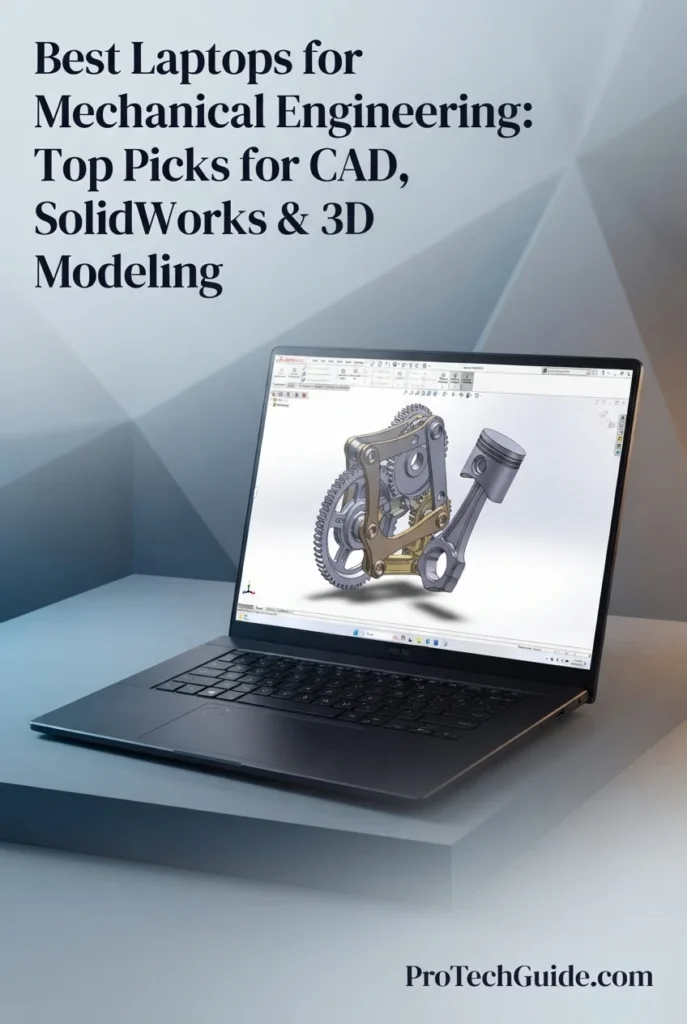
The HIDevolution ASUS ProArt P16 H7606WP with the AMD Ryzen AI 9 HX 370, NVIDIA GeForce RTX 5070 Laptop GPU, 64GB of LPDDR5X memory, and 2TB PCIe 4.0 NVMe SSD is our Best Overall laptop for mechanical engineering in 2026. Its 12-core, 24-thread Ryzen AI 9 HX 370 processor, RTX 5070 graphics with 8GB of GDDR7 memory, 64GB of system memory, and 16-inch 4K OLED touchscreen create a powerful platform for demanding CAD, SolidWorks, 3D modeling, visualization, simulation, and engineering multitasking. The combination is particularly compelling for engineers who want substantial CPU and GPU performance while also using the laptop for technical documentation, programming, visualization, and other professional workloads.

• Ideal for mechanical engineering students, CAD professionals, designers, engineers, researchers, and advanced users working with demanding 3D models, assemblies, visualization, and engineering applications
• Excellent for AutoCAD, SolidWorks, Autodesk Inventor, Fusion 360, 3D CAD, modeling, rendering, technical visualization, engineering documentation, and multitasking across demanding applications
• Particularly well suited to users who need substantial memory capacity for large assemblies, complex projects, multiple engineering applications, browsers, reference material, and other professional workloads running simultaneously
• The AMD Ryzen AI 9 HX 370 combines 12 CPU cores and 24 threads with boost speeds up to 5.1GHz, providing strong processing capability for CAD operations, engineering calculations, modeling workflows, code compilation, simulation preparation, and demanding multitasking
• 64GB of LPDDR5X memory provides substantial headroom for large CAD projects, complex assemblies, 3D applications, engineering software, browsers, documentation, and multiple professional applications running simultaneously
• The NVIDIA GeForce RTX 5070 Laptop GPU provides 8GB of GDDR7 graphics memory and a modern RTX architecture that is well suited to GPU-accelerated visualization, 3D workflows, rendering, viewport acceleration, and other graphics-intensive engineering workloads
• The 16-inch 4K OLED touchscreen provides a high-resolution 3840 × 2400 workspace with 16:10 proportions, making detailed drawings, 3D models, technical documentation, reference material, and visual content comfortable to work with
• The 2TB PCIe 4.0 NVMe SSD provides fast local storage for CAD projects, engineering software, 3D assets, datasets, documentation, and large project files while maintaining responsive application and file loading
• Windows 11 Pro provides broad compatibility with the Windows-based engineering software ecosystem, while the ProArt P16's creator-focused design combines high-end performance with a more refined professional form factor than many traditional gaming laptops

The ASUS ProArt P16 earns our Best Overall Laptop for Mechanical Engineering award because it combines high-end CPU performance, RTX 5070 graphics, 64GB of memory, 2TB of fast storage, and a premium 4K OLED display in a single professional platform. It is especially attractive for engineers who move between CAD, 3D modeling, visualization, technical work, and other demanding applications rather than using their laptop exclusively for one engineering program. The Ryzen AI 9 HX 370 provides 12 cores and 24 threads, while the RTX 5070 Laptop GPU adds 8GB of GDDR7 memory for demanding graphics workloads.

Compared with professional mobile workstations such as the Lenovo ThinkPad P16v Gen 3 and HP ZBook Power G11, the ProArt P16 takes a different approach by pairing a powerful GeForce RTX GPU with a high-capacity 64GB memory configuration and a high-resolution OLED touchscreen. This makes it particularly compelling for engineers who also perform visualization, rendering, content creation, or other GPU-intensive workloads. However, professionals whose workflow depends on ISV-certified workstation hardware and graphics configurations should consider a dedicated mobile workstation instead, particularly when certified drivers and application-specific support are important requirements.

• AMD Ryzen AI 9 HX 370• 12 CPU cores• 24 threads• Up to 5.1GHz boost clock• 36MB total cache• Zen 5 and Zen 5c architecture• AMD XDNA NPU up to 50 TOPS• 15-54W configurable TDP rangeThe AMD Ryzen AI 9 HX 370 provides a strong foundation for demanding mechanical engineering workflows. Its 12 cores and 24 threads can handle complex multitasking across CAD software, engineering applications, browsers, documentation, programming environments, and other professional tools. With boost speeds up to 5.1GHz, the processor is also well suited to workloads that benefit from strong individual-core performance alongside substantial multi-core capability.
• NVIDIA GeForce RTX 5070 Laptop GPU• 8GB GDDR7 VRAM• 4,608 CUDA cores• 798 AI TOPS• Blackwell architecture• Hardware-accelerated ray tracing• NVIDIA Studio ecosystem• GPU-accelerated 3D workflowsThe RTX 5070 Laptop GPU gives the ProArt P16 substantial graphics capability for 3D modeling, viewport rendering, visualization, rendering, and other GPU-intensive workloads. NVIDIA lists 4,608 CUDA cores, 8GB of GDDR7 memory, and 798 AI TOPS for the RTX 5070 Laptop GPU. For mechanical engineering users, this provides a powerful graphics platform for complex visual workloads, although it should not be confused with NVIDIA's professional RTX PRO workstation GPUs used in certified workstation configurations.
• 64GB LPDDR5X memory• 6400MHz memory listed for this configuration• High-capacity system memory• Excellent multitasking headroom• Suitable for large engineering projects• Strong capacity for complex assemblies• Designed for memory-intensive professional workloadsThe 64GB memory configuration is one of this ProArt P16's strongest advantages for mechanical engineering. It provides substantial headroom for large CAD projects, complex assemblies, 3D modeling software, engineering applications, browsers, technical documentation, and multiple applications running simultaneously. This capacity is particularly useful for engineers who regularly move between several demanding programs instead of working inside a single application at a time.
• AutoCAD• SolidWorks• Autodesk Inventor• Fusion 360• 3D CAD• Mechanical assemblies• Engineering visualization• 3D modeling• Rendering workflowsThe combination of the Ryzen AI 9 HX 370, RTX 5070, and 64GB of memory gives the ProArt P16 the hardware foundation required for demanding CAD and 3D workflows. It is particularly attractive for users working with complex models, assemblies, technical visualization, rendering, and multiple engineering applications. Autodesk recommends 32GB of RAM and an 8GB GPU for its recommended AutoCAD 2026 configuration, while SOLIDWORKS 2026 recommends 32GB of RAM and certified graphics hardware for supported professional configurations. This system therefore provides substantial memory capacity and dedicated graphics capability, although the GeForce RTX 5070 is not equivalent to a certified professional RTX PRO workstation GPU.
• 16-inch display• 3840 × 2400 resolution• 16:10 aspect ratio• OLED technology• 60Hz refresh rate for this configuration• Touchscreen• 100% DCI-P3 color gamut• PANTONE Validated• VESA DisplayHDR True Black 500• Stylus supportThe 16-inch 4K OLED display provides a detailed workspace for CAD drawings, 3D models, technical documentation, engineering references, and visual analysis. The 3840 × 2400 resolution and 16:10 aspect ratio provide substantial workspace for complex interfaces, while OLED technology and wide-gamut color reproduction make the system particularly attractive to engineers who also perform visualization, rendering, or other visually demanding work. ASUS lists 100% DCI-P3 coverage, PANTONE Validation, touchscreen support, and stylus compatibility for the H7606WP family.
• 2TB M.2 PCIe 4.0 x4 NVMe SSD• Fast application launches• Responsive project access• Rapid CAD file loading• Ample space for engineering applications• Suitable for 3D assets and project files• Strong capacity for professional workflowsThe 2TB PCIe 4.0 NVMe SSD provides a substantial amount of local storage for engineering software, CAD assemblies, 3D models, technical documentation, project archives, datasets, and other professional files. The HIDevolution configuration specifically lists a 2TB M.2 PCIe 4.0 x4 NVMe SSD, giving the system a strong combination of capacity and responsive storage performance.
• Windows 11 Pro• Broad Windows software compatibility• AutoCAD support• SolidWorks support• Autodesk Inventor support• Fusion 360 support• Professional engineering ecosystem• Compatible with external displays and storageWindows 11 Pro makes the ProArt P16 particularly practical for mechanical engineering users who rely on Windows-based CAD and engineering applications. It provides the platform compatibility needed for major engineering software while also supporting professional productivity, programming, external displays, storage devices, and other peripherals used in technical workflows. ASUS lists Windows 11 Pro as an available operating system for the H7606WP configuration.
• 16-inch professional form factor• Approximately 4.08 pounds for this configuration• Nano Black finish• Backlit keyboard• Touchscreen• Professional creator-oriented design• HIDevolution thermal enhancements• Thermal Grizzly Conductonaut on CPU• Gelid GC Extreme on GPUThe ProArt P16 offers a more refined alternative to bulky desktop-replacement gaming laptops while retaining hardware suitable for demanding professional workloads. The specific HIDevolution configuration listed here also includes thermal compound upgrades, with Thermal Grizzly Conductonaut on the CPU and Gelid GC Extreme on the GPU. These are configuration-specific enhancements from the system integrator rather than standard specifications that should be assumed for every ProArt P16 model.
Ideal for:• Mechanical engineering students• Professional mechanical engineers• CAD professionals• SolidWorks users• AutoCAD users• Autodesk Inventor users• Fusion 360 users• 3D modeling• Engineering visualization• Rendering workloads• Large CAD projects• Engineers who need 64GB of memory• Professionals who also perform creative workThe HIDevolution ASUS ProArt P16 H7606WP is particularly well suited to mechanical engineering users who want one premium Windows laptop capable of handling demanding CAD, 3D modeling, visualization, multitasking, and creative workloads. Its Ryzen AI 9 HX 370, RTX 5070, 64GB memory, 2TB SSD, and 4K OLED display create a versatile configuration for engineers who want substantial performance without moving exclusively into a traditional mobile-workstation platform.
Best Professional CAD Workstation (2026)

Lenovo ThinkPad P16v Gen 3 Mobile Workstation

Professional Workstation for CAD, SolidWorks & Engineering Simulation
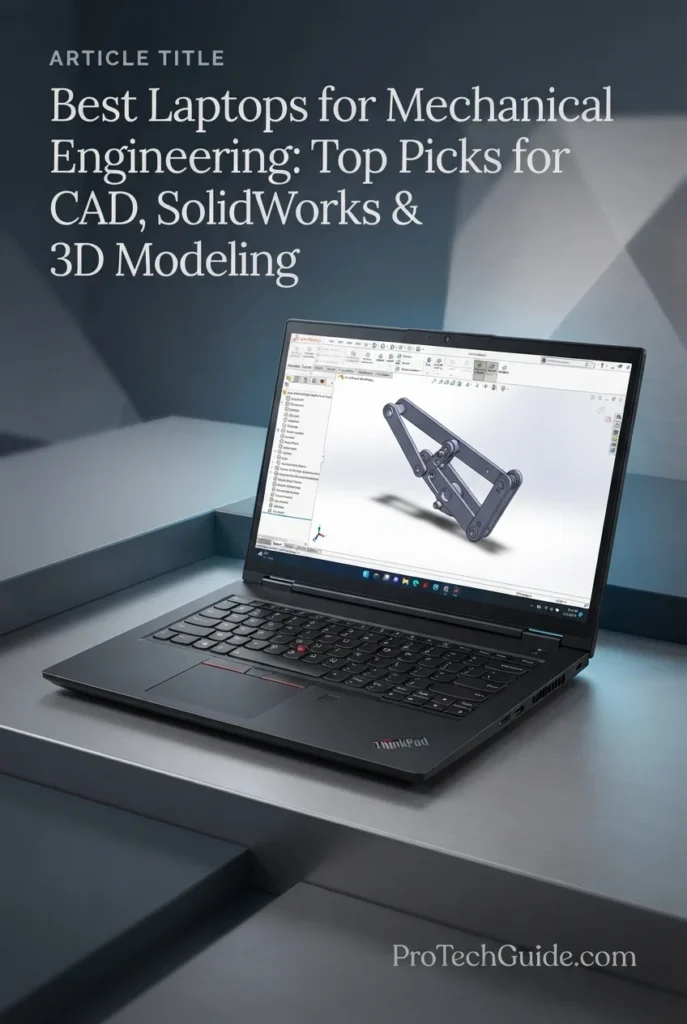
The Lenovo ThinkPad P16v Gen 3 with the Intel Core Ultra 9 285H vPro processor, NVIDIA RTX PRO 2000 Blackwell GPU, 32GB of DDR5 memory, and 1TB PCIe SSD is our Best Professional CAD Workstation for mechanical engineering in 2026. Unlike performance-focused gaming and creator laptops, this configuration is built around a professional mobile-workstation platform with NVIDIA RTX PRO graphics, Windows 11 Pro, expandable DDR5 memory, and business-oriented connectivity. Its 16-core Core Ultra 9 processor, 8GB GDDR7 professional GPU, 32GB RAM, and 16-inch 1920 × 1200 display create a strong foundation for SolidWorks, AutoCAD, 3D CAD, engineering design, technical documentation, visualization, and demanding professional multitasking.

• Ideal for professional mechanical engineers, CAD designers, engineering students working with advanced projects, architects, technical professionals, and organizations that require a dedicated mobile workstation
• Excellent for SolidWorks, AutoCAD, mechanical CAD, engineering assemblies, 3D modeling, technical visualization, simulation preparation, and professional Windows-based engineering workflows
• Particularly well suited to users who prioritize professional GPU drivers, workstation-oriented hardware, memory expandability, enterprise connectivity, and long-term engineering workflows over gaming-focused features
• The Intel Core Ultra 9 285H provides 16 CPU cores and boost speeds up to 5.4GHz, delivering strong processing capability for CAD operations, engineering applications, multitasking, rendering, and computational workloads
• The NVIDIA RTX PRO 2000 Blackwell provides 8GB of GDDR7 graphics memory and professional workstation graphics capabilities designed for demanding CAD, 3D visualization, rendering, and engineering workflows
• 32GB of DDR5 memory provides a solid professional starting point for CAD, SolidWorks, engineering software, browsers, documentation, and multitasking, while the two memory slots allow this configuration to be expanded substantially later
• The 16-inch WUXGA display provides a 1920 × 1200 workspace with a 16:10 aspect ratio, 500-nit brightness, and 100% sRGB coverage in this configuration, creating a practical workspace for technical drawings, CAD interfaces, documentation, and engineering applications
• The 1TB NVMe SSD provides responsive storage for engineering applications, CAD projects, assemblies, technical documentation, and project files while leaving room for additional storage expansion
• Windows 11 Pro, Intel vPro, Ethernet connectivity, Wi-Fi, fingerprint authentication, and ThinkPad's professional keyboard and chassis design make the P16v particularly suitable for structured workplace and enterprise engineering environments

The ThinkPad P16v Gen 3 earns our Best Professional CAD Workstation award because it prioritizes the features that distinguish a true mobile workstation from a conventional high-performance laptop: professional RTX PRO graphics, workstation-oriented drivers and ecosystem support, expandable DDR5 memory, Windows 11 Pro, enterprise connectivity, and a durable ThinkPad platform. For engineers who depend on professional CAD software and want a system designed specifically around technical workloads, its workstation architecture is a major advantage. Lenovo's specifications also provide two memory slots and support for substantially more RAM than the 32GB installed in this particular configuration.

Compared with the ASUS ProArt P16 H7606WP, the ThinkPad P16v Gen 3 takes a more specialized engineering-workstation approach. The ProArt offers a faster-class GeForce RTX 5070 configuration, 64GB of memory, a 4K OLED touchscreen, and stronger creator-oriented appeal, while the ThinkPad focuses on professional RTX PRO graphics, workstation software support, expandability, and enterprise features. SOLIDWORKS maintains a hardware-certification program specifically for qualified workstation and graphics configurations, making professional workstation hardware particularly relevant for users whose engineering workflow depends on certified configurations.

• Intel Core Ultra 9 285H• 16 CPU cores• 16 threads• Up to 5.4GHz max turbo frequency• 24MB Intel Smart Cache• 6 Performance-cores• 8 Efficient-cores• 2 Low Power Efficient-cores• Intel vPro technology in this configurationThe Intel Core Ultra 9 285H provides the processing foundation for demanding professional engineering workloads. With 16 cores and boost speeds up to 5.4GHz, it is well suited to CAD operations, engineering applications, multitasking, rendering, technical analysis, and workloads that require a combination of strong responsiveness and multi-core processing capability. Lenovo specifies the Core Ultra 9 285H with 16 cores, 16 threads, and up to 5.4GHz for the ThinkPad P16v Gen 3.
• NVIDIA RTX PRO 2000 Blackwell Generation• 8GB GDDR7 memory• 3,328 CUDA cores• 128-bit memory interface• 384GB/s memory bandwidth• 4th-generation RT Cores• 5th-generation Tensor Cores• Up to 572 AI TOPS• Professional RTX PRO graphics architectureThe NVIDIA RTX PRO 2000 Blackwell is the defining graphics component of this ThinkPad workstation. Lenovo lists the mobile GPU with 8GB of GDDR7 memory and up to 572 AI TOPS, while NVIDIA specifies 3,328 CUDA cores, 384GB/s memory bandwidth, and a 45-115W power range for the mobile RTX PRO 2000 Blackwell. Its professional positioning makes it fundamentally different from GeForce graphics used in gaming and creator laptops, particularly for applications where professional drivers and certified workstation configurations matter.
• 32GB DDR5 memory• Two memory slots• Dual-channel capable• DDR5-5600 support for this configuration• Up to 96GB supported by Lenovo• SODIMM/CSODIMM memory architecture• Expandable professional workstation platformThe 32GB configuration provides a strong starting point for professional CAD and engineering applications, but one of the P16v Gen 3's most important advantages is its upgradeability. Lenovo specifies two memory slots and support for up to 96GB depending on the memory configuration. This gives engineers a practical path to expand memory as projects become larger or workflows involve multiple engineering applications simultaneously.
• SolidWorks• AutoCAD• Mechanical CAD• 3D assemblies• Autodesk engineering workflows• 3D visualization• Technical design• Engineering documentation• Simulation-oriented workloadsThe ThinkPad P16v Gen 3 is designed around the professional CAD and engineering workstation category. Its RTX PRO graphics, high-performance Core Ultra processor, 32GB of RAM, and Windows 11 Pro provide a strong foundation for SolidWorks, AutoCAD, mechanical assemblies, 3D modeling, visualization, and other demanding technical workflows. SOLIDWORKS maintains a dedicated hardware-certification program for qualified workstations and graphics configurations, which is an important distinction when selecting hardware for professional engineering environments.
• 16-inch display• 1920 × 1200 resolution• 16:10 aspect ratio• IPS display technology• 60Hz refresh rate• 500-nit brightness• 100% sRGB coverage• Low-power display• Anti-glare professional workspaceThe 16-inch WUXGA display prioritizes practical engineering productivity rather than ultra-high resolution or gaming refresh rates. The 1920 × 1200 resolution and 16:10 aspect ratio provide useful vertical workspace for CAD interfaces, drawings, specifications, documentation, and engineering applications. The 500-nit brightness and 100% sRGB coverage listed for this configuration also make it suitable for professional environments where screen visibility and consistent color reproduction matter.
• 1TB NVMe SSD• PCIe storage• M.2 2280 format• Fast application loading• Responsive CAD project access• Suitable for engineering documentation• Space for 3D project files• Additional storage expansion supportedThe 1TB SSD provides a practical amount of local storage for engineering applications, CAD projects, assemblies, technical documentation, and everyday professional files. Lenovo's P16v Gen 3 platform supports two M.2 2280 storage slots, providing a useful expansion path when larger engineering datasets, project libraries, or additional local storage become necessary.
• Windows 11 Pro• Intel vPro technology• Professional workstation platform• Enterprise management capabilities• Fingerprint reader• Windows Hello support• Ethernet connectivity• Wi-Fi connectivity• Professional engineering software ecosystemWindows 11 Pro and Intel vPro help position the ThinkPad P16v Gen 3 for professional and enterprise environments rather than purely consumer use. The platform combines workstation graphics with business-oriented security, management, connectivity, and authentication features. For engineering departments and professionals who work with managed Windows environments, this combination can be particularly valuable.
• 16-inch ThinkPad chassis• Approximately 4.6-pound starting weight• Backlit ThinkPad keyboard• Numeric keypad• Spill-resistant keyboard• Ethernet RJ-45• Wi-Fi• Bluetooth• HDMI• Thunderbolt connectivity• 5MP RGB + IR camera in supported configurations• 90Wh battery platformThe ThinkPad P16v Gen 3 is designed as a professional mobile workstation rather than an ultraportable laptop. Lenovo lists a starting weight of approximately 4.6 pounds, along with a ThinkPad keyboard with numeric keypad and a 90Wh customer-replaceable battery platform. Its Ethernet connectivity and broad professional I/O are particularly useful in engineering offices, laboratories, and workstation environments where wired networking and multiple peripherals remain important.
Ideal for:• Professional mechanical engineers• CAD engineers• SolidWorks users• AutoCAD professionals• Mechanical designers• Engineering firms• Technical professionals• 3D CAD workflows• Professional visualization• Engineering simulation• Enterprise Windows environments• Users who need workstation-class graphics• Users who value RAM and storage expandabilityThe Lenovo ThinkPad P16v Gen 3 is particularly well suited to mechanical engineers and CAD professionals who need a true mobile workstation rather than a gaming or creator laptop. Its RTX PRO 2000 Blackwell graphics, Core Ultra 9 285H processor, expandable DDR5 memory, Windows 11 Pro, professional connectivity, and workstation-oriented platform make it a strong fit for serious engineering workflows where hardware certification, professional graphics support, and long-term expandability are important considerations.
Best Performance Value for Mechanical Engineering (2026)

Lenovo Legion Pro 5i Gen 10

High-Performance Laptop for CAD, SolidWorks & 3D Modeling
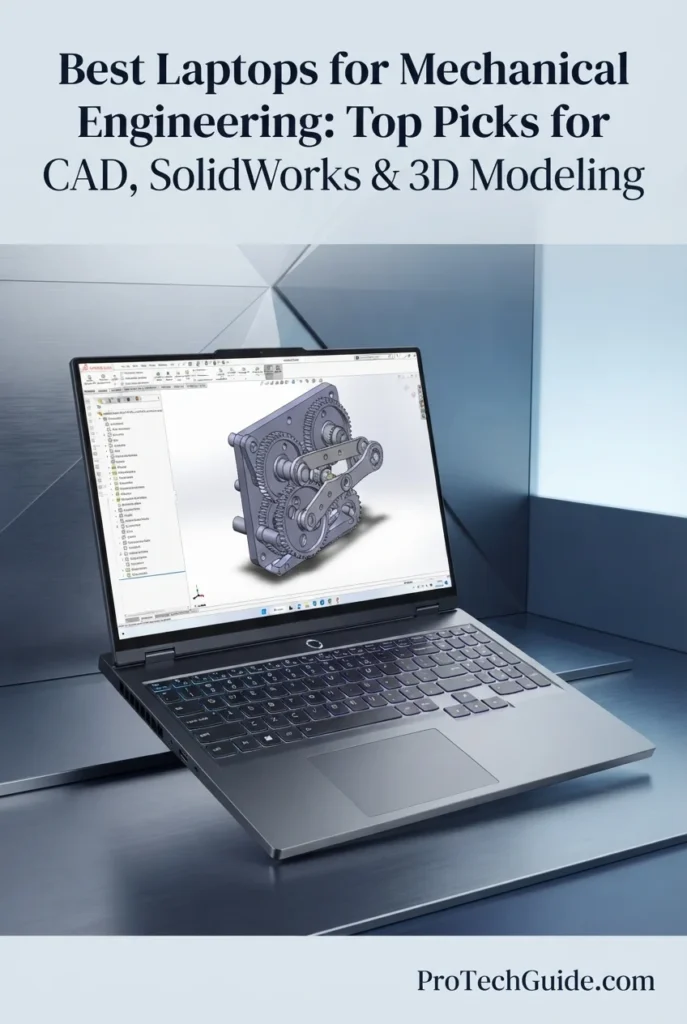
The Lenovo Legion Pro 5i Gen 10 with the Intel Core Ultra 9 275HX, NVIDIA GeForce RTX 5070, 32GB of DDR5 memory, and 2TB SSD is our Best Performance Value laptop for mechanical engineering in 2026. Its 24-core processor, RTX 5070 graphics with 8GB of GDDR7 memory, 32GB of DDR5 RAM, and fast 2TB storage create a powerful platform for CAD, SolidWorks, 3D modeling, engineering visualization, rendering, and demanding multitasking. The combination is particularly compelling for engineering students and professionals who want workstation-class levels of processing and graphics performance while retaining the flexibility of a high-performance Legion platform.

• Ideal for mechanical engineering students, CAD users, designers, engineers, and advanced users who need substantial CPU and GPU performance for demanding technical workloads
• Excellent for SolidWorks, AutoCAD, Autodesk Inventor, Fusion 360, 3D CAD, mechanical assemblies, engineering visualization, rendering, and other GPU-accelerated workflows
• Particularly well suited to users who prioritize raw performance, 32GB of memory, fast storage, and strong graphics capability over the professional certification and enterprise features of a traditional mobile workstation
• The Intel Core Ultra 9 275HX provides 24 CPU cores and 24 threads with boost speeds up to 5.4GHz, delivering substantial processing capacity for CAD operations, engineering applications, rendering, simulation preparation, and demanding multitasking
• The NVIDIA GeForce RTX 5070 Laptop GPU provides 8GB of GDDR7 memory, 4,608 CUDA cores, and Blackwell architecture, creating a strong graphics platform for 3D modeling, viewport acceleration, visualization, rendering, and other GPU-intensive engineering workloads
• 32GB of DDR5 memory provides a strong capacity for SolidWorks assemblies, CAD projects, engineering software, browsers, technical documentation, and multiple applications running simultaneously
• The 16-inch 2560 × 1600 OLED display with a 165Hz refresh rate provides a sharp 16:10 workspace for detailed CAD interfaces, 3D models, technical drawings, engineering documentation, and visual workflows
• The 2TB SSD provides substantial local storage for engineering applications, CAD assemblies, 3D assets, project files, datasets, technical documentation, and large professional software installations
• Thunderbolt 4, USB-C, HDMI 2.1, Ethernet, Wi-Fi 7, and Bluetooth 5.4 provide broad connectivity for external displays, storage, networking, peripherals, and engineering workstations

The Legion Pro 5i Gen 10 earns our Best Performance Value for Mechanical Engineering award because it combines an unusually powerful 24-core Core Ultra 9 275HX processor with RTX 5070 graphics, 32GB of DDR5 memory, and 2TB of storage. This gives engineering students and professionals substantial performance headroom for CAD, SolidWorks, 3D modeling, visualization, and demanding multitasking without requiring a traditional professional mobile-workstation platform. Its high-performance hardware also makes it particularly attractive for users whose engineering workload overlaps with rendering, creative applications, and GPU-intensive visualization.

Compared with the Lenovo ThinkPad P16v Gen 3 and other professional mobile workstations, the Legion Pro 5i Gen 10 emphasizes raw CPU and GeForce RTX performance, display quality, and performance-oriented value rather than professional RTX PRO graphics, enterprise management, or workstation-specific certification. The ThinkPad P16v is therefore more appropriate for workflows that specifically depend on professional workstation graphics and certified configurations, while the Legion is particularly compelling for engineers who prioritize high performance across CAD, 3D modeling, visualization, and other demanding workloads.

• Intel Core Ultra 9 275HX• 24 CPU cores• 24 threads• 8 Performance-cores• 16 Efficient-cores• Up to 5.4GHz max turbo frequency• 36MB Intel Smart Cache• Intel Thread Director• Intel AI Boost NPUThe Intel Core Ultra 9 275HX provides the Legion Pro 5i Gen 10 with substantial processing capability for demanding mechanical engineering workloads. Its 24 cores and 24 threads allow the system to handle complex multitasking across CAD software, engineering applications, browsers, documentation, programming environments, and rendering workloads. With boost frequencies reaching up to 5.4GHz, the processor is also well suited to engineering applications and operations that benefit from strong single-thread performance.
• NVIDIA GeForce RTX 5070 Laptop GPU• 8GB GDDR7 VRAM• 4,608 CUDA cores• Up to 798 AI TOPS• Blackwell architecture• Fourth-generation Ray Tracing Cores• Fifth-generation Tensor Cores• Hardware-accelerated ray tracing• DLSS 4• NVIDIA Studio ecosystemThe GeForce RTX 5070 provides the graphics horsepower required for demanding 3D engineering workflows. NVIDIA specifies 4,608 CUDA cores, 8GB of GDDR7 memory, and up to 798 AI TOPS for the RTX 5070 Laptop GPU. For mechanical engineering users, this provides a strong platform for 3D modeling, viewport acceleration, visualization, rendering, and other GPU-intensive workloads. However, the GeForce RTX 5070 should not be treated as equivalent to NVIDIA RTX PRO workstation graphics when an engineering application specifically requires certified professional hardware or drivers.
• 32GB DDR5 memory• DDR5-5600 memory speed• Dual-channel memory architecture• Strong capacity for CAD workloads• Suitable for large engineering projects• Excellent multitasking capability• Supports demanding 3D workflowsThe 32GB memory configuration provides a strong foundation for mechanical engineering applications. It gives users enough capacity to keep CAD software, SolidWorks assemblies, browsers, technical documentation, spreadsheets, communication tools, and other engineering applications active simultaneously. For users working with particularly large assemblies, simulation datasets, or highly intensive multitasking, memory requirements can vary by project and software workload, making the actual project size more important than RAM capacity alone.
• SolidWorks• AutoCAD• Autodesk Inventor• Fusion 360• 3D CAD• Mechanical assemblies• Parametric modeling• Engineering visualization• 3D rendering• Technical designThe combination of the Core Ultra 9 275HX, RTX 5070, and 32GB of memory gives the Legion Pro 5i a strong hardware foundation for demanding CAD and 3D workflows. It is particularly attractive for mechanical engineering students and professionals working with detailed models, assemblies, visualization, and rendering. Autodesk recommends 32GB of RAM and an 8GB GPU for its recommended AutoCAD 2026 configuration, while SOLIDWORKS 2026 recommends 32GB of RAM and certified graphics hardware for supported professional configurations. The Legion therefore aligns well with the recommended memory and graphics capacity for AutoCAD, while professionals who require certified SOLIDWORKS hardware should verify the exact configuration in the SOLIDWORKS certification database.
• 16-inch display• 2560 × 1600 resolution• 16:10 aspect ratio• OLED technology• 165Hz refresh rate• Non-touch display• HDR-capable OLED panel• High-resolution engineering workspaceThe 16-inch 2560 × 1600 OLED display provides a detailed workspace for CAD interfaces, engineering drawings, 3D models, technical documentation, and visual analysis. Its 16:10 aspect ratio provides useful vertical workspace compared with conventional 16:9 panels, while the OLED technology delivers deep blacks and strong contrast. The 165Hz refresh rate also makes viewport navigation, scrolling, and general system interaction exceptionally fluid, although refresh rate is less important to engineering productivity than resolution, clarity, and workspace area.
• 2TB SSD• PCIe NVMe storage• Fast application launches• Responsive CAD project access• Suitable for large 3D assets• Space for engineering software• Ample capacity for project files• Fast access to professional workloadsThe 2TB SSD provides substantial local capacity for mechanical engineering software, CAD assemblies, 3D models, rendering assets, technical documentation, datasets, and project archives. For students and professionals who maintain several engineering applications and large project libraries locally, the 2TB configuration reduces the need to rely on external storage for everyday project access while maintaining a responsive Windows environment.
• Windows 11 Home• Thunderbolt 4• USB-C with DisplayPort 2.1• HDMI 2.1• USB-A connectivity• Ethernet RJ-45• Wi-Fi 7• Bluetooth 5.4• External display support• Professional peripheral compatibilityWindows 11 Home provides the operating environment for major Windows-based engineering applications, while the Legion Pro 5i's extensive connectivity makes it practical for workstation-style setups. Thunderbolt 4, USB-C, HDMI 2.1, Ethernet, USB-A, Wi-Fi 7, and Bluetooth 5.4 allow engineers to connect external displays, storage devices, networking equipment, input peripherals, and other technical accessories.
• Legion performance-focused chassis• 16-inch form factor• Full-sized keyboard• 1.6mm key travel• 24-zone RGB keyboard lighting• Backlit keyboard• Ethernet connectivity• 80Wh battery• 3-year Lenovo Courier/Carry-in warrantyThe Legion Pro 5i Gen 10 is designed around sustained high performance rather than ultraportable mobility. Its performance-oriented chassis, full-sized keyboard, extensive connectivity, and 80Wh battery make it well suited to demanding engineering work at a desk or workstation. The 24-zone RGB lighting is primarily a gaming-oriented feature, but the keyboard itself can also be useful for long engineering sessions thanks to its full-sized layout and responsive key travel. The specific configuration listed here includes three years of Lenovo Courier/Carry-in warranty coverage.
Ideal for:• Mechanical engineering students• Professional mechanical engineers• SolidWorks users• AutoCAD users• Autodesk Inventor users• Fusion 360 users• CAD designers• 3D modeling• Engineering visualization• Rendering workloads• Large CAD projects• Users who prioritize raw performance• Users who want GeForce RTX graphics• Engineering users who also gameThe Lenovo Legion Pro 5i Gen 10 is particularly well suited to mechanical engineering students and professionals who want a high-performance Windows laptop capable of handling CAD, 3D modeling, visualization, rendering, and demanding multitasking. Its Core Ultra 9 275HX, RTX 5070, 32GB of DDR5 memory, 2TB SSD, and high-resolution OLED display make it a performance-focused alternative to traditional mobile workstations, especially for users who do not specifically require professional RTX PRO graphics or application-certified workstation hardware.
Best Premium Portable Workstation (2026)

Lenovo ThinkPad P1 Gen 8

Premium Mobile Workstation for CAD, SolidWorks & Engineering Design
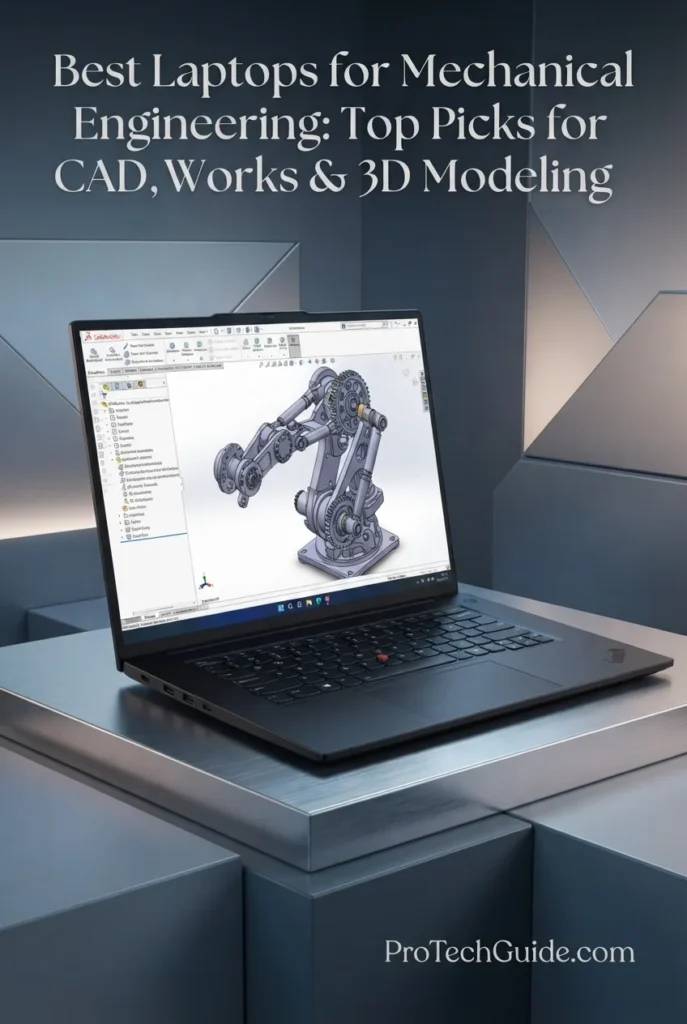
The Lenovo ThinkPad P1 Gen 8 with the Intel Core Ultra 9 285H, NVIDIA RTX PRO 2000 Blackwell graphics, 64GB of LPDDR5X memory, and 2TB PCIe 5.0 SSD is our Best Premium Portable Workstation for mechanical engineering in 2026. Its 16-core processor, professional RTX PRO graphics, 64GB of high-speed memory, next-generation SSD, and 16-inch 3.2K OLED touchscreen create a sophisticated platform for CAD, SolidWorks, 3D modeling, engineering visualization, technical design, and demanding professional multitasking. The configuration is particularly attractive to engineers who want workstation-class hardware in a premium design that is more focused on mobility and display quality than a traditional desktop-replacement workstation.

• Ideal for professional mechanical engineers, CAD specialists, engineering designers, architects, technical professionals, and advanced students working with demanding professional applications
• Excellent for SolidWorks, AutoCAD, Autodesk Inventor, Fusion 360, 3D CAD, engineering visualization, technical design, assemblies, and professional Windows-based engineering workflows
• Particularly well suited to professionals who need workstation-class RTX PRO graphics, substantial memory capacity, premium display quality, and a more refined mobile design for working across offices, meetings, and engineering environments
• The Intel Core Ultra 9 285H provides 16 CPU cores, 16 threads, and boost speeds up to 5.4GHz, delivering strong processing capability for CAD operations, engineering applications, rendering, analysis, and demanding multitasking
• The NVIDIA RTX PRO 2000 Blackwell provides 8GB of GDDR7 professional graphics memory and a workstation-oriented architecture designed for professional 3D graphics, CAD, visualization, and engineering workloads
• 64GB of LPDDR5X-7467 memory provides substantial headroom for large CAD assemblies, SolidWorks projects, 3D applications, engineering software, browsers, documentation, and multiple professional applications running simultaneously
• The 16-inch 3.2K OLED touchscreen provides a 3200 × 2000 workspace, 100% DCI-P3 coverage, and variable 40–120Hz refresh rate, creating an excellent environment for detailed engineering design and visual analysis
• The 2TB PCIe 5.0 performance SSD provides fast local storage for engineering software, CAD projects, assemblies, 3D assets, datasets, and technical documentation, while the platform supports additional M.2 storage expansion
• Two Thunderbolt 5 ports, Thunderbolt 4, HDMI 2.1, SD Express 7.0, Wi-Fi 7, fingerprint authentication, and ThinkPad security features create a sophisticated professional platform for modern engineering environments

The ThinkPad P1 Gen 8 earns our Best Premium Portable Workstation award because it combines professional RTX PRO graphics, 64GB of high-speed memory, a powerful Core Ultra 9 processor, PCIe 5.0 storage, and an exceptionally high-resolution 3.2K OLED touchscreen in a premium mobile-workstation platform. It is especially compelling for engineers who want substantial CAD and 3D capability without choosing a bulkier workstation design, while its professional graphics architecture makes it particularly relevant to users whose workflows benefit from workstation-class GPU support.

Compared with the Lenovo ThinkPad P16v Gen 3, the ThinkPad P1 Gen 8 emphasizes a more premium and mobile workstation experience, with 64GB of LPDDR5X memory, PCIe 5.0 storage, a 3.2K OLED touchscreen, Thunderbolt 5 connectivity, and a refined chassis design. Both platforms use NVIDIA RTX PRO 2000 Blackwell graphics, so the distinction is less about the professional GPU category and more about configuration, display technology, portability, connectivity, and overall platform design. Engineers who specifically require certified SOLIDWORKS hardware should still verify the exact system and driver combination through the SOLIDWORKS certification database.

• Intel Core Ultra 9 285H• 16 CPU cores• 16 threads• 6 Performance-cores• 8 Efficient-cores• 2 Low Power Efficient-cores• Up to 5.4GHz max turbo frequency• 24MB Intel Smart Cache• Intel vPro• Intel AI Boost NPUThe Intel Core Ultra 9 285H provides the processing foundation for demanding professional engineering workflows. With 16 cores and boost speeds up to 5.4GHz, it can handle CAD operations, engineering applications, multitasking, rendering, technical analysis, and other workloads that benefit from strong CPU responsiveness. Lenovo specifies this exact processor configuration with 16 cores, 16 threads, and up to 5.4GHz.
• NVIDIA RTX PRO 2000 Blackwell Generation• 8GB GDDR7 memory• 3,328 CUDA cores• 384GB/s memory bandwidth• 128-bit memory interface• Fourth-generation Ray Tracing Cores• Fifth-generation Tensor Cores• Up to 572 AI TOPS• Professional RTX PRO architectureThe NVIDIA RTX PRO 2000 Blackwell is the key component that separates the ThinkPad P1 Gen 8 from conventional GeForce-based performance laptops. NVIDIA specifies 3,328 CUDA cores, 8GB of GDDR7 memory, 384GB/s memory bandwidth, and up to 572 AI TOPS for the mobile RTX PRO 2000 Blackwell. Its professional positioning makes it particularly relevant to CAD, 3D visualization, rendering, and engineering applications where workstation-class graphics support and professional driver ecosystems matter.
• 64GB LPDDR5X memory• LPDDR5X-7467• Dual-channel memory architecture• High memory bandwidth• Excellent CAD multitasking capacity• Suitable for large assemblies• Strong capacity for 3D workflows• Up to 64GB supported on this platform configurationThe 64GB memory configuration is one of the ThinkPad P1 Gen 8's strongest advantages for professional engineering work. It provides substantial headroom for large CAD assemblies, SolidWorks projects, 3D modeling applications, engineering software, browsers, technical documentation, and multiple professional applications operating simultaneously. Lenovo specifies 64GB LPDDR5X-7467 for this configuration, with a single LPCAMM2 connector and dual-channel operation.
• SolidWorks• AutoCAD• Autodesk Inventor• Fusion 360• 3D CAD• Mechanical assemblies• Parametric modeling• Engineering visualization• Technical design• Professional workstation workflowsThe combination of the Core Ultra 9 285H, RTX PRO 2000 Blackwell, and 64GB of memory creates a strong platform for professional CAD and engineering workflows. The system is particularly suited to detailed 3D models, assemblies, visualization, technical design, and demanding multitasking. SOLIDWORKS 2026 recommends 32GB of RAM and requires certified graphics cards and drivers for certified configurations, so the P1's 64GB capacity provides substantial memory headroom, while users requiring formal SOLIDWORKS certification should verify the exact ThinkPad P1 Gen 8 configuration and driver in the certification database.
• 16-inch display• 3200 × 2000 resolution• 16:10 aspect ratio• Tandem OLED technology• Touchscreen• 100% DCI-P3• 40–120Hz variable refresh rate• Up to 600 nits brightness• DisplayHDR 600• Dolby Vision• Anti-glare / anti-reflection / anti-smudgeThe 3.2K OLED touchscreen is one of the ThinkPad P1 Gen 8's defining features. Its 3200 × 2000 resolution provides a highly detailed workspace for CAD drawings, 3D models, technical documentation, engineering references, and visual analysis. The 16:10 aspect ratio provides useful vertical workspace, while 100% DCI-P3 coverage and OLED contrast make the display particularly attractive to engineers who also work with visualization, rendering, design, and color-sensitive content.
• 2TB PCIe 5.0 x4 NVMe SSD• M.2 2280 format• Performance-class SSD• Opal 2.0 security• Fast application launches• Rapid CAD project access• Suitable for large engineering files• Two M.2 storage slots• Up to 8TB platform storage supportThe 2TB PCIe 5.0 SSD provides fast local storage for engineering applications, CAD assemblies, 3D models, technical documentation, project archives, and professional datasets. Lenovo's platform includes two M.2 2280 storage slots and supports substantially more total storage, providing a useful expansion path for engineers whose project libraries grow over time.
• Windows 11 Pro• Intel vPro• Professional mobile workstation platform• ThinkShield security• Self-healing BIOS• Discrete TPM• Fingerprint reader• 5MP + IR camera with privacy shutter• Enterprise-oriented management and securityWindows 11 Pro and Intel vPro position the ThinkPad P1 Gen 8 for professional and enterprise engineering environments. ThinkShield security features, fingerprint authentication, TPM protection, and a self-healing BIOS add further business-oriented capabilities. For engineering teams and professionals working with managed Windows environments, the combination of professional graphics and enterprise-focused platform features provides a strong foundation for technical workflows.
• Premium 16-inch mobile workstation• 90Wh battery• 2x Thunderbolt 5• 1x Thunderbolt 4• USB-C Power Delivery• HDMI 2.1• SD Express 7.0 card reader• Wi-Fi 7• Bluetooth• Backlit ThinkPad keyboard• Fingerprint readerThe ThinkPad P1 Gen 8 is designed to combine professional workstation capability with a more refined mobile form factor. Its 90Wh battery, Thunderbolt 5 connectivity, Thunderbolt 4, HDMI 2.1, SD Express 7.0, Wi-Fi 7, and professional ThinkPad input features make it particularly practical for engineers who move between offices, project sites, meetings, laboratories, and home workspaces. Lenovo also positions the P1 Gen 8 as a lightweight mobile workstation, distinguishing it from larger desktop-replacement workstation designs.
Ideal for:• Professional mechanical engineers• CAD specialists• SolidWorks users• AutoCAD professionals• Mechanical designers• Engineering consultants• 3D modeling professionals• Technical visualization• Engineering documentation• Large CAD assemblies• Professional workstation workflows• Engineers who value premium displays• Professionals who need 64GB of memory• Mobile workstation usersThe Lenovo ThinkPad P1 Gen 8 is particularly well suited to engineers and technical professionals who want workstation-class graphics and memory capacity in a premium mobile platform. Its Core Ultra 9 285H, RTX PRO 2000 Blackwell, 64GB LPDDR5X, 2TB PCIe 5.0 SSD, and 3.2K OLED touchscreen make it a sophisticated choice for CAD, 3D modeling, visualization, and demanding professional multitasking. Users who require formal application certification should verify the exact system and driver combination against the relevant software vendor's certification database.
Best Compact Engineering Laptop (2026)

ASUS ROG Zephyrus G14

Compact Laptop for CAD, SolidWorks & 3D Modeling
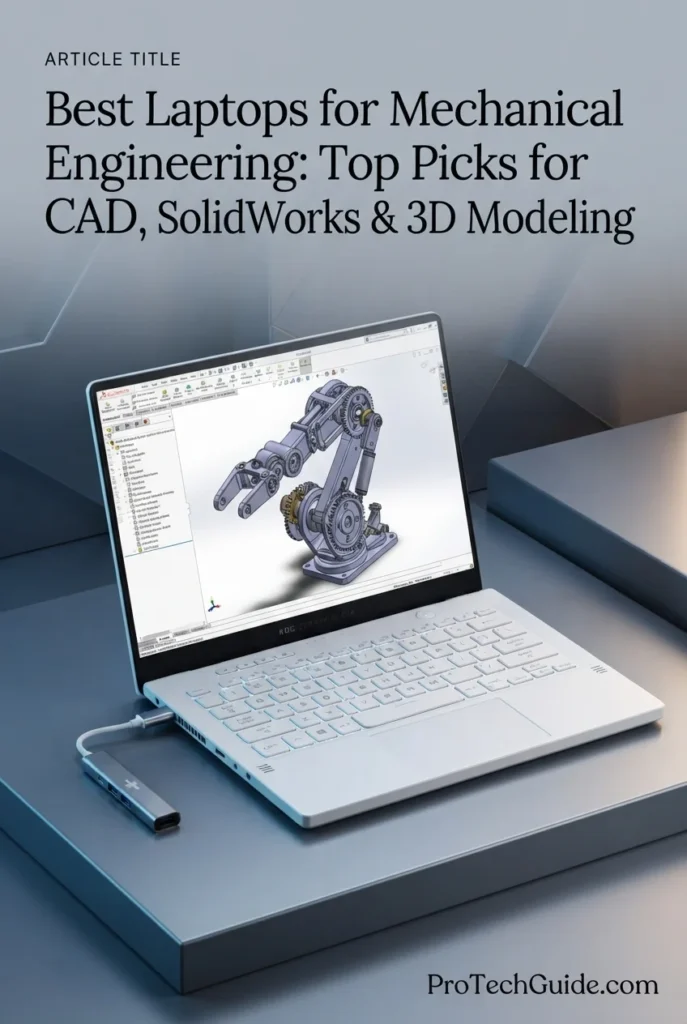
The ASUS ROG Zephyrus G14 with the AMD Ryzen 9 270, NVIDIA GeForce RTX 5060 Laptop GPU, 16GB of memory, and 1TB PCIe NVMe SSD is our Best Compact Engineering Laptop for mechanical engineering in 2026. Its 8-core, 16-thread Ryzen 9 processor, RTX 5060 graphics with 8GB of GDDR7 memory, 16GB of RAM, and 14-inch 2.8K OLED display create a highly portable platform for CAD, SolidWorks, 3D modeling, visualization, technical design, and everyday engineering work. The compact format is particularly attractive to students and professionals who regularly move between classrooms, laboratories, offices, meetings, and home workspaces while still needing dedicated graphics performance.

• Ideal for mechanical engineering students, CAD users, designers, engineers, and technical professionals who prioritize portability without giving up dedicated RTX graphics
• Excellent for AutoCAD, SolidWorks, Autodesk Inventor, Fusion 360, 3D CAD, technical visualization, engineering documentation, and moderate 3D modeling workloads
• Particularly well suited to users who frequently carry their laptop between university, engineering labs, offices, meetings, and home and want a smaller alternative to conventional 16-inch performance laptops
• The AMD Ryzen 9 270 provides 8 CPU cores and 16 threads with boost speeds up to 5.2GHz, providing strong processing capability for CAD operations, engineering applications, multitasking, and technical workflows
• The NVIDIA GeForce RTX 5060 Laptop GPU provides 8GB of GDDR7 graphics memory and Blackwell architecture, creating a capable platform for 3D modeling, viewport acceleration, visualization, rendering, and other GPU-intensive engineering workloads
• 16GB of onboard memory provides a practical starting point for CAD, SolidWorks, engineering applications, browsers, documentation, and everyday multitasking, although users working with exceptionally large assemblies or heavier simultaneous workloads may benefit from higher-memory configurations
• The 14-inch 2880 × 1800 OLED display provides a sharp 16:10 workspace for detailed CAD interfaces, technical drawings, 3D models, documentation, and visual analysis, with a 120Hz refresh rate for smooth interaction
• The 1TB PCIe NVMe SSD provides responsive application loading and useful local capacity for engineering software, CAD projects, 3D assets, documentation, and project files
• Windows 11 Pro, Wi-Fi 7, Bluetooth 5.4, HDMI, USB-C connectivity, a backlit keyboard, and the compact Zephyrus design create a versatile platform for students and professionals who need engineering performance in a highly mobile form factor

The ROG Zephyrus G14 earns our Best Compact Engineering Laptop award because it combines an 8-core Ryzen 9 processor, RTX 5060 graphics, 16GB of memory, 1TB SSD, and a high-resolution 14-inch OLED display in a significantly more compact format than the larger engineering laptops in this guide. Its greatest strength is mobility: it gives engineering students and professionals dedicated RTX graphics for CAD and 3D workloads without requiring a bulky 15- or 16-inch performance chassis.

Compared with larger performance laptops such as the Lenovo Legion Pro 5i Gen 10 and Acer Predator Helios Neo 16S AI, the Zephyrus G14 places greater emphasis on compact size, portability, and premium display quality. Its RTX 5060 provides dedicated graphics capability for 3D engineering workloads, but the 16GB onboard memory configuration offers less headroom than the 32GB and 64GB configurations found elsewhere in this guide. Professionals working with very large assemblies, intensive simulation, or extensive multitasking should therefore consider a higher-memory workstation or performance laptop instead.

• AMD Ryzen 9 270 processor• 8 CPU cores• 16 threads• 4.0GHz base clock• Up to 5.2GHz boost clock• 24MB cache• Zen 4 architecture• AMD XDNA NPUThe AMD Ryzen 9 270 provides the processing foundation for the Zephyrus G14's engineering workloads. Its 8 cores and 16 threads provide strong capability for CAD applications, engineering software, technical documentation, programming, browser multitasking, and everyday professional workloads. With boost speeds up to 5.2GHz, the processor is also well suited to operations that benefit from strong individual-core responsiveness.
• NVIDIA GeForce RTX 5060 Laptop GPU• 8GB GDDR7 VRAM• 3,328 CUDA cores• Blackwell architecture• Fourth-generation Ray Tracing Cores• Fifth-generation Tensor Cores• Up to 572 AI TOPS• Hardware-accelerated ray tracing• NVIDIA Studio ecosystemThe GeForce RTX 5060 Laptop GPU provides the dedicated graphics capability that makes the compact Zephyrus G14 practical for demanding 3D engineering workflows. NVIDIA specifies 3,328 CUDA cores, 8GB of GDDR7 memory, and up to 572 AI TOPS for the RTX 5060 Laptop GPU. For mechanical engineering users, this provides a capable foundation for 3D modeling, viewport acceleration, visualization, rendering, and other GPU-intensive workloads. However, it is a GeForce GPU rather than a professional RTX PRO workstation GPU, so users who require application-specific workstation certification should verify the exact software requirements before purchasing.
• 16GB onboard memory• DDR5-class memory• 7500MHz memory speed listed for the platform• Dual-channel memory architecture• Suitable for everyday CAD workloads• Solid capacity for engineering applications• Useful multitasking headroom• 16GB maximum for this listed configurationThe 16GB onboard memory configuration provides a practical starting point for mechanical engineering coursework, CAD applications, browsers, technical documentation, and everyday multitasking. It is important to distinguish this configuration from higher-memory Zephyrus G14 variants: the specific Amazon configuration used in this guide lists 16GB onboard memory and a 16GB maximum. Engineers working with very large assemblies, heavy simulation datasets, or numerous demanding applications simultaneously should consider a system with more memory capacity.
• SolidWorks• AutoCAD• Autodesk Inventor• Fusion 360• 3D CAD• Mechanical assemblies• Parametric modeling• Engineering visualization• Technical design• 3D renderingThe combination of the Ryzen 9 270, RTX 5060, and 16GB of memory gives the Zephyrus G14 a capable foundation for CAD and 3D engineering workflows. It is particularly attractive for students and professionals working with everyday CAD, moderate assemblies, 3D modeling, visualization, and technical design while placing a high priority on portability. Autodesk recommends 32GB of RAM and an 8GB GPU for its recommended AutoCAD 2026 configuration, while SOLIDWORKS 2026 recommends 32GB of RAM and certified graphics hardware for supported professional configurations. The G14 therefore provides the required 8GB dedicated GPU capacity for Autodesk's recommended graphics level, but its 16GB system memory is below that 32GB recommendation and its GeForce GPU should not be presented as equivalent to certified professional workstation graphics.
• 14-inch display• 2880 × 1800 resolution• 16:10 aspect ratio• OLED technology• 120Hz refresh rate• Anti-reflection display• G-SYNC / Adaptive-Sync• Pantone Validated• MUX Switch• NVIDIA Advanced OptimusThe 14-inch 2880 × 1800 OLED display is one of the Zephyrus G14's strongest advantages for mobile engineering work. Its high pixel density provides a detailed workspace for CAD drawings, 3D models, technical documentation, and engineering applications, while the 16:10 aspect ratio provides useful vertical space for interfaces and tool panels. ASUS specifies a 120Hz OLED panel with anti-reflection treatment, G-SYNC or Adaptive-Sync, Pantone Validation, and NVIDIA Advanced Optimus for the G14 platform.
• 1TB PCIe NVMe SSD• M.2 storage• Fast application launches• Responsive project access• Suitable for CAD files• Space for engineering applications• Useful capacity for 3D assets• Fast access to project filesThe 1TB PCIe NVMe SSD provides a practical storage foundation for engineering software, CAD projects, 3D models, technical documentation, datasets, and everyday files. It offers enough capacity for a typical student or professional engineering environment while maintaining responsive application and project loading. Users who maintain extensive local libraries of large 3D assets or engineering datasets may eventually benefit from additional external or expanded storage.
• Windows 11 Pro• Wi-Fi 7• Bluetooth 5.4• HDMI output• USB-C connectivity• USB connectivity• MicroSD card reader• Headphone/microphone combo jack• External display support• Professional peripheral compatibilityWindows 11 Pro provides the operating environment required by major Windows-based engineering applications, while the Zephyrus G14 offers a useful selection of connectivity for mobile engineering setups. Wi-Fi 7 and Bluetooth 5.4 support modern wireless peripherals and networking, while HDMI, USB-C, USB, and the microSD reader provide options for external displays, storage, input devices, and technical accessories.
• Compact 14-inch design• Platinum White finish• 73Wh battery• 200W power adapter• Backlit RGB keyboard• Portable professional form factor• OLED display• Wi-Fi 7• Bluetooth 5.4• Included USB hub in this configurationThe Zephyrus G14 is designed around mobility without abandoning dedicated graphics performance. Its compact 14-inch chassis makes it easier to carry between classrooms, laboratories, offices, meetings, and home workspaces than larger performance laptops. The specific configuration listed here includes a 73Wh battery, 200W power supply, Platinum White finish, RGB backlit keyboard, and an included portable USB hub. The Amazon listing reports a 7.5-pound item weight, but that figure should be treated as listing metadata rather than a reliable indication of the bare laptop's chassis weight.
Ideal for:• Mechanical engineering students• CAD students• Professional engineers who prioritize portability• SolidWorks users• AutoCAD users• Autodesk Inventor users• Fusion 360 users• 3D modeling• Engineering visualization• Technical design• Mobile engineering workflows• Users who prefer compact laptops• Engineers who also perform creative or gaming workloadsThe ASUS ROG Zephyrus G14 is particularly well suited to mechanical engineering students and professionals who want dedicated RTX graphics and a high-resolution OLED display in a compact 14-inch platform. Its Ryzen 9 270, RTX 5060, 16GB memory, and 1TB SSD provide a capable foundation for CAD, 3D modeling, visualization, and technical work, while its compact format makes it especially practical for users who carry their laptop frequently. For very large CAD assemblies, intensive simulation, or memory-heavy professional workflows, a 32GB-or-higher workstation or performance laptop is a more appropriate platform.
Best Gaming Laptop for Engineering (2026)

Acer Predator Helios Neo 16S AI

High-Performance Laptop for CAD, SolidWorks & 3D Modeling
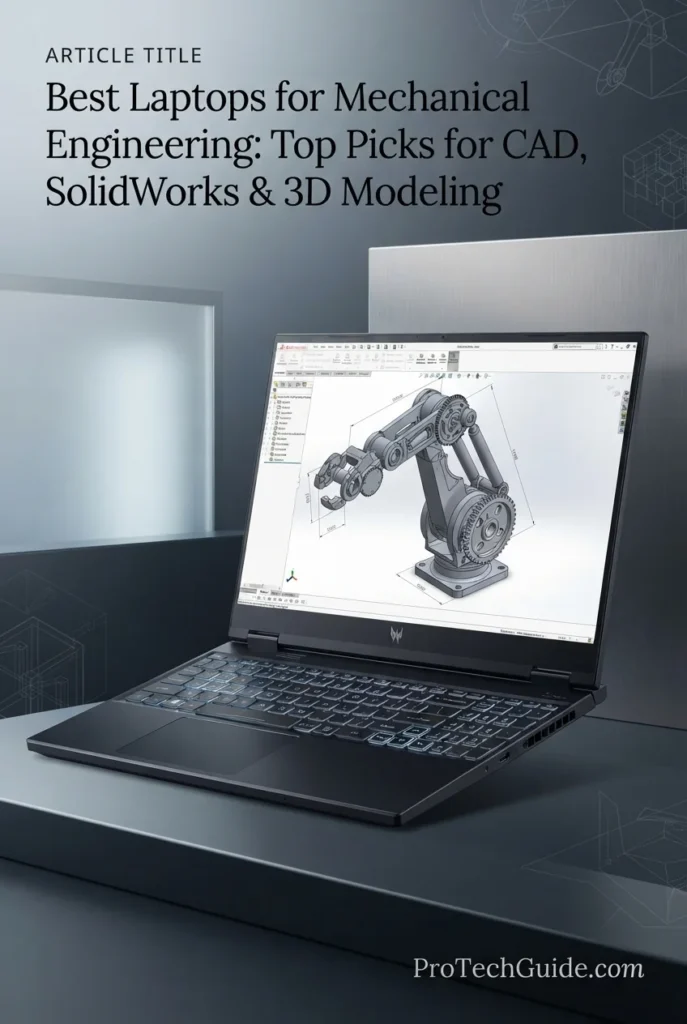
The Acer Predator Helios Neo 16S AI with the Intel Core Ultra 9 275HX, NVIDIA GeForce RTX 5060, 64GB of DDR5 memory, and 1TB SSD is our Best Gaming Laptop for Engineering in 2026. Its 24-core processor, RTX 5060 graphics with 8GB of dedicated memory, 64GB of RAM, and 16-inch 2560 × 1600 OLED display create a powerful platform for demanding CAD, SolidWorks, 3D modeling, visualization, rendering, and engineering multitasking. The combination is particularly compelling for engineering students and professionals who want substantial performance for technical workloads while also benefiting from a high-refresh-rate OLED display and a performance-oriented cooling system.

• Ideal for mechanical engineering students, CAD users, designers, engineers, and advanced users who need substantial CPU, GPU, and memory performance for demanding technical workloads
• Excellent for AutoCAD, SolidWorks, Autodesk Inventor, Fusion 360, 3D CAD, mechanical assemblies, visualization, rendering, and other GPU-accelerated engineering workflows
• Particularly well suited to users who want 64GB of memory and strong dedicated graphics in a high-performance laptop that can also handle gaming, creative applications, and other demanding workloads
• The Intel Core Ultra 9 275HX provides 24 CPU cores and 24 threads with boost speeds up to 5.4GHz, delivering substantial processing capacity for CAD operations, engineering applications, rendering, simulation preparation, and demanding multitasking
• The NVIDIA GeForce RTX 5060 provides 8GB of dedicated graphics memory and Blackwell architecture, creating a capable platform for 3D modeling, viewport acceleration, visualization, rendering, and other GPU-intensive engineering workloads
• 64GB of DDR5 memory provides substantial headroom for large CAD projects, complex assemblies, SolidWorks workflows, engineering applications, browsers, documentation, and multiple demanding programs running simultaneously
• The 16-inch 2560 × 1600 OLED display with a 240Hz refresh rate provides a detailed 16:10 workspace for CAD interfaces, technical drawings, 3D models, visualization, and engineering documentation
• The 1TB SSD provides responsive storage for engineering applications, CAD assemblies, 3D assets, project files, datasets, and technical documentation while maintaining fast application and file access
• The fifth-generation AeroBlade 3D cooling system, USB-C, HDMI 2.1, 5Gb Ethernet, Wi-Fi connectivity, and a backlit RGB keyboard create a versatile high-performance platform for engineering and other demanding workloads

The Predator Helios Neo 16S AI earns our Best Gaming Laptop for Engineering award because it combines a 24-core Core Ultra 9 275HX processor, RTX 5060 graphics, 64GB of DDR5 memory, 1TB SSD, and a high-resolution 240Hz OLED display. The 64GB memory configuration is particularly valuable for mechanical engineering workloads because it provides substantial capacity for large CAD assemblies, 3D applications, engineering software, browsers, and other tools running simultaneously. It is a performance-focused alternative to traditional mobile workstations for users who do not specifically require professional RTX PRO graphics or certified workstation hardware.

Compared with the Lenovo ThinkPad P16v Gen 3 and Lenovo ThinkPad P1 Gen 8, the Predator Helios Neo 16S AI takes a performance-oriented GeForce RTX approach rather than a professional RTX PRO workstation approach. Its 64GB of RAM and RTX 5060 provide strong capability for CAD, 3D modeling, visualization, and multitasking, while its 240Hz OLED display is especially attractive for users who also game or work with visually intensive applications. Engineers who depend on formal workstation certification or professional graphics drivers should instead verify the exact requirements of their software before choosing a GeForce-based system.

• Intel Core Ultra 9 275HX• 24 CPU cores• 24 threads• 8 Performance-cores• 16 Efficient-cores• Up to 5.4GHz max turbo frequency• 36MB Intel Smart Cache• 40MB total L2 cache• 55W processor base powerThe Intel Core Ultra 9 275HX provides the processing foundation for demanding mechanical engineering workloads. Its 24 cores and 24 threads provide substantial capacity for CAD applications, engineering software, rendering, technical analysis, programming, simulation preparation, and demanding multitasking. With boost speeds up to 5.4GHz, the processor also provides strong responsiveness for engineering operations that benefit from high individual-core performance.
• NVIDIA GeForce RTX 5060 Laptop GPU• 8GB dedicated graphics memory• 3,328 CUDA cores• Blackwell architecture• Fourth-generation Ray Tracing Cores• Fifth-generation Tensor Cores• Up to 572 AI TOPS• Hardware-accelerated ray tracing• NVIDIA Studio ecosystemThe GeForce RTX 5060 provides the dedicated graphics capability required for demanding 3D engineering workflows. Its 8GB graphics memory and modern Blackwell architecture make it well suited to 3D modeling, viewport acceleration, visualization, rendering, and other GPU-intensive applications. The GPU is particularly useful for engineers who also use their laptop for gaming or creative workloads, although it should not be treated as equivalent to professional RTX PRO graphics when a software vendor specifically requires certified workstation hardware or drivers.
• 64GB DDR5 memory• 64GB maximum listed for this configuration• High-capacity system memory• Strong multitasking capability• Suitable for large CAD assemblies• Excellent for 3D modeling workflows• Substantial headroom for engineering applications• Useful for demanding professional multitaskingThe 64GB memory configuration is one of this Predator's strongest advantages for mechanical engineering. It provides substantial headroom for large CAD projects, complex assemblies, SolidWorks, engineering applications, browsers, technical documentation, visualization tools, and multiple demanding programs operating simultaneously. For engineers who regularly work with larger assemblies or several applications at once, the capacity provides considerably more working room than typical 16GB configurations.
• SolidWorks• AutoCAD• Autodesk Inventor• Fusion 360• 3D CAD• Mechanical assemblies• Parametric modeling• Engineering visualization• 3D rendering• Technical designThe combination of the Core Ultra 9 275HX, RTX 5060, and 64GB of memory gives the Predator Helios Neo 16S AI a strong hardware foundation for demanding CAD and 3D workflows. It is particularly attractive for engineers working with detailed models, assemblies, visualization, rendering, and intensive multitasking. Autodesk recommends 32GB of RAM and an 8GB GPU for its recommended AutoCAD 2026 configuration, while SOLIDWORKS 2026 recommends 32GB of RAM and certified graphics hardware for supported professional configurations. This system provides substantial memory capacity and 8GB of dedicated graphics memory, but professionals who require formal SOLIDWORKS certification should verify the exact configuration and driver in the SOLIDWORKS certification database.
• 16-inch OLED display• 2560 × 1600 resolution• 16:10 aspect ratio• 240Hz refresh rate• G-SYNC support listed for this configuration• High-resolution engineering workspace• OLED contrast and color reproduction• Suitable for CAD and 3D visualizationThe 16-inch 2560 × 1600 OLED display provides a detailed workspace for CAD interfaces, engineering drawings, 3D models, technical documentation, and visual analysis. Its 16:10 aspect ratio provides useful vertical workspace for engineering applications, while the 240Hz refresh rate makes viewport navigation, scrolling, and general interaction exceptionally fluid. The high refresh rate is also valuable for gaming, making this display particularly versatile for users whose engineering and personal workloads overlap.
• 1TB SSD• Solid-state storage• Fast application launches• Responsive CAD project access• Suitable for engineering software• Space for 3D assets• Suitable for technical documentation• Fast access to professional project filesThe 1TB SSD provides a practical storage foundation for engineering applications, CAD assemblies, 3D models, technical documentation, project files, and everyday professional data. It offers useful local capacity for students and professionals who maintain their primary engineering applications and projects on the laptop, while larger project libraries or extensive datasets can be supplemented with external or additional storage where supported.
• Windows 11 Pro• USB-C connectivity• HDMI 2.1• 5Gb Ethernet• USB connectivity• Wi-Fi• Bluetooth• External display support• High-speed peripheral connectivityWindows 11 Pro provides the operating environment for major Windows-based engineering applications, while the Predator Helios Neo 16S AI offers broad connectivity for engineering workstation setups. HDMI 2.1, USB-C, USB ports, Ethernet, and wireless connectivity allow users to connect external displays, storage devices, networking equipment, input peripherals, and other technical accessories. The inclusion of 5Gb Ethernet is particularly useful for engineering environments that transfer large project files across fast wired networks.
• Fifth-generation AeroBlade 3D cooling• Performance-oriented 16-inch chassis• Backlit keyboard• 4-zone RGB keyboard• 5.08-pound listed item weight• High-performance cooling platform• Designed for sustained workloads• Windows 11 ProAcer positions the Predator Helios Neo 16S AI around sustained high performance, and the specific configuration uses a fifth-generation AeroBlade 3D cooling system designed to support demanding workloads. This is particularly relevant to engineering applications such as rendering, visualization, and extended CAD sessions where sustained performance matters. The Amazon listing gives the configuration an item weight of 5.08 pounds, while its relatively large 16-inch chassis reflects its performance-oriented rather than ultraportable design.
Ideal for:• Mechanical engineering students• Professional mechanical engineers• SolidWorks users• AutoCAD users• Autodesk Inventor users• Fusion 360 users• CAD designers• 3D modeling• Engineering visualization• Rendering workloads• Large CAD projects• Users who need 64GB of memory• Engineers who also game• Users who prioritize high-performance hardwareThe Acer Predator Helios Neo 16S AI is particularly well suited to mechanical engineering students and professionals who want substantial CPU, GPU, and memory performance in a high-performance Windows laptop. Its Core Ultra 9 275HX, RTX 5060, 64GB DDR5 memory, 1TB SSD, and 16-inch 2560 × 1600 OLED display create a strong platform for CAD, 3D modeling, visualization, rendering, and demanding multitasking. It is especially attractive for users who also want a gaming-capable system, while engineers requiring professional workstation certification should verify their application's hardware requirements before purchase.
Best Budget Engineering Laptop (2026)

Lenovo LOQ 15 Gaming Laptop

High-Performance Budget Laptop for CAD, SolidWorks & 3D Modeling
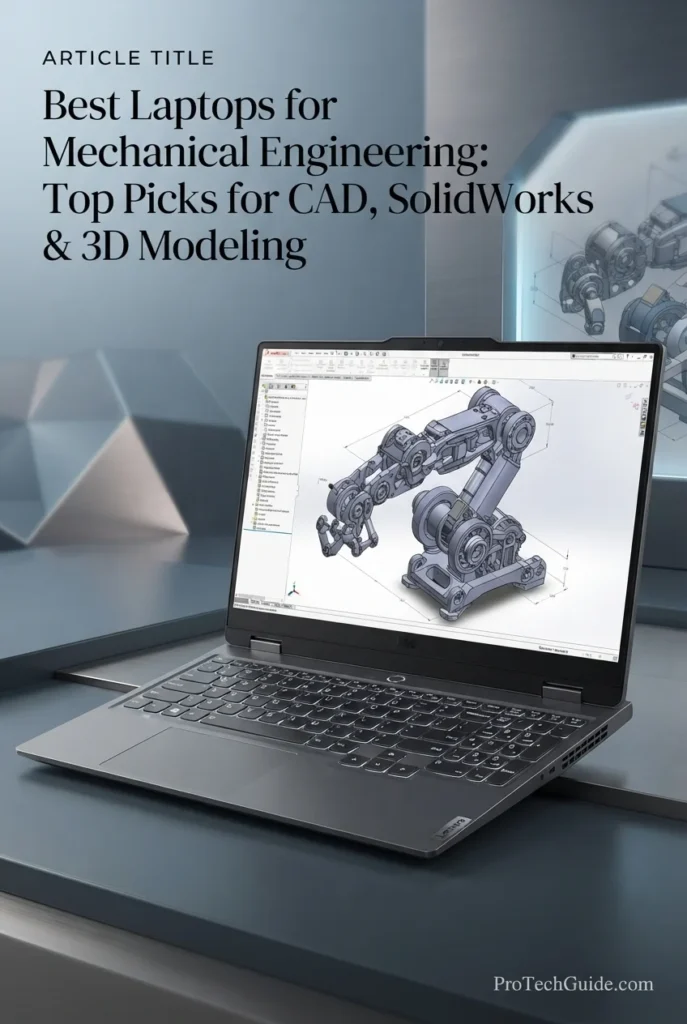
The Lenovo LOQ 15 with the AMD Ryzen 7 8845HS, NVIDIA GeForce RTX 4060, 64GB of DDR5 memory, and 2TB PCIe SSD is our Best Budget Engineering Laptop for mechanical engineering in 2026. Its 8-core, 16-thread Ryzen processor, dedicated RTX 4060 graphics, unusually generous 64GB memory configuration, and 2TB storage provide a strong foundation for CAD, SolidWorks, 3D modeling, engineering visualization, technical documentation, and demanding multitasking. The combination is particularly compelling for engineering students and early-career professionals who need substantial hardware capacity without moving immediately into a traditional mobile workstation.

• Ideal for mechanical engineering students, CAD learners, engineering students, designers, and professionals who need strong hardware for demanding technical coursework and projects
• Excellent for AutoCAD, SolidWorks, Autodesk Inventor, Fusion 360, 3D CAD, mechanical assemblies, engineering visualization, and other Windows-based engineering workflows
• Particularly well suited to users who prioritize CPU/GPU performance, 64GB of memory, large local storage, and gaming capability over professional workstation certification and enterprise features
• The AMD Ryzen 7 8845HS provides 8 CPU cores and 16 threads with boost speeds up to 5.1GHz, giving the LOQ 15 strong processing capability for CAD operations, engineering applications, multitasking, and demanding student workloads
• 64GB of DDR5-5600 memory provides substantial headroom for SolidWorks assemblies, CAD projects, browsers, technical documentation, programming environments, and multiple engineering applications running simultaneously
• The NVIDIA GeForce RTX 4060 provides dedicated graphics capability for 3D modeling, viewport acceleration, visualization, rendering, and other GPU-intensive engineering workloads, while NVIDIA specifically positions RTX graphics as an accelerator for STEM applications including engineering
• The 15.6-inch Full HD display with a 144Hz refresh rate and NVIDIA G-SYNC provides a responsive workspace for CAD interfaces, technical drawings, 3D models, and everyday engineering work while also supporting smooth gaming and visual workflows
• The 2TB PCIe SSD provides substantial local capacity for engineering software, CAD assemblies, 3D assets, datasets, technical documentation, and project files without requiring external storage for everyday work
• Windows 11 Home, Wi-Fi 6, USB-C connectivity, a backlit keyboard, webcam privacy features, and upgraded thermal cooling create a practical platform for engineering school, home workstations, and general-purpose productivity

The Lenovo LOQ 15 earns our Best Budget Engineering Laptop award because its configuration places unusually strong emphasis on memory and storage capacity while retaining dedicated RTX graphics and a capable Ryzen 7 processor. The 64GB of DDR5 memory and 2TB SSD give engineering students substantial room for CAD applications, large project files, multitasking, and 3D assets, while the RTX 4060 provides dedicated GPU acceleration for visualization and 3D workloads. It is a performance-oriented alternative to entry-level laptops that rely exclusively on integrated graphics.

Compared with professional mobile workstations such as the Lenovo ThinkPad P16v Gen 3 and HP ZBook Power G11, the LOQ 15 takes a more performance-focused consumer approach. Its GeForce RTX 4060, 64GB memory configuration, 2TB SSD, and gaming-oriented display prioritize practical performance and capacity rather than professional RTX PRO graphics, enterprise management, or workstation-specific certification. For engineering users who require certified hardware and drivers for supported applications, a professional workstation remains the more appropriate platform; for students and users who prioritize performance and flexibility, the LOQ provides a capable Windows-based foundation.

• AMD Ryzen 7 8845HS• 8 CPU cores• 16 threads• Up to 5.1GHz boost clock• 3.8GHz base clock• Zen 4 architecture• 16MB L3 cache• 45W default TDP• 35-54W configurable TDPThe AMD Ryzen 7 8845HS provides the processing foundation for the Lenovo LOQ 15's engineering workloads. Its 8 cores and 16 threads provide strong capacity for CAD applications, engineering software, browsers, documentation, programming environments, and multitasking. With boost speeds up to 5.1GHz, the processor is also well suited to operations that benefit from strong individual-core performance. AMD specifies a 45W default TDP and a configurable 35-54W range for this processor.
• NVIDIA GeForce RTX 4060 Laptop GPU• 6GB GDDR6 listed for this configuration• Dedicated NVIDIA graphics• Hardware-accelerated ray tracing• CUDA acceleration• AI acceleration• GPU-accelerated 3D workflows• NVIDIA GeForce RTX platformThe dedicated GeForce RTX 4060 gives the LOQ 15 a substantially stronger graphics foundation for 3D engineering work than an integrated-GPU laptop. It can accelerate 3D modeling, visualization, rendering, viewport workloads, and other graphics-intensive applications. NVIDIA's RTX 4060 Laptop GPU specification lists 8GB GDDR6 for the reference GPU, but the specific Amazon configuration supplied for this article lists 6GB of graphics memory; this section therefore follows the advertised configuration rather than combining specifications from another LOQ variant. NVIDIA also identifies GeForce RTX laptops as accelerators for STEM applications, including engineering.
• 64GB DDR5 memory• DDR5-5600• Two memory slots listed for this configuration• Dual-channel capable platform• High-capacity system memory• Strong multitasking headroom• Suitable for large CAD projects• Useful for complex engineering workflowsThe 64GB memory configuration is one of the Lenovo LOQ 15's most important advantages for mechanical engineering. It provides substantial capacity for SolidWorks assemblies, CAD applications, browsers, technical documentation, programming tools, spreadsheets, and multiple engineering applications operating simultaneously. This is especially useful for students and professionals who routinely move between several applications during engineering projects.
• SolidWorks• AutoCAD• Autodesk Inventor• Fusion 360• 3D CAD• Mechanical assemblies• Parametric modeling• Engineering visualization• Technical design• 3D renderingThe Ryzen 7 8845HS, RTX 4060, and 64GB memory create a capable hardware foundation for demanding student and professional CAD workflows. Autodesk recommends 32GB of RAM and an 8GB GPU for its recommended AutoCAD 2026 configuration, while SOLIDWORKS 2026 recommends 32GB of RAM and certified graphics hardware for supported professional configurations. The LOQ's 64GB memory provides substantial capacity, but its GeForce RTX graphics should not be treated as equivalent to an application-certified professional workstation GPU. Users who require formal SOLIDWORKS certification should verify the exact system and driver combination through the SOLIDWORKS certification database.
• 15.6-inch display• 1920 × 1080 resolution• Full HD• 16:9 aspect ratio• 144Hz refresh rate• NVIDIA G-SYNC• LED display technology• 100% color gamut listed by the Amazon configuration• External HDMI display supportThe 15.6-inch Full HD display provides a practical workspace for CAD interfaces, technical drawings, engineering documentation, 3D models, and everyday productivity. Its 144Hz refresh rate and NVIDIA G-SYNC technology are primarily performance-oriented features, but they can also make viewport navigation, scrolling, and general interaction feel smooth. The 1920 × 1080 resolution is less expansive than the higher-resolution panels found on premium workstations, making external displays useful for engineers who need additional workspace for complex CAD interfaces.
• 2TB PCIe SSD• NVMe solid-state storage• Fast application loading• Rapid project access• Suitable for large CAD assemblies• Space for 3D assets• Suitable for engineering applications• Large local project capacityThe 2TB PCIe SSD gives the LOQ 15 substantial local storage for engineering software, CAD projects, SolidWorks files, 3D models, technical documentation, datasets, and project archives. The exact Amazon configuration used here is the 64GB RAM / 2TB PCIe SSD version. The listing also offers a separate 4TB variant, but that configuration is not the one covered in this guide.
• Windows 11 Home• Wi-Fi 6 / 802.11ax• Bluetooth• USB connectivity• USB-C• HDMI• Ethernet connectivity• Webcam with E-shutter• External display supportWindows 11 Home provides broad compatibility with the Windows-based engineering software ecosystem. The LOQ 15 also provides Wi-Fi 6, USB-C, HDMI, Ethernet, Bluetooth, and support for external peripherals and displays, making it practical for engineering classrooms, home workstations, laboratories, and desk-based project environments. The webcam's E-shutter adds a useful privacy feature for students and professionals using the laptop for remote meetings and coursework.
• 15.6-inch chassis• Approximately 4.95 pounds for this configuration• Backlit keyboard• Upgraded thermal cooling technology• 60Wh battery• 14.16 × 10.49 × 0.86-inch dimensions listed• Gaming-oriented chassis• Performance-focused designThe Lenovo LOQ 15 is designed as a performance-oriented laptop rather than an ultraportable workstation. At approximately 4.95 pounds in the supplied configuration, it remains practical for carrying between classes, home, and engineering labs, although its gaming-oriented design is less focused on mobility than premium professional workstations. The 60Wh battery and upgraded thermal cooling system support its high-performance hardware platform, while the backlit keyboard makes it practical for longer engineering and study sessions.
Ideal for:• Mechanical engineering students• CAD students• SolidWorks users• AutoCAD users• Autodesk Inventor users• Fusion 360 users• Engineering coursework• 3D modeling• Mechanical assemblies• Engineering visualization• Technical documentation• Users who need 64GB of RAM• Users who need 2TB of storage• Engineering users who also gameThe Lenovo LOQ 15 is particularly well suited to mechanical engineering students and budget-conscious users who need substantial memory, storage, and dedicated graphics for CAD and 3D workflows. Its Ryzen 7 8845HS, RTX 4060, 64GB DDR5 memory, 2TB PCIe SSD, and 144Hz G-SYNC display provide a capable platform for engineering coursework, CAD projects, visualization, and multitasking. Users whose professional workflow requires certified workstation graphics should instead verify the relevant software certification requirements before choosing a GeForce-based system.
Best Entry-Level Professional Workstation (2026)

HP ZBook Power G11 A Mobile Workstation

Professional Workstation for CAD, SolidWorks & Engineering Workflows
The HP ZBook Power G11 A with the AMD Ryzen 7 PRO 8845HS, NVIDIA RTX 1000 Ada 6GB, 32GB of DDR5 memory, and 1TB PCIe NVMe SSD is our Best Entry-Level Professional Workstation for mechanical engineering in 2026. Its 8-core, 16-thread Ryzen PRO processor, professional RTX 1000 Ada graphics, 32GB of memory, and 16-inch WUXGA display create a capable foundation for CAD, SolidWorks, AutoCAD, 3D modeling, engineering visualization, simulation-oriented workflows, and demanding professional multitasking. The configuration is particularly attractive to engineers and advanced students who want workstation-class graphics and professional Windows features without moving into a larger or more expensive high-end mobile workstation.

• Ideal for mechanical engineering students, professional engineers, CAD designers, architects, technical professionals, and advanced users who need a dedicated mobile workstation for demanding engineering applications
• Excellent for SolidWorks, AutoCAD, 3D CAD, mechanical assemblies, 3D modeling, technical visualization, engineering documentation, and simulation-oriented professional workflows
• Particularly well suited to users who prioritize professional workstation graphics, Windows 11 Pro, business-oriented security, connectivity, and portability over the gaming-focused features of conventional performance laptops
• The AMD Ryzen 7 PRO 8845HS provides 8 CPU cores and 16 threads with boost speeds up to 5.1GHz, delivering strong processing capability for CAD operations, engineering applications, multitasking, technical analysis, and demanding professional workloads
• The NVIDIA RTX 1000 Ada provides 6GB of dedicated GDDR6 professional graphics memory, giving the ZBook Power G11 A a workstation-oriented graphics platform for CAD, 3D modeling, visualization, rendering, and other GPU-accelerated engineering workloads
• 32GB of DDR5 memory provides a solid professional capacity for SolidWorks assemblies, CAD projects, engineering applications, browsers, technical documentation, and multitasking across multiple professional tools
• The 16-inch WUXGA display provides a 1920 × 1200 workspace with 400-nit brightness and anti-glare technology in this configuration, creating a practical environment for CAD interfaces, technical drawings, documentation, and engineering applications
• The 1TB PCIe NVMe SSD provides responsive storage for engineering applications, CAD projects, 3D assets, technical documentation, datasets, and professional project files while maintaining fast application and file access
• Windows 11 Pro, dual Thunderbolt 4, HDMI 2.1, Ethernet, Wi-Fi 6E, fingerprint authentication, a backlit keyboard, and a numeric keypad create a professional platform suited to engineering offices, classrooms, laboratories, and mobile work environments

The ZBook Power G11 A earns our Best Entry-Level Professional Workstation award because it combines a professional NVIDIA RTX 1000 Ada GPU with the Ryzen 7 PRO 8845HS, 32GB of DDR5 memory, 1TB SSD storage, and Windows 11 Pro in a relatively portable 16-inch workstation platform. It is particularly well suited to engineers who want the advantages of professional workstation graphics and business-focused features without stepping into the larger configurations and higher component tiers of premium mobile workstations.

Compared with performance-focused laptops such as the Lenovo LOQ 15 and Lenovo Legion Pro 5i Gen 10, the ZBook Power G11 A takes a more specialized workstation approach. Its NVIDIA RTX 1000 Ada professional graphics, Ryzen PRO processor, Windows 11 Pro environment, enterprise-oriented security features, and workstation platform are designed around professional engineering workflows rather than gaming performance. Compared with higher-tier workstations such as the Lenovo ThinkPad P16v Gen 3, it uses a lower-tier professional GPU and a more modest CPU configuration, making it a practical entry point into the mobile-workstation category. Users who require formal application certification should verify the exact system and driver combination with the software vendor.

• AMD Ryzen 7 PRO 8845HS• 8 CPU cores• 16 threads• Up to 5.1GHz boost clock• 3.8GHz base clock• 16MB L3 cache• AMD Ryzen PRO platform• Zen 4 architectureThe AMD Ryzen 7 PRO 8845HS provides the processing foundation for the ZBook Power G11 A's professional engineering workloads. Its 8 cores and 16 threads provide strong capacity for CAD applications, engineering software, browsers, documentation, programming environments, and multitasking. With boost speeds up to 5.1GHz, the processor is also well suited to engineering operations that benefit from strong individual-core performance alongside multi-core capability.
• NVIDIA RTX 1000 Ada Generation• 2,560 CUDA cores• 6GB GDDR6 memory• 192GB/s memory bandwidth• 96-bit memory interface• Third-generation RT Cores• Fourth-generation Tensor Cores• Professional NVIDIA RTX architectureThe NVIDIA RTX 1000 Ada is the defining graphics component of the ZBook Power G11 A. Its professional RTX architecture provides dedicated graphics capability for CAD, 3D modeling, visualization, rendering, and other GPU-accelerated engineering workflows. The 6GB GDDR6 configuration provides a practical amount of dedicated graphics memory for professional applications, while the RTX workstation platform differentiates this system from conventional GeForce-based performance laptops.
• 32GB DDR5 memory• DDR5-4800 listed for this configuration• Two SODIMM memory slots• Dual-channel capable platform• 32GB installed capacity• Up to 64GB listed for this configuration• Strong multitasking headroom• Suitable for professional CAD workflowsThe 32GB memory configuration provides a strong starting point for mechanical engineering applications. It gives users practical capacity for SolidWorks assemblies, CAD software, engineering documentation, browsers, spreadsheets, communication tools, and other applications running simultaneously. The ZBook Power G11 A platform also provides two SODIMM slots, giving users an upgrade path when larger projects or more demanding multitasking requirements justify additional memory.
• SolidWorks• AutoCAD• 3D CAD• Mechanical assemblies• Parametric modeling• Engineering visualization• Technical design• 3D rendering• Simulation-oriented workloads• Professional workstation workflowsThe combination of the Ryzen 7 PRO 8845HS, RTX 1000 Ada, and 32GB of memory gives the ZBook Power G11 A a solid foundation for professional CAD and engineering workflows. The system is particularly suited to mechanical design, detailed 3D models, assemblies, visualization, technical documentation, and simulation-oriented applications. SOLIDWORKS 2026 recommends 32GB of RAM and requires certified graphics cards and drivers for certified configurations, so users who depend on formal certification should verify the exact ZBook system and driver combination through the SOLIDWORKS hardware certification database.
• 16-inch display• 1920 × 1200 resolution• 16:10 aspect ratio• IPS technology• 400-nit brightness• Anti-glare coating• WUXGA resolution• Professional engineering workspace• External display supportThe 16-inch WUXGA display provides a practical workspace for CAD interfaces, technical drawings, engineering documentation, 3D models, and everyday professional work. Its 1920 × 1200 resolution and 16:10 aspect ratio provide additional vertical workspace compared with conventional 16:9 Full HD panels, while the 400-nit brightness and anti-glare treatment make the display suitable for varied office, classroom, laboratory, and mobile environments.
• 1TB PCIe NVMe SSD• M.2 solid-state storage• Fast application launches• Responsive CAD project access• Suitable for engineering documentation• Space for 3D project files• Suitable for professional applications• Additional storage configurations availableThe 1TB SSD provides a practical amount of local storage for engineering applications, CAD assemblies, SolidWorks projects, technical documentation, 3D models, datasets, and professional files. The supplied Amazon configuration is the 32GB RAM / 1TB SSD version, while the listing also offers higher-memory and higher-capacity variants that are not the configuration covered in this guide.
• Windows 11 Pro• Professional workstation platform• AMD Ryzen PRO processor• Fingerprint reader• 5MP IR privacy-shutter webcam• Enterprise-oriented security features• BitLocker support• Remote Desktop support• Professional engineering software ecosystemWindows 11 Pro provides the operating environment required by major Windows-based engineering applications while adding professional security and management capabilities. The ZBook Power G11 A combines Windows 11 Pro with a Ryzen PRO processor, fingerprint authentication, a privacy-shutter webcam, and a professional workstation platform, making it particularly suitable for engineering departments, offices, laboratories, and managed business environments.
• Approximately 4.5-pound configuration• 14.15 × 9.88 × 0.9-inch dimensions listed• 2x Thunderbolt 4• 2x USB-A• HDMI 2.1• Ethernet RJ-45• SD card reader• Wi-Fi 6E• Bluetooth 5.3• Backlit keyboard• Numeric keypad• Fingerprint reader• Bundled 7-in-1 USB-C hubThe ZBook Power G11 A combines workstation hardware with a relatively practical mobile form factor. At approximately 4.5 pounds in the supplied configuration, it is substantially easier to carry than many larger desktop-replacement workstations. Its dual Thunderbolt 4 ports, HDMI 2.1, Ethernet, USB-A connectivity, SD card reader, Wi-Fi 6E, and bundled 7-in-1 USB-C hub provide the connectivity needed for external displays, storage, networking equipment, peripherals, and engineering workstation setups.
• Exact configuration: 32GB RAM / 1TB SSD• Brand-new computer according to the listing• Resealed for SSD upgrade• 1TB PCIe NVMe SSD• 3-year warranty on upgraded SSD from the marketplace seller• 1-year warranty on remaining components as listed• IST Computers 7-in-1 USB-C hub included• Configuration-specific marketplace purchaseThis particular ZBook Power G11 A should be treated as the exact marketplace configuration rather than a generic factory configuration. The Amazon listing states that the computer has been resealed to upgrade the SSD and specifies a three-year warranty from Issaquah Highlands Tech on the upgraded SSD, with a one-year warranty on the remaining components. The bundled USB-C hub is also part of this specific offer. These details apply to the listed configuration and should not automatically be assumed for every HP ZBook Power G11 A.
Ideal for:• Mechanical engineering students• Professional mechanical engineers• CAD engineers• SolidWorks users• AutoCAD users• Mechanical designers• Engineering firms• Architects and technical professionals• 3D modeling• Engineering visualization• Technical documentation• Simulation-oriented workflows• Users who need professional RTX graphics• Users who value Windows 11 Pro• Entry-level mobile workstation usersThe HP ZBook Power G11 A is particularly well suited to mechanical engineering students and professionals who want to enter the mobile-workstation category without choosing a larger, higher-tier workstation. Its Ryzen 7 PRO 8845HS, RTX 1000 Ada, 32GB DDR5 memory, 1TB SSD, Windows 11 Pro, and professional connectivity create a capable platform for CAD, SolidWorks, 3D modeling, visualization, and demanding engineering multitasking. Users who require formal application certification should verify the exact system and driver combination with the relevant software vendor before deployment.
At a Glance

Best Laptops for Mechanical Engineering in 2026

Ranked by CPU Performance, GPU Capability, CAD Performance, SolidWorks, 3D Modeling, RAM Capacity, Display Quality, Storage, Portability & Professional Workstation Features

Choosing the best laptop for mechanical engineering in 2026 requires more than comparing processor and GPU specifications. Engineering students and professionals need enough memory for large CAD assemblies, strong CPU performance for modeling and engineering applications, dedicated graphics for 3D visualization, fast storage for projects and software, a practical display for detailed technical work, and reliable compatibility with professional engineering software. We evaluated these laptops across real-world mechanical engineering workflows including AutoCAD, SolidWorks, Autodesk Inventor, Fusion 360, 3D modeling, visualization, engineering documentation, multitasking, and simulation-oriented workloads to help you choose the right platform for your specific engineering needs.

LaptopCPU & Key SpecsBest ForWhy It WinsEditor's Verdict
Best OverallASUS ProArt P16Check Price
Ryzen AI 9 HX 370
12-Core CPU / 24 Threads
64GB LPDDR5X
RTX 5070 8GB GDDR7
2TB PCIe 4.0 SSD
16" 4K OLED Touch
Mechanical Engineers
CAD Professionals
SolidWorks Users
3D Modeling
Engineering Visualization
The ProArt P16 combines a powerful Ryzen AI 9 HX 370 processor, RTX 5070 graphics, 64GB of memory, 2TB SSD storage, and a high-resolution 4K OLED touchscreen. It provides substantial performance headroom for CAD, SolidWorks, 3D modeling, visualization, rendering, and demanding multitasking while remaining versatile enough for creative and professional workloads beyond engineering.Best Overall Laptop for Mechanical Engineering
Best Professional WorkstationLenovo ThinkPad P16v Gen 3Check Price
Core Ultra 9 285H
16-Core CPU / 16 Threads
32GB DDR5
RTX PRO 2000 Blackwell 8GB
1TB PCIe SSD
16" WUXGA 500-Nit
Professional Engineers
CAD Workstations
SolidWorks Users
Engineering Firms
Enterprise Workflows
The ThinkPad P16v Gen 3 is built around a professional mobile-workstation platform with RTX PRO 2000 Blackwell graphics, a high-performance Core Ultra 9 processor, expandable DDR5 memory, Windows 11 Pro, and enterprise-oriented connectivity. It is particularly suited to engineers who prioritize professional graphics, workstation software support, expandability, and structured engineering workflows over gaming-focused features.Best Professional CAD Workstation
Best Performance ValueLenovo Legion Pro 5i Gen 10Check Price
Core Ultra 9 275HX
24-Core CPU / 24 Threads
32GB DDR5
RTX 5070 8GB GDDR7
2TB SSD
16" 2560×1600 OLED 165Hz
CAD Students
SolidWorks Users
3D Modeling
Rendering
Performance-Focused Engineers
The Legion Pro 5i Gen 10 delivers exceptional processing and graphics capability through its 24-core Core Ultra 9 275HX and RTX 5070 combination. With 32GB of RAM, 2TB of storage, and a high-resolution OLED display, it provides substantial performance for CAD, 3D modeling, visualization, rendering, and demanding multitasking without requiring a traditional professional workstation platform.Best Performance Value for Mechanical Engineering
Best Premium WorkstationLenovo ThinkPad P1 Gen 8Check Price
Core Ultra 9 285H
16-Core CPU / 16 Threads
64GB LPDDR5X
RTX PRO 2000 Blackwell 8GB
2TB PCIe 5.0 SSD
16" 3.2K OLED Touch
Professional Engineers
Mobile Workstations
Large CAD Assemblies
3D Visualization
Premium Workflows
The ThinkPad P1 Gen 8 combines professional RTX PRO graphics with 64GB of memory, a powerful Core Ultra 9 processor, PCIe 5.0 storage, and a premium 3.2K OLED touchscreen. Its combination of workstation-class hardware, high memory capacity, advanced connectivity, and refined mobile design makes it particularly suitable for engineers who need professional capability in a more premium portable platform.Best Premium Portable Workstation
Best CompactASUS ROG Zephyrus G14Check Price
Ryzen 9 270
8-Core CPU
16GB DDR5
RTX 5060 8GB
1TB SSD
14" 2.8K OLED 120Hz
Engineering Students
Mobile Engineers
CAD Users
3D Modeling
Frequent Travelers
The Zephyrus G14 combines a compact 14-inch form factor with Ryzen 9 processing, RTX 5060 graphics, a 2.8K OLED display, and 1TB of storage. Its smaller footprint makes it particularly attractive to engineering students and professionals who frequently move between classrooms, laboratories, offices, and home while still needing dedicated graphics for CAD and 3D workflows.Best Compact Engineering Laptop
Best Gaming LaptopAcer Predator Helios Neo 16S AICheck Price
Core Ultra 9 275HX
24-Core CPU / 24 Threads
64GB DDR5
RTX 5060 8GB
1TB SSD
16" 2560×1600 OLED 240Hz
Engineering Students
3D Modeling
CAD & Visualization
GPU-Intensive Workloads
Engineering + Gaming
The Predator Helios Neo 16S AI combines a 24-core Core Ultra 9 275HX processor with 64GB of DDR5 memory, RTX 5060 graphics, 1TB SSD storage, and a high-resolution 240Hz OLED display. Its substantial memory capacity and performance-oriented hardware make it well suited to demanding CAD, 3D modeling, visualization, rendering, and multitasking while also serving as a capable gaming platform.Best Gaming Laptop for Engineering
Best BudgetLenovo LOQ 15 Gaming LaptopCheck Price
Ryzen 7 8845HS
8-Core CPU / 16 Threads
64GB DDR5-5600
RTX 4060 6GB*
2TB PCIe SSD
15.6" FHD 144Hz G-SYNC
Engineering Students
CAD Coursework
SolidWorks Users
3D Modeling
Value-Focused Users
The Lenovo LOQ 15 provides an unusually generous 64GB memory and 2TB storage configuration alongside a Ryzen 7 8845HS processor and dedicated RTX 4060 graphics. It is particularly practical for engineering students who need substantial capacity for CAD software, SolidWorks projects, 3D assets, technical documentation, and multitasking without choosing a traditional professional workstation.Best Budget Engineering Laptop
Best Entry-Level WorkstationHP ZBook Power G11 ACheck Price
Ryzen 7 PRO 8845HS
8-Core CPU / 16 Threads
32GB DDR5
RTX 1000 Ada 6GB
1TB PCIe NVMe SSD
16" WUXGA 400-Nit
Engineering Students
CAD Professionals
SolidWorks Users
Entry-Level Workstations
Professional Windows Workflows
The HP ZBook Power G11 A combines a Ryzen 7 PRO processor, professional RTX 1000 Ada graphics, 32GB of DDR5 memory, 1TB SSD storage, and Windows 11 Pro in a relatively portable workstation platform. Its professional GPU architecture, business-focused security, extensive connectivity, and workstation design make it a practical entry point for engineers who need more than a conventional consumer laptop.Best Entry-Level Professional Workstation
Keep Exploring

Recommended Next Reads

Finished comparing the best laptops for mechanical engineering? Explore our related buying guides for CAD, 3D modeling, engineering students, GPU performance, professional workstations, and laptop value.

Whether you're choosing a laptop for SolidWorks and AutoCAD, moving into advanced 3D modeling, comparing professional workstation graphics, or simply looking for the right balance of performance and price, these guides can help you make a more informed decision for your engineering workflow.

01

EDITOR'S FINAL RECOMMENDATIONS

Our Final Mechanical Engineering Laptop Recommendations for 2026

After comparing laptops across CPU performance, GPU capability, RAM capacity, CAD workloads, SolidWorks, 3D modeling, visualization, simulation, display quality, storage, thermals, portability, workstation features, software compatibility, and long-term value, these are our final recommendations for mechanical engineering in 2026. Whether you are an engineering student building your first CAD projects, a professional working with complex assemblies, or an engineer who needs workstation-class graphics and certified hardware support, there is an option here for your specific workflow.

BEST PROFESSIONAL WORKSTATION

Lenovo ThinkPad P16v Gen 3

The professional workstation choice for engineers who prioritize workstation-oriented hardware, professional graphics, business-class features, and demanding CAD workflows. Its Core Ultra 9 285H processor, RTX PRO 2000 Blackwell GPU, 32GB of DDR5 memory, and 1TB PCIe 5.0 SSD provide a strong foundation for professional CAD, SolidWorks, engineering applications, 3D visualization, and technical workloads where professional GPU support can matter. Users who specifically require certified hardware should verify certification for their exact application and configuration.

  • ✓ Intel Core Ultra 9 285H with vPro
  • ✓ NVIDIA RTX PRO 2000 Blackwell 8GB GDDR7
  • ✓ 32GB DDR5 Memory
  • ✓ 1TB PCIe 5.0 NVMe SSD
  • ✓ 16-inch WUXGA 500-nit 100% sRGB Display
Best professional mobile workstation for CAD and engineering applications
BEST PERFORMANCE VALUE

Lenovo Legion Pro 5i Gen 10

The performance-focused choice for engineers who want high-end CPU and GPU capability without moving to a traditional mobile workstation. Its Core Ultra 9 275HX and GeForce RTX 5070 provide substantial performance for CAD, 3D modeling, visualization, rendering, and demanding multitasking, while 32GB of RAM and a 2TB SSD give the system enough headroom for large engineering projects and applications.

  • ✓ Intel Core Ultra 9 275HX, 24 cores
  • ✓ NVIDIA GeForce RTX 5070 8GB GDDR7
  • ✓ 32GB DDR5 Memory
  • ✓ 2TB SSD Storage
  • ✓ 16-inch 2560 × 1600 OLED 165Hz Display
Best performance-focused laptop for demanding CAD and 3D workloads
BEST PREMIUM WORKSTATION

Lenovo ThinkPad P1 Gen 8

The premium workstation choice for engineers who want professional graphics capability in a more refined and portable platform. The ThinkPad P1 Gen 8 pairs a Core Ultra 9 285H processor with RTX PRO 2000 Blackwell graphics, 64GB of memory, a 2TB Gen5 SSD, and a high-resolution 3.2K OLED touchscreen. It is particularly well suited to engineers who move between CAD, visualization, technical design, multitasking, and professional productivity.

  • ✓ Intel Core Ultra 9 285H
  • ✓ NVIDIA RTX PRO 2000 Blackwell 8GB
  • ✓ 64GB LPDDR5X Memory
  • ✓ 2TB PCIe Gen5 Performance SSD
  • ✓ 16-inch 3.2K OLED Touch Display
Best premium portable workstation for professional engineering
BEST COMPACT

ASUS ROG Zephyrus G14

The compact choice for engineering students and professionals who need serious graphics performance without carrying a large 15- or 16-inch workstation. Its Ryzen 9 270 processor, RTX 5060 graphics, 16GB of memory, and 14-inch 2.8K OLED display create a highly portable platform for CAD, SolidWorks, 3D modeling, technical coursework, and everyday engineering productivity. Its 16GB configuration is better suited to moderate engineering projects than exceptionally large assemblies or heavily multitasked workflows.

  • ✓ AMD Ryzen 9 270, 8 cores
  • ✓ NVIDIA GeForce RTX 5060 8GB
  • ✓ 16GB Memory
  • ✓ 1TB SSD Storage
  • ✓ 14-inch 2.8K OLED 120Hz Display
Best compact laptop for portable CAD and engineering work
BEST GAMING LAPTOP

Acer Predator Helios Neo 16S AI

The gaming-oriented performance choice for engineers who want strong CPU and GPU capability, a large high-refresh OLED display, and generous memory for demanding engineering workloads. Its Core Ultra 9 275HX, RTX 5060, and 64GB of DDR5 memory provide a powerful platform for CAD, 3D modeling, visualization, rendering, and multitasking. The GeForce platform is performance-focused rather than workstation-certified, making it a different proposition from the ThinkPad and ZBook systems.

  • ✓ Intel Core Ultra 9 275HX, 24 cores
  • ✓ NVIDIA GeForce RTX 5060 8GB
  • ✓ 64GB DDR5 Memory
  • ✓ 1TB SSD Storage
  • ✓ 16-inch 2560 × 1600 OLED 240Hz G-SYNC Display
Best gaming laptop for demanding engineering workloads
BEST BUDGET

Lenovo LOQ 15 Gaming Laptop

The budget-focused engineering choice for students and early-career engineers who want substantial performance and memory capacity without moving into premium workstation pricing. The Ryzen 7 8845HS, RTX 4060, 64GB of RAM, and 2TB SSD create a capable platform for CAD, SolidWorks, 3D modeling, engineering coursework, and everyday technical workloads. It is especially attractive when performance and storage capacity matter more than workstation-class graphics certification or premium materials.

  • ✓ AMD Ryzen 7 8845HS, 8 cores / 16 threads
  • ✓ NVIDIA GeForce RTX 4060 Graphics
  • ✓ 64GB DDR5 Memory
  • ✓ 2TB PCIe SSD Storage
  • ✓ 15.6-inch FHD 144Hz G-SYNC Display
Best budget laptop for CAD, SolidWorks and engineering students
BEST ENTRY-LEVEL WORKSTATION

HP ZBook Power G11 A

The entry-level professional workstation choice for engineers who want a business-focused platform with professional NVIDIA graphics and Windows 11 Pro. Its Ryzen 7 PRO 8845HS, RTX 1000 Ada graphics, 32GB of DDR5 memory, and 1TB SSD provide a solid foundation for CAD, SolidWorks, engineering applications, technical documentation, and professional productivity. Its workstation-oriented design makes it a natural step up from mainstream consumer laptops when professional hardware features are more important than maximum gaming performance.

  • ✓ AMD Ryzen 7 PRO 8845HS
  • ✓ NVIDIA RTX 1000 Ada Graphics
  • ✓ 32GB DDR5 Memory
  • ✓ 1TB SSD Storage
  • ✓ 16-inch FHD+ Display with Windows 11 Pro
Best entry-level professional workstation for CAD and engineering
QUICK DECISION

Which mechanical engineering laptop should you choose?

Best Overall

ASUS ProArt P16

Best Professional Workstation

ThinkPad P16v Gen 3

Best Performance Value

Legion Pro 5i Gen 10

Best Premium Workstation

ThinkPad P1 Gen 8

Best Compact

ROG Zephyrus G14

Best Gaming

Predator Helios Neo 16S AI

Best Budget

Lenovo LOQ 15

Best Entry-Level Workstation

HP ZBook Power G11 A

Laptop prices, configurations, and availability can change frequently. Before purchasing, check Amazon for the latest price, available memory and storage configurations, warranty coverage, and current promotions. For professional engineering applications, also verify the software vendor's current hardware certification and driver requirements for your exact laptop configuration.

EDITOR'S FINAL VERDICT

Final Verdict: Best Laptops for Mechanical Engineering in 2026

After comparing processor performance, GPU capability, RAM capacity, CAD workloads, SolidWorks, 3D modeling, visualization, simulation, display quality, storage, portability, thermals, connectivity, workstation features, software compatibility, and long-term value, one conclusion stands out:The best laptop for mechanical engineering is not necessarily the laptop with the most powerful processor or the most expensive professional GPU. It is the system that provides the right balance of CPU performance, graphics capability, memory, storage, display quality, software compatibility, portability, and reliability for the engineering workloads you actually perform.

Modern mechanical engineering workflows can span AutoCAD, SolidWorks, Autodesk Inventor, Fusion 360, 3D CAD, complex assemblies, technical drawings, rendering, visualization, simulation preparation, engineering documentation, and demanding multitasking. These workloads benefit from strong CPU performance and sufficient memory, while GPU requirements become increasingly important as projects move from conventional 2D CAD into detailed 3D models, real-time visualization, rendering, and GPU-accelerated workflows.

For most mechanical engineering students and professionals, 32GB of RAM is a strong long-term target, while 16GB can remain suitable for moderate CAD workloads and lighter engineering projects. For larger assemblies, advanced 3D modeling, simulation-related workloads, visualization, and heavy multitasking, 64GB provides substantially more headroom. GPU selection also deserves careful attention: GeForce RTX laptops can deliver excellent graphics performance, while professional RTX PRO and RTX workstation platforms are more relevant when certified hardware, drivers, and application-specific workstation support are important requirements.
Best Mechanical Engineering Laptop OverallHIDevolution ASUS ProArt P16
Best Professional CAD WorkstationLenovo ThinkPad P16v Gen 3
Best Performance ValueLenovo Legion Pro 5i Gen 10
Best Premium WorkstationLenovo ThinkPad P1 Gen 8
The simple answer:
  • Choose the ASUS ProArt P16 if you want the strongest overall combination of CPU performance, RTX graphics, 64GB of memory, 2TB of storage, a premium 4K OLED display, and versatility across CAD, SolidWorks, 3D modeling, visualization, and demanding engineering multitasking.
  • Choose the Lenovo ThinkPad P16v Gen 3 if your engineering workflow places greater importance on a professional mobile-workstation platform, RTX PRO graphics, business-class features, and workstation-oriented CAD workloads. If your software requires certified hardware or drivers, verify the exact configuration through the application's current certification requirements.
  • Choose the Lenovo Legion Pro 5i Gen 10 if raw CPU and GPU performance are your priority and you do not specifically require a traditional mobile workstation. Its Core Ultra 9 275HX, RTX 5070, 32GB of RAM, and 2TB SSD make it a strong platform for demanding CAD, 3D modeling, visualization, rendering, and multitasking.
  • Choose the Lenovo ThinkPad P1 Gen 8 if you want premium mobile-workstation hardware, RTX PRO graphics, 64GB of memory, 2TB Gen5 storage, and a high-resolution OLED touchscreen in a more refined portable platform.

Top Mechanical Engineering Laptop Recommendations (2026)

BEST OVERALL

ASUS ProArt P16

Our Editor's Choice for mechanical engineering because it combines a high-performance Ryzen AI 9 HX 370 processor, GeForce RTX 5070 graphics, 64GB of memory, 2TB SSD storage, and a 16-inch 4K OLED touchscreen. This configuration provides substantial headroom for CAD, SolidWorks, 3D modeling, visualization, rendering, and demanding engineering multitasking.

  • ✓ AMD Ryzen AI 9 HX 370, 12 cores / 24 threads
  • ✓ NVIDIA GeForce RTX 5070 8GB GDDR7
  • ✓ 64GB LPDDR5X Memory
  • ✓ 2TB PCIe 4.0 NVMe SSD
BEST PROFESSIONAL WORKSTATION

Lenovo ThinkPad P16v Gen 3

The workstation-focused choice for engineers who prioritize professional graphics, business-class features, and a platform designed around demanding technical applications. Its Core Ultra 9 285H and RTX PRO 2000 Blackwell provide a different proposition from the GeForce-based systems in this guide, particularly for workflows where professional GPU support and application-specific certification matter.

  • ✓ Intel Core Ultra 9 285H with vPro
  • ✓ NVIDIA RTX PRO 2000 Blackwell 8GB GDDR7
  • ✓ 32GB DDR5 Memory
  • ✓ 1TB PCIe 5.0 NVMe SSD
BEST PERFORMANCE VALUE

Lenovo Legion Pro 5i Gen 10

The performance-focused alternative for engineers who want powerful CPU and GeForce RTX graphics without specifically needing a traditional professional workstation. Its Core Ultra 9 275HX, RTX 5070, 32GB of RAM, and 2TB SSD provide a strong foundation for demanding CAD, 3D modeling, visualization, rendering, and engineering multitasking.

  • ✓ Intel Core Ultra 9 275HX, 24 cores
  • ✓ NVIDIA GeForce RTX 5070 8GB GDDR7
  • ✓ 32GB DDR5 Memory
  • ✓ 2TB SSD Storage
Choose the ASUS ProArt P16 if:
  • ✓ You want the strongest overall balance for mechanical engineering workloads
  • ✓ You regularly work with CAD, SolidWorks, 3D modeling, visualization, and demanding multitasking
  • ✓ You want 64GB of memory and 2TB of storage for large projects and applications
  • ✓ You value a high-resolution 4K OLED touchscreen alongside strong CPU and GPU performance
Choose the ThinkPad P16v Gen 3 if:
  • ✓ Professional workstation hardware and RTX PRO graphics are important to your workflow
  • ✓ Your engineering applications benefit from workstation-oriented drivers or certified configurations
  • ✓ You want a business-focused mobile workstation with Windows 11 Pro and professional connectivity
  • ✓ CAD, SolidWorks, engineering applications, and technical productivity are more important than gaming-focused features
Before Buying Any Mechanical Engineering Laptop:
  • ✓ Prefer 32GB of RAM for demanding CAD workloads and long-term engineering use
  • ✓ Consider 16GB acceptable for students and moderate CAD projects, but leave additional headroom if you work with large assemblies
  • ✓ Choose 64GB when your workflow regularly involves complex assemblies, 3D modeling, visualization, simulation-related workloads, or heavy multitasking
  • ✓ Pay close attention to GPU capability when moving from 2D CAD into advanced 3D modeling, rendering, and visualization
  • ✓ Consider professional RTX PRO or workstation graphics when certified hardware and application-specific driver support are important requirements
  • ✓ Verify your engineering software's current CPU, GPU, RAM, driver, and certification requirements before purchasing
Editor's Final Recommendation:

A mechanical engineering laptop is a professional tool that may be used for thousands of hours across CAD projects, 3D assemblies, technical drawings, simulations, visualization, documentation, coursework, research, and engineering productivity. Raw processor specifications matter, but memory capacity, GPU capability, display quality, storage, keyboard and input comfort, connectivity, portability, thermals, and software compatibility can have an equally important impact on everyday engineering work.

Among the models evaluated in this guide, the HIDevolution ASUS ProArt P16 delivers the strongest overall combination of CPU performance, RTX 5070 graphics, 64GB of memory, 2TB storage, and a premium 4K OLED display, making it our Editor's Choice for the best laptop for mechanical engineering in 2026. It is particularly compelling for engineers who need one system capable of handling CAD, SolidWorks, 3D modeling, visualization, and demanding multitasking.The Lenovo ThinkPad P16v Gen 3 is the more workstation-focused choice for professionals who place greater importance on RTX PRO graphics and professional workstation features. The Lenovo ThinkPad P1 Gen 8 extends that workstation approach into a more premium portable design with 64GB of memory and a 3.2K OLED touchscreen, while the Lenovo Legion Pro 5i Gen 10 provides a high-performance GeForce platform for engineers who prioritize CPU and GPU performance without specifically requiring workstation-class hardware.

Editor's ChoiceSee Today's Best Mechanical Engineering Laptop Deals

Compare current prices, configurations, memory, storage, warranty coverage, and availability before choosing the laptop that best matches your CAD, SolidWorks, 3D modeling, and engineering workflow.

Check Latest Deals

EDITOR'S FAQ

Frequently Asked Questions About the Best Laptops for Mechanical Engineering in 2026

Choosing the best laptop for mechanical engineering requires more than comparing processor specifications. Engineering students and professionals need to consider CPU performance, GPU capability, RAM capacity, SSD storage, CAD and SolidWorks requirements, 3D modeling performance, display quality, software compatibility, portability, thermals, and whether a professional workstation or a high-performance GeForce laptop better matches their workflow.These frequently asked questions address the most important laptop decisions for mechanical engineering in 2026, from choosing the right system for SolidWorks and AutoCAD to determining how much RAM and GPU power you need for large assemblies, 3D modeling, visualization, simulation, engineering coursework, and professional CAD workloads.

The HIDevolution ASUS ProArt P16 is our top overall recommendation for mechanical engineering in 2026.

Its AMD Ryzen AI 9 HX 370 processor, NVIDIA GeForce RTX 5070 graphics, 64GB of memory, 2TB SSD, and 16-inch 4K OLED touchscreen create a powerful platform for CAD, SolidWorks, 3D modeling, visualization, rendering, engineering multitasking, and other demanding technical workflows.

  • Strong Ryzen AI 9 HX 370 processing performance with 12 cores and 24 threads.
  • NVIDIA GeForce RTX 5070 graphics with 8GB of GDDR7 memory.
  • 64GB of LPDDR5X memory for large projects and demanding multitasking.
  • 2TB PCIe 4.0 NVMe SSD for engineering applications and project files.
  • 16-inch 4K OLED touchscreen for detailed CAD models, drawings, documentation, and visualization.

For engineers who specifically need professional workstation graphics and application-specific certification, the Lenovo ThinkPad P16v Gen 3 and ThinkPad P1 Gen 8 provide a different workstation-oriented approach with NVIDIA RTX PRO graphics.

Check Price
32GB of RAM is the recommended target for demanding mechanical engineering workloads in 2026, while 16GB can be sufficient for students and moderate CAD projects.

Mechanical engineering workflows frequently involve CAD software, large assemblies, browsers, technical documentation, spreadsheets, simulation tools, communication applications, and other programs running simultaneously. Memory requirements increase quickly as assemblies and 3D projects become more complex.

  • 16GB → Suitable for engineering students, moderate CAD projects, basic 3D modeling, coursework, and lighter multitasking.
  • 32GB → Recommended for professional CAD, SolidWorks, larger assemblies, 3D modeling, engineering applications, and demanding multitasking.
  • 64GB or more → Best for very large assemblies, advanced 3D workflows, visualization, simulation-related workloads, virtual machines, and heavy professional multitasking.

In this guide, the ASUS ROG Zephyrus G14 represents the more compact 16GB configuration, while the ThinkPad P16v, Legion Pro 5i, and HP ZBook Power provide 32GB configurations. The ASUS ProArt P16, ThinkPad P1 Gen 8, Predator Helios Neo 16S AI, and Lenovo LOQ 15 provide 64GB configurations for users who need additional headroom.

Yes, 16GB can be enough for SolidWorks and AutoCAD when projects are moderate, but 32GB is a better long-term target for demanding engineering work.

Students working with individual parts, smaller assemblies, 2D drawings, coursework, and moderate 3D models can often work effectively with 16GB. However, memory pressure becomes more relevant when large assemblies, multiple applications, rendering, visualization, and extensive multitasking are involved.

  • 16GB can handle moderate AutoCAD and SolidWorks projects.
  • 16GB is appropriate for many engineering students and lighter coursework.
  • 32GB provides more comfortable headroom for larger assemblies and professional CAD workflows.
  • 64GB becomes valuable for complex assemblies, advanced 3D work, visualization, and heavy multitasking.
  • Memory requirements also depend on project complexity and the number of applications running simultaneously.

The ASUS ROG Zephyrus G14 in this guide uses 16GB and is therefore best positioned as a compact engineering system for moderate workloads. For heavier professional CAD use, the 32GB and 64GB configurations in the lineup provide more memory headroom.

Check Compact Option
A dedicated GPU is strongly recommended for demanding 3D CAD, visualization, rendering, and advanced engineering workflows, although the ideal GPU depends on the applications and projects you use.

Basic 2D CAD does not require the same graphics capability as complex 3D assemblies, real-time visualization, rendering, or other graphics-intensive engineering workflows. As project complexity increases, GPU capability becomes increasingly important.

  • Integrated graphics → Can be adequate for basic 2D CAD, technical documentation, and lighter engineering workloads.
  • GeForce RTX → Well suited to 3D modeling, visualization, rendering, CAD acceleration, and performance-focused engineering workloads.
  • Professional RTX graphics → More relevant when workstation-class hardware, certified drivers, and application-specific support are important requirements.

This is why the ASUS ProArt P16, Legion Pro 5i, Predator Helios Neo 16S AI, ROG Zephyrus G14, and Lenovo LOQ use GeForce RTX graphics, while the ThinkPad P16v, ThinkPad P1, and HP ZBook Power use professional NVIDIA workstation graphics. The distinction is not simply about which GPU is faster; it is also about the software ecosystem and certification requirements of the engineering workflow.

Yes. A modern gaming laptop can be an excellent mechanical engineering laptop when its CPU, GPU, RAM, storage, display, and cooling are appropriate for the engineering workloads you perform.

Gaming laptops often provide powerful processors and GeForce RTX GPUs at competitive prices, making them particularly attractive for CAD, 3D modeling, visualization, rendering, and engineering students. They can deliver substantial graphics performance without requiring a traditional mobile workstation.

  • Gaming laptops → Often provide strong CPU and GPU performance for CAD, 3D modeling, visualization, and rendering.
  • Mobile workstations → Better suited to professionals who require workstation-oriented features, professional graphics, certified drivers, or application-specific support.
  • Engineering students → Can benefit from gaming laptops when performance and value are more important than workstation certification.

The Lenovo Legion Pro 5i Gen 10 and Acer Predator Helios Neo 16S AI demonstrate how powerful GeForce-based gaming platforms can serve demanding engineering workloads. However, engineers whose software specifically depends on certified workstation hardware should consider a ThinkPad P16v, ThinkPad P1, or HP ZBook configuration instead.

Check Legion Pro 5i
A professional workstation can be preferable for SolidWorks when certified hardware, drivers, and application-specific support are important, while a high-performance gaming laptop can provide excellent raw performance for many users.

The choice depends on how SolidWorks is used. Professional workstations are designed around business and engineering applications and may offer professional GPU configurations, certified drivers, enterprise support, and other workstation-oriented features. Gaming laptops typically emphasize raw GeForce performance and performance-per-dollar.

  • Workstation → Better suited to professional environments where certified hardware and drivers are important.
  • Gaming laptop → Attractive for students and users who prioritize raw CPU/GPU performance, 3D visualization, and value.
  • Professional CAD workflow → Verify the exact SolidWorks hardware certification for the specific GPU, driver, and configuration before purchasing.

The Lenovo ThinkPad P16v Gen 3, ThinkPad P1 Gen 8, and HP ZBook Power G11 A represent the workstation side of this guide. The Legion Pro 5i, Predator Helios Neo 16S AI, and ASUS ProArt P16 represent performance-oriented GeForce alternatives.

Check ThinkPad P16v
1TB of SSD storage is a sensible starting point for professional mechanical engineering, while 2TB is preferable for users who maintain large local CAD and 3D projects.

Engineering laptops can accumulate CAD applications, SolidWorks files, assemblies, rendered assets, technical documentation, project backups, datasets, simulation files, and other large files. Storage requirements can therefore grow quickly over the life of the laptop.

  • 512GB → Acceptable for students with smaller projects who rely on external or cloud storage.
  • 1TB → Recommended for most engineering students and professionals.
  • 2TB → Better for large CAD libraries, 3D assets, extensive project archives, and professionals who keep substantial files locally.
  • 4TB or more → Useful for exceptionally storage-intensive professional workflows and large local project libraries.

A fast PCIe NVMe SSD is also important because it can improve application startup, project loading, file transfers, and general system responsiveness. Several laptops in this guide provide 2TB configurations, including the ASUS ProArt P16, Legion Pro 5i, ThinkPad P1 Gen 8, and Lenovo LOQ 15.

A 16-inch laptop is generally better for engineers who prioritize CAD workspace and large 3D models, while a 14-inch laptop is better for students and professionals who prioritize portability.
  • 14-inch → Best for engineers who frequently travel between classrooms, laboratories, offices, meetings, and home.
  • 16-inch → Better for CAD drawings, large 3D assemblies, technical documentation, split-screen workflows, and extended engineering sessions.

A larger display can make complex CAD interfaces, tool panels, drawings, reference material, and 3D models easier to manage. However, the additional size and weight may matter if the laptop is carried throughout the day.

The ASUS ROG Zephyrus G14 provides the compact 14-inch approach, while the ASUS ProArt P16, ThinkPad P16v, Legion Pro 5i, ThinkPad P1, Predator Helios Neo 16S AI, and HP ZBook Power G11 A provide larger displays better suited to extended engineering workflows.

Check 16-inch Engineering Option
The ASUS ProArt P16 and Lenovo ThinkPad P1 Gen 8 are particularly strong choices for large assemblies and demanding 3D engineering workflows, with the right choice depending on whether you prioritize GeForce performance or professional workstation graphics.

Large SolidWorks assemblies and complex 3D models can place significant demands on CPU performance, system memory, GPU capability, and storage. A laptop with 64GB of RAM provides substantially more headroom than a 16GB configuration when projects become complex and multiple engineering applications are open simultaneously.

  • ASUS ProArt P16 → Ryzen AI 9 HX 370, RTX 5070, 64GB RAM, and 2TB SSD for high-performance CAD and 3D workflows.
  • ThinkPad P1 Gen 8 → Core Ultra 9 285H, RTX PRO 2000 Blackwell, 64GB RAM, and 2TB Gen5 SSD for a professional workstation approach.
  • ThinkPad P16v Gen 3 → RTX PRO 2000 Blackwell and Core Ultra 9 285H for engineers who prioritize workstation-oriented hardware.

For professional SolidWorks environments, however, performance specifications should not be the only consideration. Verify the current SolidWorks hardware certification and driver requirements for the exact GPU and configuration you intend to purchase.

View ThinkPad P1
For most mechanical engineering students and professionals, the ASUS ProArt P16 is our best overall recommendation, but the right laptop depends on your CAD software, project complexity, workstation requirements, and portability needs.

There is no single engineering laptop that is ideal for every workflow. Your decision should be based on the CAD applications you use, assembly sizes, 3D modeling requirements, graphics needs, RAM capacity, storage requirements, and whether your professional environment requires certified workstation hardware.

  • Best Overall → HIDevolution ASUS ProArt P16
  • Best Professional Workstation → Lenovo ThinkPad P16v Gen 3
  • Best Performance Value → Lenovo Legion Pro 5i Gen 10
  • Best Premium Workstation → Lenovo ThinkPad P1 Gen 8
  • Best Compact → ASUS ROG Zephyrus G14
  • Best Gaming Laptop → Acer Predator Helios Neo 16S AI
  • Best Budget → Lenovo LOQ 15
  • Best Entry-Level Workstation → HP ZBook Power G11 A

If you want the strongest all-around platform for CAD, SolidWorks, 3D modeling, visualization, and demanding multitasking, the ASUS ProArt P16 remains our Editor's Choice. If professional workstation hardware is a priority, consider the ThinkPad P16v or ThinkPad P1. If performance-per-dollar is more important, the Legion Pro 5i provides a powerful GeForce RTX platform, while the ROG Zephyrus G14 offers the most compact approach in this lineup.

Check Best Overall Deal

MECHANICAL ENGINEERING LAPTOP BUYING GUIDE

Common Mistakes When Choosing a Mechanical Engineering Laptop in 2026

Choosing a laptop for mechanical engineering is not simply about buying the fastest processor or the most powerful graphics card. Engineering students and professionals need a system that can handle CAD software, SolidWorks assemblies, 3D modeling, engineering visualization, simulation workloads, large technical projects, and demanding multitasking while remaining reliable and practical for everyday use.The wrong laptop can become a daily limitation through insufficient RAM, weak graphics performance, inadequate storage, poor display quality, excessive weight, or hardware that is not appropriate for your engineering software. Avoid these common mistakes before choosing your next mechanical engineering laptop.

Editor's Insight

The best mechanical engineering laptop is rarely the one with the most impressive specification sheet. For CAD and engineering workflows, processor performance, GPU capability, memory capacity, SSD speed, display quality, cooling, portability, and software compatibility all matter. Professional workstation graphics can also provide an important advantage when certified hardware and drivers are required for supported engineering applications.For most mechanical engineering students and professionals in 2026, we recommend targeting 32GB of memory, fast SSD storage, a modern high-performance processor, and a capable dedicated GPU for demanding 3D workloads. Systems with 64GB of RAM become increasingly valuable for large assemblies, advanced 3D modeling, simulation, virtual machines, and heavy multitasking.

Choosing Only 16GB of RAM

  • Mechanical engineering workflows can involve SolidWorks, AutoCAD, Inventor, Fusion 360, browsers, spreadsheets, simulation tools, and other applications running simultaneously.
  • Large SolidWorks assemblies and detailed 3D models can consume substantially more memory than basic CAD projects.
  • Insufficient memory can reduce multitasking responsiveness and create limitations as engineering projects become more complex.

Better decision:Choose 32GB of memory as a strong target for professional mechanical engineering and demanding CAD work. A 16GB configuration can still be appropriate for students and moderate projects, while 64GB becomes valuable for large assemblies, advanced 3D modeling, simulation, virtual machines, and heavy multitasking.

Choosing a Laptop With Weak Graphics

  • Modern mechanical engineering workflows increasingly rely on dedicated graphics for 3D CAD, visualization, rendering, and complex models.
  • Integrated graphics can be sufficient for basic 2D CAD, but they become limiting for demanding 3D engineering workloads.
  • GPU capability can have a significant impact on viewport performance and other graphics-intensive engineering applications.

Better decision:Prioritize a capable dedicated GPU when your workflow includes 3D modeling, visualization, rendering, or demanding CAD assemblies. GeForce RTX GPUs can provide strong performance for performance-focused engineering laptops, while NVIDIA RTX PRO workstation GPUs are designed for professional workflows where certified hardware and drivers are important.

Ignoring SolidWorks and CAD Hardware Compatibility

  • SolidWorks supports certified graphics hardware and drivers for professional engineering workflows.
  • Not every gaming or consumer GPU configuration is certified for every professional CAD application.
  • Choosing hardware without checking software requirements can create compatibility or support limitations later.

Better decision:Check the hardware and driver requirements for the engineering applications you actually use. If certified graphics hardware is important to your workflow, consider a professional mobile workstation such as the Lenovo ThinkPad P16v Gen 3, ThinkPad P1 Gen 8, or HP ZBook Power G11 A, and verify certification for your specific application and configuration.

Choosing Too Little SSD Storage

  • Mechanical engineering projects can accumulate CAD files, SolidWorks assemblies, 3D models, simulation data, applications, libraries, and project backups.
  • A nearly full SSD can make project management increasingly inconvenient and reduce available working space.
  • Large engineering projects can require substantially more local storage than ordinary office documents.

Better decision:Target 1TB of SSD storage as a practical starting point for mechanical engineering. A 512GB SSD can work for lighter student workloads, while 2TB or more is preferable for large CAD libraries, extensive 3D projects, simulation data, and users who keep projects locally.

Buying More Performance Than Your Workflow Requires

  • Not every mechanical engineering student needs a workstation-class processor, professional RTX PRO graphics, or 64GB of memory.
  • Excess performance can increase purchase cost, weight, heat, and power consumption without providing a meaningful advantage for lighter CAD workloads.
  • A balanced laptop can provide better portability and value than a specification-heavy workstation when projects are relatively moderate.

Better decision:Match the hardware to the complexity of your engineering projects. A 32GB laptop with a modern high-performance CPU and dedicated RTX graphics is sufficient for many students and professionals. Move toward workstation-class hardware or 64GB of memory when your workflow genuinely requires large assemblies, advanced simulation, professional certification, or heavier multitasking.

Overlooking Display Size and Workspace

  • Mechanical engineers can spend hours working with CAD interfaces, drawings, assemblies, technical documentation, simulation results, and 3D models.
  • A small display can make detailed CAD interfaces and split-screen multitasking more difficult.
  • Larger displays provide additional workspace for toolbars, model trees, drawings, reference documents, and engineering applications.

Better decision:Choose a 14-inch laptop when portability is the priority and a 16-inch model when CAD workspace and multitasking matter more. If you primarily work at a desk, pairing the laptop with an external monitor can provide substantially more workspace for engineering applications.

Smart Buying Advice for Mechanical Engineers

Choose a professional workstation if:

You prioritize certified graphics hardware, professional drivers, workstation-oriented reliability, expandability, business features, and compatibility with demanding engineering applications. The Lenovo ThinkPad P16v Gen 3 and HP ZBook Power G11 A are particularly relevant when professional workstation hardware is more important than gaming-focused performance.

Choose a high-performance GeForce laptop if:

You want strong CAD, 3D modeling, visualization, and multitasking performance while also prioritizing performance per dollar. The Lenovo Legion Pro 5i Gen 10 and Acer Predator Helios Neo 16S AI offer powerful GeForce RTX platforms for demanding engineering workloads, although they should not automatically be treated as substitutes for certified professional workstations.

Key takeaway:The best mechanical engineering laptop is not necessarily the fastest or most expensive machine. It is the laptop that provides the right balance of CPU performance, dedicated GPU capability, memory capacity, SSD storage, display quality, cooling, portability, and software compatibility for the CAD, SolidWorks, 3D modeling, and simulation workloads you actually use.

After evaluating the laptops featured in this guide, these are our Editor's top recommendations for mechanical engineering in 2026:

  • Best Overall Mechanical Engineering Laptop:HIDevolution ASUS ProArt P16 — the strongest overall combination of Ryzen AI 9 HX 370 performance, RTX 5070 graphics, 64GB of memory, 2TB SSD storage, and a high-resolution 16-inch OLED display for demanding CAD, SolidWorks, 3D modeling, visualization, and professional multitasking.
  • Best Professional CAD Workstation:Lenovo ThinkPad P16v Gen 3 — a workstation-focused platform with Core Ultra 9 285H, NVIDIA RTX PRO 2000 Blackwell graphics, 32GB of memory, 1TB PCIe 5.0 storage, and Windows 11 Pro for users who prioritize professional graphics hardware and workstation-oriented features.
  • Best Performance Value:Lenovo Legion Pro 5i Gen 10 — a high-performance GeForce RTX platform combining the Core Ultra 9 275HX, RTX 5070, 32GB of RAM, and 2TB SSD storage for demanding CAD, 3D modeling, visualization, and engineering multitasking.
  • Best Premium Portable Workstation:Lenovo ThinkPad P1 Gen 8 — a premium mobile workstation with Core Ultra 9 285H, RTX PRO 2000 Blackwell graphics, 64GB of memory, 2TB PCIe 5.0 storage, and a 3.2K OLED touchscreen for engineers who need workstation-class capability in a more portable design.

Need help choosing your laptop?

Not sure which option fits your workflow? Get a personalized recommendation based on your budget, performance needs, and usage.

Get personalized recommendation

⚡ Usually responds within 24 hours