
Explore Our Best Laptops by Use Case
This guide to Best Laptops for Mechanical Engineering in 2026: 8 Top Picks for CAD, SolidWorks & 3D Modeling is part of our curated laptop recommendations by use case. Explore more expert comparisons and buying guides designed to help you choose the right laptop for mechanical engineering, CAD, SolidWorks, 3D modeling, simulation, technical design, productivity, and other demanding professional workloads.Best Laptops for Mechanical Engineering in 2026: 8 Top Picks for CAD, SolidWorks & 3D Modeling
The best laptop for mechanical engineering in 2026 is not simply the one with the fastest processor or most powerful GPU. The right choice depends on the CAD and engineering software you use, the complexity of your models and assemblies, how much 3D work or simulation you perform, and whether you need workstation-class hardware or the stronger performance-per-dollar offered by modern gaming and creator laptops.From AutoCAD and SolidWorks to Autodesk Inventor, Fusion 360, 3D modeling, rendering, and engineering simulation, today's laptops can deliver substantial performance across demanding technical workflows. For AutoCAD 2026, Autodesk recommends 32GB of RAM and an 8GB GPU for its recommended Windows configuration, while SOLIDWORKS 2026 recommends 32GB of RAM and certified graphics hardware for supported professional workflows.
In this guide, we've selected the best laptops for mechanical engineering in 2026 based on processor performance, GPU capability, RAM capacity, CAD and 3D performance, display quality, storage, cooling, portability, software requirements, professional graphics certification where applicable, and long-term value. We also considered the different ways engineering students and professionals actually use their laptops, from everyday CAD work and large assemblies to 3D modeling, visualization, simulation, and demanding multitasking.The ASUS ProArt P16 with Ryzen AI 9 HX 370, RTX 5070, 64GB of memory, and 2TB of storage takes our top position for its strong combination of CPU and GPU performance, generous memory, high-resolution OLED display, and versatility across engineering and creative workloads. The Lenovo ThinkPad P16v Gen 3 and HP ZBook Power G11 bring professional mobile-workstation features to engineers who prioritize certified graphics and business-focused reliability, while the Lenovo ThinkPad P1 Gen 8 combines workstation-class hardware with a more premium, portable design.For students and engineers who want high performance without moving into traditional workstation pricing, the Lenovo Legion Pro 5i Gen 10, Acer Predator Helios Neo 16S AI, and Lenovo LOQ 15 provide powerful GeForce RTX-based platforms for CAD, 3D modeling, visualization, and other demanding workloads. The ASUS ROG Zephyrus G14 completes the lineup with a more compact design for engineering students and professionals who place a higher priority on portability.
ASUS ProArt P16 H7606WP
Best Overall for CAD, SolidWorks & 3D Modeling
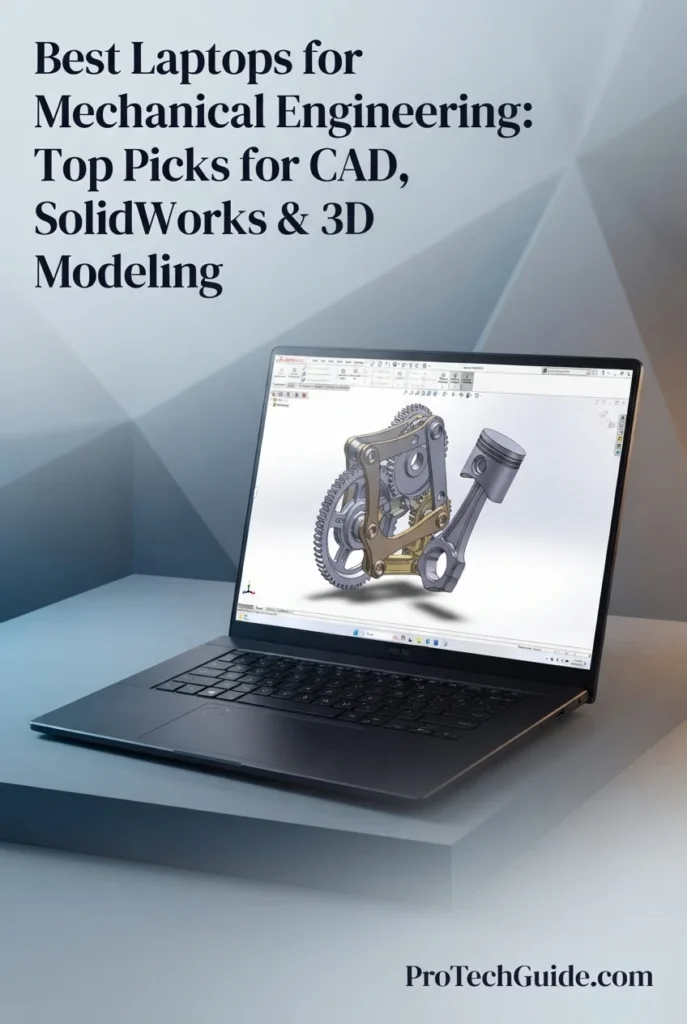
The HIDevolution ASUS ProArt P16 H7606WP with the AMD Ryzen AI 9 HX 370, NVIDIA GeForce RTX 5070 Laptop GPU, 64GB of LPDDR5X memory, and 2TB PCIe 4.0 NVMe SSD is our Best Overall laptop for mechanical engineering in 2026. Its 12-core, 24-thread Ryzen AI 9 HX 370 processor, RTX 5070 graphics with 8GB of GDDR7 memory, 64GB of system memory, and 16-inch 4K OLED touchscreen create a powerful platform for demanding CAD, SolidWorks, 3D modeling, visualization, simulation, and engineering multitasking. The combination is particularly compelling for engineers who want substantial CPU and GPU performance while also using the laptop for technical documentation, programming, visualization, and other professional workloads.
The ASUS ProArt P16 earns our Best Overall Laptop for Mechanical Engineering award because it combines high-end CPU performance, RTX 5070 graphics, 64GB of memory, 2TB of fast storage, and a premium 4K OLED display in a single professional platform. It is especially attractive for engineers who move between CAD, 3D modeling, visualization, technical work, and other demanding applications rather than using their laptop exclusively for one engineering program. The Ryzen AI 9 HX 370 provides 12 cores and 24 threads, while the RTX 5070 Laptop GPU adds 8GB of GDDR7 memory for demanding graphics workloads.
Compared with professional mobile workstations such as the Lenovo ThinkPad P16v Gen 3 and HP ZBook Power G11, the ProArt P16 takes a different approach by pairing a powerful GeForce RTX GPU with a high-capacity 64GB memory configuration and a high-resolution OLED touchscreen. This makes it particularly compelling for engineers who also perform visualization, rendering, content creation, or other GPU-intensive workloads. However, professionals whose workflow depends on ISV-certified workstation hardware and graphics configurations should consider a dedicated mobile workstation instead, particularly when certified drivers and application-specific support are important requirements.
Key Features
Lenovo ThinkPad P16v Gen 3 Mobile Workstation
Professional Workstation for CAD, SolidWorks & Engineering Simulation
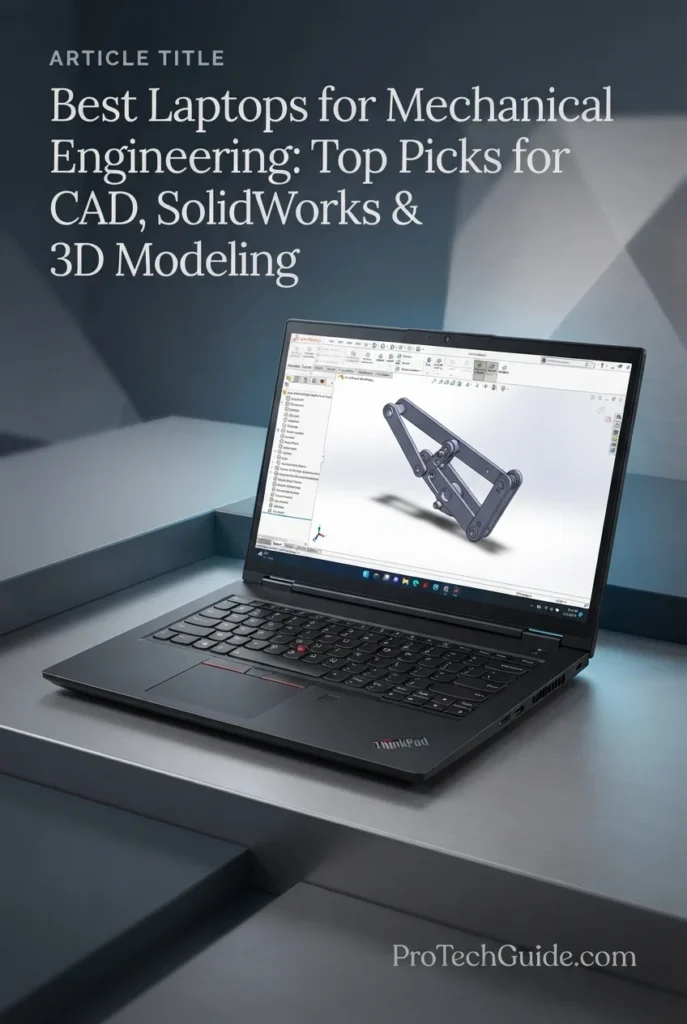
The Lenovo ThinkPad P16v Gen 3 with the Intel Core Ultra 9 285H vPro processor, NVIDIA RTX PRO 2000 Blackwell GPU, 32GB of DDR5 memory, and 1TB PCIe SSD is our Best Professional CAD Workstation for mechanical engineering in 2026. Unlike performance-focused gaming and creator laptops, this configuration is built around a professional mobile-workstation platform with NVIDIA RTX PRO graphics, Windows 11 Pro, expandable DDR5 memory, and business-oriented connectivity. Its 16-core Core Ultra 9 processor, 8GB GDDR7 professional GPU, 32GB RAM, and 16-inch 1920 × 1200 display create a strong foundation for SolidWorks, AutoCAD, 3D CAD, engineering design, technical documentation, visualization, and demanding professional multitasking.
The ThinkPad P16v Gen 3 earns our Best Professional CAD Workstation award because it prioritizes the features that distinguish a true mobile workstation from a conventional high-performance laptop: professional RTX PRO graphics, workstation-oriented drivers and ecosystem support, expandable DDR5 memory, Windows 11 Pro, enterprise connectivity, and a durable ThinkPad platform. For engineers who depend on professional CAD software and want a system designed specifically around technical workloads, its workstation architecture is a major advantage. Lenovo's specifications also provide two memory slots and support for substantially more RAM than the 32GB installed in this particular configuration.
Compared with the ASUS ProArt P16 H7606WP, the ThinkPad P16v Gen 3 takes a more specialized engineering-workstation approach. The ProArt offers a faster-class GeForce RTX 5070 configuration, 64GB of memory, a 4K OLED touchscreen, and stronger creator-oriented appeal, while the ThinkPad focuses on professional RTX PRO graphics, workstation software support, expandability, and enterprise features. SOLIDWORKS maintains a hardware-certification program specifically for qualified workstation and graphics configurations, making professional workstation hardware particularly relevant for users whose engineering workflow depends on certified configurations.
Key Features
Lenovo Legion Pro 5i Gen 10
High-Performance Laptop for CAD, SolidWorks & 3D Modeling
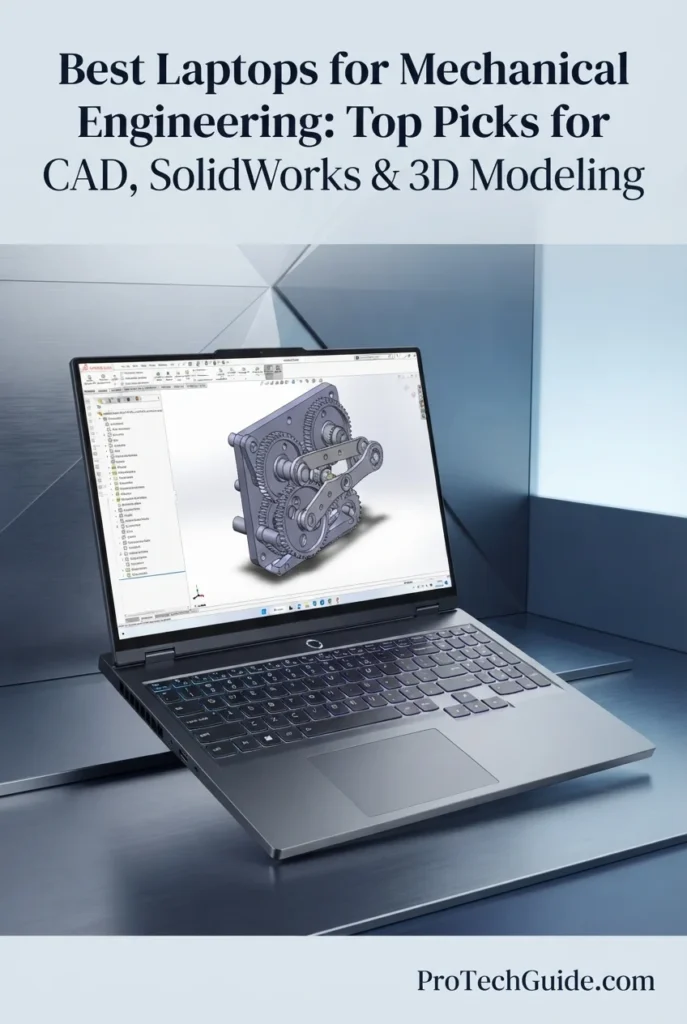
The Lenovo Legion Pro 5i Gen 10 with the Intel Core Ultra 9 275HX, NVIDIA GeForce RTX 5070, 32GB of DDR5 memory, and 2TB SSD is our Best Performance Value laptop for mechanical engineering in 2026. Its 24-core processor, RTX 5070 graphics with 8GB of GDDR7 memory, 32GB of DDR5 RAM, and fast 2TB storage create a powerful platform for CAD, SolidWorks, 3D modeling, engineering visualization, rendering, and demanding multitasking. The combination is particularly compelling for engineering students and professionals who want workstation-class levels of processing and graphics performance while retaining the flexibility of a high-performance Legion platform.
The Legion Pro 5i Gen 10 earns our Best Performance Value for Mechanical Engineering award because it combines an unusually powerful 24-core Core Ultra 9 275HX processor with RTX 5070 graphics, 32GB of DDR5 memory, and 2TB of storage. This gives engineering students and professionals substantial performance headroom for CAD, SolidWorks, 3D modeling, visualization, and demanding multitasking without requiring a traditional professional mobile-workstation platform. Its high-performance hardware also makes it particularly attractive for users whose engineering workload overlaps with rendering, creative applications, and GPU-intensive visualization.
Compared with the Lenovo ThinkPad P16v Gen 3 and other professional mobile workstations, the Legion Pro 5i Gen 10 emphasizes raw CPU and GeForce RTX performance, display quality, and performance-oriented value rather than professional RTX PRO graphics, enterprise management, or workstation-specific certification. The ThinkPad P16v is therefore more appropriate for workflows that specifically depend on professional workstation graphics and certified configurations, while the Legion is particularly compelling for engineers who prioritize high performance across CAD, 3D modeling, visualization, and other demanding workloads.
Key Features
Lenovo ThinkPad P1 Gen 8
Premium Mobile Workstation for CAD, SolidWorks & Engineering Design
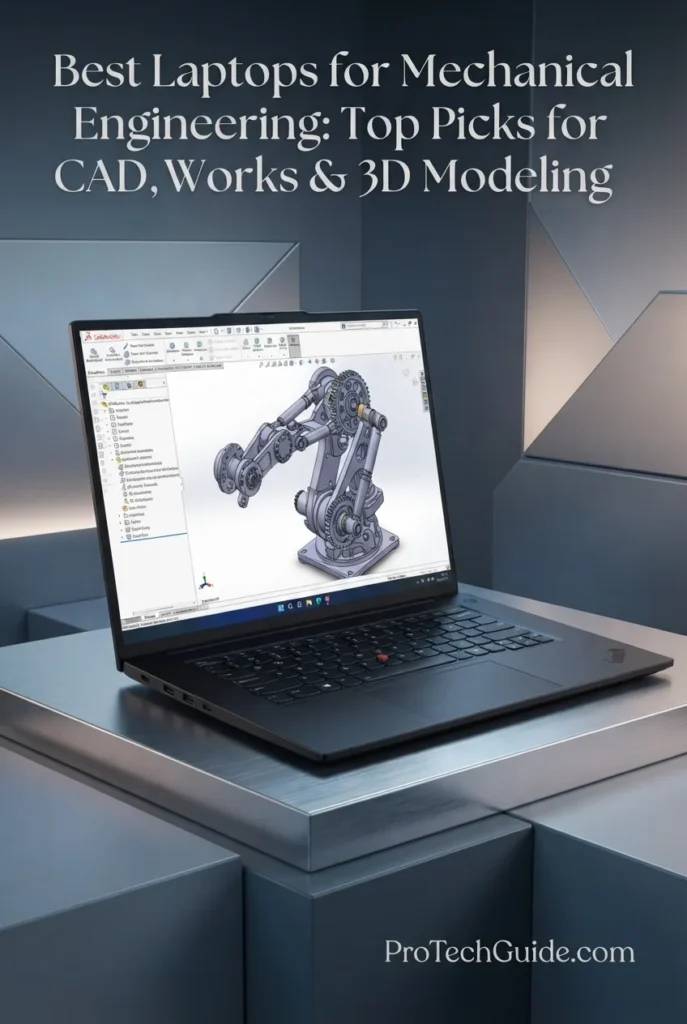
The Lenovo ThinkPad P1 Gen 8 with the Intel Core Ultra 9 285H, NVIDIA RTX PRO 2000 Blackwell graphics, 64GB of LPDDR5X memory, and 2TB PCIe 5.0 SSD is our Best Premium Portable Workstation for mechanical engineering in 2026. Its 16-core processor, professional RTX PRO graphics, 64GB of high-speed memory, next-generation SSD, and 16-inch 3.2K OLED touchscreen create a sophisticated platform for CAD, SolidWorks, 3D modeling, engineering visualization, technical design, and demanding professional multitasking. The configuration is particularly attractive to engineers who want workstation-class hardware in a premium design that is more focused on mobility and display quality than a traditional desktop-replacement workstation.
The ThinkPad P1 Gen 8 earns our Best Premium Portable Workstation award because it combines professional RTX PRO graphics, 64GB of high-speed memory, a powerful Core Ultra 9 processor, PCIe 5.0 storage, and an exceptionally high-resolution 3.2K OLED touchscreen in a premium mobile-workstation platform. It is especially compelling for engineers who want substantial CAD and 3D capability without choosing a bulkier workstation design, while its professional graphics architecture makes it particularly relevant to users whose workflows benefit from workstation-class GPU support.
Compared with the Lenovo ThinkPad P16v Gen 3, the ThinkPad P1 Gen 8 emphasizes a more premium and mobile workstation experience, with 64GB of LPDDR5X memory, PCIe 5.0 storage, a 3.2K OLED touchscreen, Thunderbolt 5 connectivity, and a refined chassis design. Both platforms use NVIDIA RTX PRO 2000 Blackwell graphics, so the distinction is less about the professional GPU category and more about configuration, display technology, portability, connectivity, and overall platform design. Engineers who specifically require certified SOLIDWORKS hardware should still verify the exact system and driver combination through the SOLIDWORKS certification database.
Key Features
ASUS ROG Zephyrus G14
Compact Laptop for CAD, SolidWorks & 3D Modeling
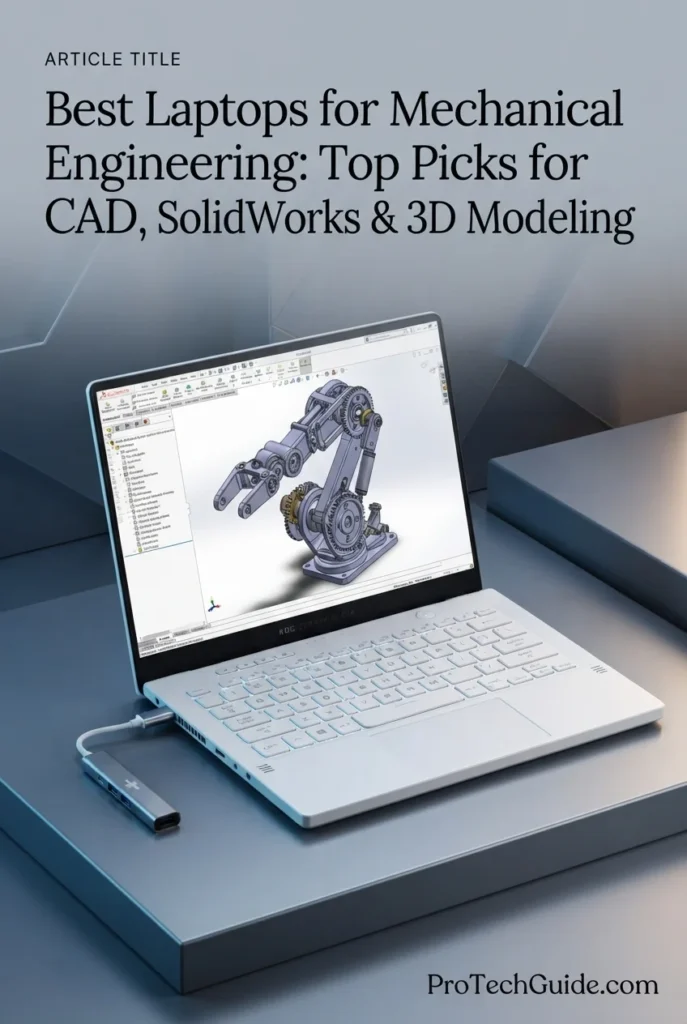
The ASUS ROG Zephyrus G14 with the AMD Ryzen 9 270, NVIDIA GeForce RTX 5060 Laptop GPU, 16GB of memory, and 1TB PCIe NVMe SSD is our Best Compact Engineering Laptop for mechanical engineering in 2026. Its 8-core, 16-thread Ryzen 9 processor, RTX 5060 graphics with 8GB of GDDR7 memory, 16GB of RAM, and 14-inch 2.8K OLED display create a highly portable platform for CAD, SolidWorks, 3D modeling, visualization, technical design, and everyday engineering work. The compact format is particularly attractive to students and professionals who regularly move between classrooms, laboratories, offices, meetings, and home workspaces while still needing dedicated graphics performance.
The ROG Zephyrus G14 earns our Best Compact Engineering Laptop award because it combines an 8-core Ryzen 9 processor, RTX 5060 graphics, 16GB of memory, 1TB SSD, and a high-resolution 14-inch OLED display in a significantly more compact format than the larger engineering laptops in this guide. Its greatest strength is mobility: it gives engineering students and professionals dedicated RTX graphics for CAD and 3D workloads without requiring a bulky 15- or 16-inch performance chassis.
Compared with larger performance laptops such as the Lenovo Legion Pro 5i Gen 10 and Acer Predator Helios Neo 16S AI, the Zephyrus G14 places greater emphasis on compact size, portability, and premium display quality. Its RTX 5060 provides dedicated graphics capability for 3D engineering workloads, but the 16GB onboard memory configuration offers less headroom than the 32GB and 64GB configurations found elsewhere in this guide. Professionals working with very large assemblies, intensive simulation, or extensive multitasking should therefore consider a higher-memory workstation or performance laptop instead.
Key Features
Acer Predator Helios Neo 16S AI
High-Performance Laptop for CAD, SolidWorks & 3D Modeling
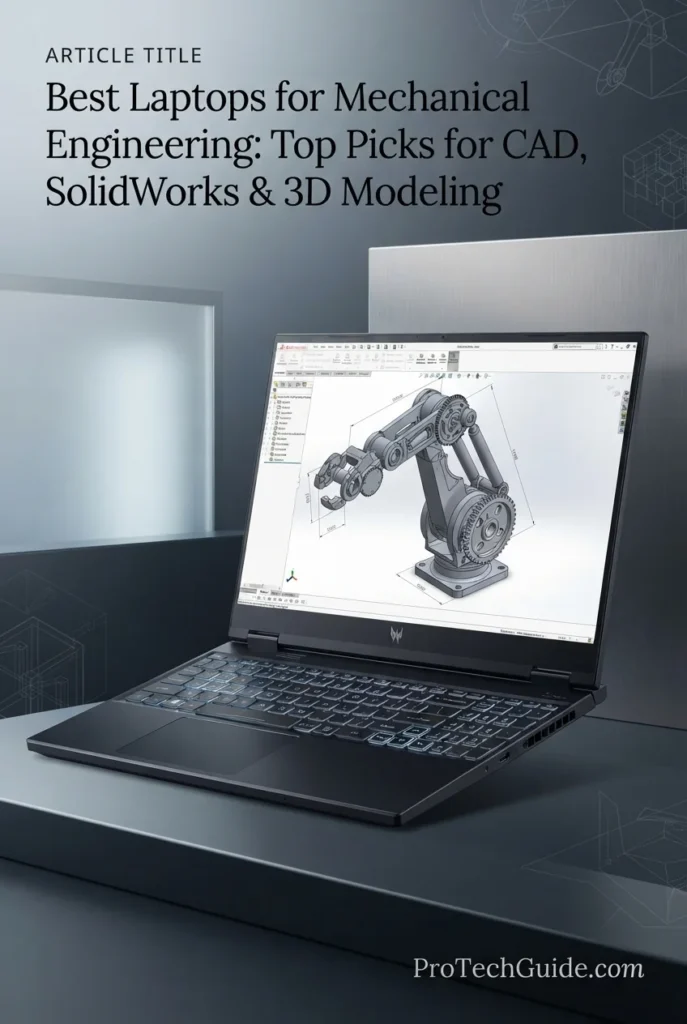
The Acer Predator Helios Neo 16S AI with the Intel Core Ultra 9 275HX, NVIDIA GeForce RTX 5060, 64GB of DDR5 memory, and 1TB SSD is our Best Gaming Laptop for Engineering in 2026. Its 24-core processor, RTX 5060 graphics with 8GB of dedicated memory, 64GB of RAM, and 16-inch 2560 × 1600 OLED display create a powerful platform for demanding CAD, SolidWorks, 3D modeling, visualization, rendering, and engineering multitasking. The combination is particularly compelling for engineering students and professionals who want substantial performance for technical workloads while also benefiting from a high-refresh-rate OLED display and a performance-oriented cooling system.
The Predator Helios Neo 16S AI earns our Best Gaming Laptop for Engineering award because it combines a 24-core Core Ultra 9 275HX processor, RTX 5060 graphics, 64GB of DDR5 memory, 1TB SSD, and a high-resolution 240Hz OLED display. The 64GB memory configuration is particularly valuable for mechanical engineering workloads because it provides substantial capacity for large CAD assemblies, 3D applications, engineering software, browsers, and other tools running simultaneously. It is a performance-focused alternative to traditional mobile workstations for users who do not specifically require professional RTX PRO graphics or certified workstation hardware.
Compared with the Lenovo ThinkPad P16v Gen 3 and Lenovo ThinkPad P1 Gen 8, the Predator Helios Neo 16S AI takes a performance-oriented GeForce RTX approach rather than a professional RTX PRO workstation approach. Its 64GB of RAM and RTX 5060 provide strong capability for CAD, 3D modeling, visualization, and multitasking, while its 240Hz OLED display is especially attractive for users who also game or work with visually intensive applications. Engineers who depend on formal workstation certification or professional graphics drivers should instead verify the exact requirements of their software before choosing a GeForce-based system.
Key Features
Lenovo LOQ 15 Gaming Laptop
High-Performance Budget Laptop for CAD, SolidWorks & 3D Modeling
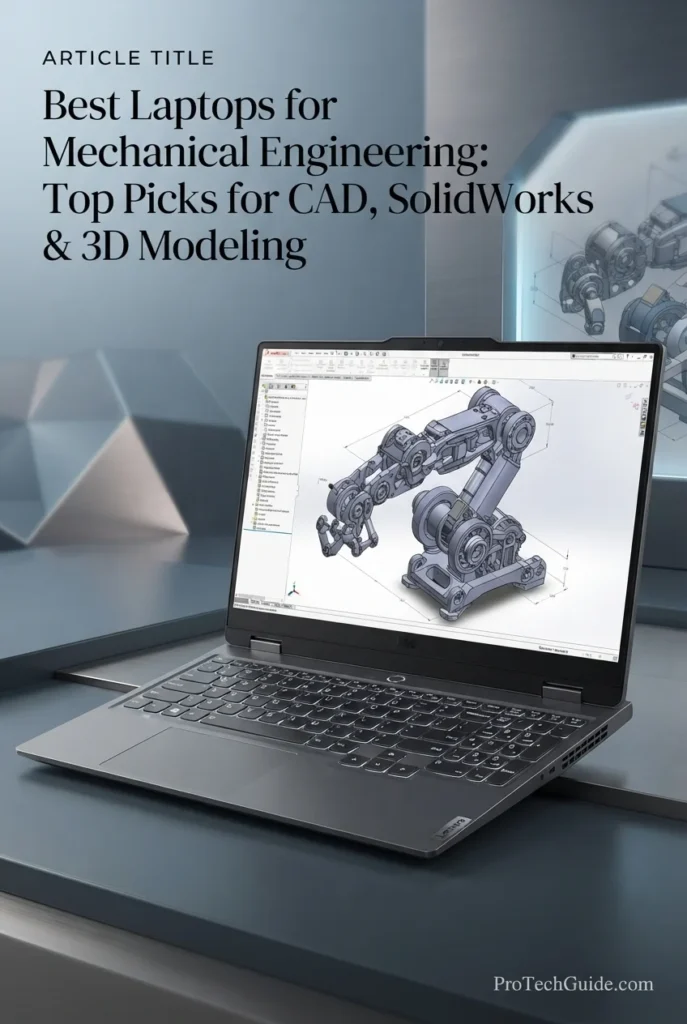
The Lenovo LOQ 15 with the AMD Ryzen 7 8845HS, NVIDIA GeForce RTX 4060, 64GB of DDR5 memory, and 2TB PCIe SSD is our Best Budget Engineering Laptop for mechanical engineering in 2026. Its 8-core, 16-thread Ryzen processor, dedicated RTX 4060 graphics, unusually generous 64GB memory configuration, and 2TB storage provide a strong foundation for CAD, SolidWorks, 3D modeling, engineering visualization, technical documentation, and demanding multitasking. The combination is particularly compelling for engineering students and early-career professionals who need substantial hardware capacity without moving immediately into a traditional mobile workstation.
The Lenovo LOQ 15 earns our Best Budget Engineering Laptop award because its configuration places unusually strong emphasis on memory and storage capacity while retaining dedicated RTX graphics and a capable Ryzen 7 processor. The 64GB of DDR5 memory and 2TB SSD give engineering students substantial room for CAD applications, large project files, multitasking, and 3D assets, while the RTX 4060 provides dedicated GPU acceleration for visualization and 3D workloads. It is a performance-oriented alternative to entry-level laptops that rely exclusively on integrated graphics.
Compared with professional mobile workstations such as the Lenovo ThinkPad P16v Gen 3 and HP ZBook Power G11, the LOQ 15 takes a more performance-focused consumer approach. Its GeForce RTX 4060, 64GB memory configuration, 2TB SSD, and gaming-oriented display prioritize practical performance and capacity rather than professional RTX PRO graphics, enterprise management, or workstation-specific certification. For engineering users who require certified hardware and drivers for supported applications, a professional workstation remains the more appropriate platform; for students and users who prioritize performance and flexibility, the LOQ provides a capable Windows-based foundation.
Key Features
HP ZBook Power G11 A Mobile Workstation
Professional Workstation for CAD, SolidWorks & Engineering Workflows
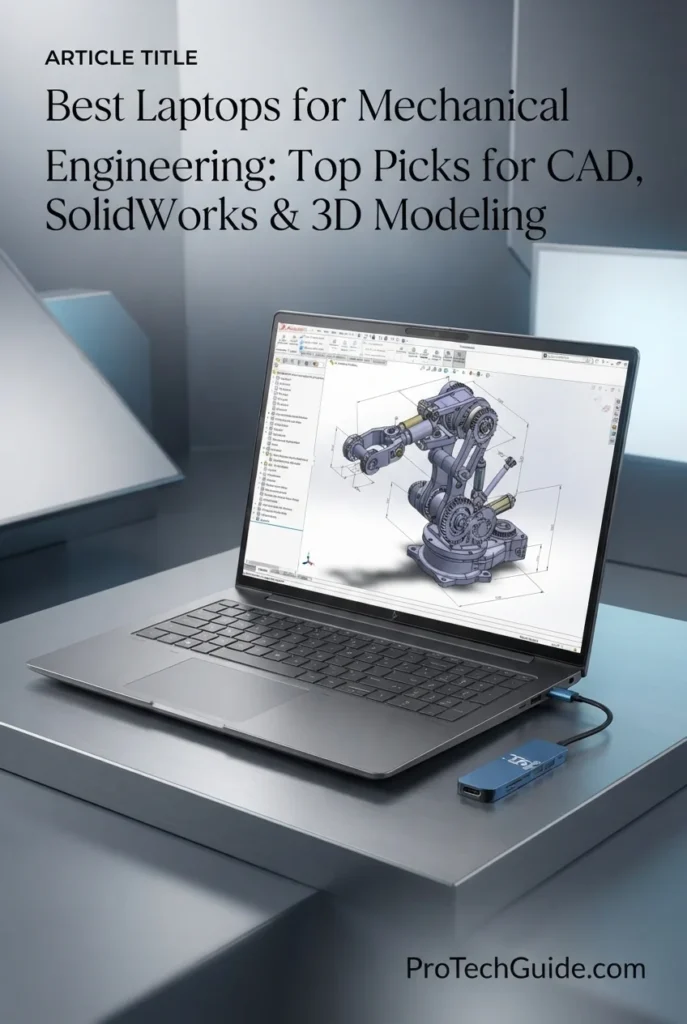
The HP ZBook Power G11 A with the AMD Ryzen 7 PRO 8845HS, NVIDIA RTX 1000 Ada 6GB, 32GB of DDR5 memory, and 1TB PCIe NVMe SSD is our Best Entry-Level Professional Workstation for mechanical engineering in 2026. Its 8-core, 16-thread Ryzen PRO processor, professional RTX 1000 Ada graphics, 32GB of memory, and 16-inch WUXGA display create a capable foundation for CAD, SolidWorks, AutoCAD, 3D modeling, engineering visualization, simulation-oriented workflows, and demanding professional multitasking. The configuration is particularly attractive to engineers and advanced students who want workstation-class graphics and professional Windows features without moving into a larger or more expensive high-end mobile workstation.
The ZBook Power G11 A earns our Best Entry-Level Professional Workstation award because it combines a professional NVIDIA RTX 1000 Ada GPU with the Ryzen 7 PRO 8845HS, 32GB of DDR5 memory, 1TB SSD storage, and Windows 11 Pro in a relatively portable 16-inch workstation platform. It is particularly well suited to engineers who want the advantages of professional workstation graphics and business-focused features without stepping into the larger configurations and higher component tiers of premium mobile workstations.
Compared with performance-focused laptops such as the Lenovo LOQ 15 and Lenovo Legion Pro 5i Gen 10, the ZBook Power G11 A takes a more specialized workstation approach. Its NVIDIA RTX 1000 Ada professional graphics, Ryzen PRO processor, Windows 11 Pro environment, enterprise-oriented security features, and workstation platform are designed around professional engineering workflows rather than gaming performance. Compared with higher-tier workstations such as the Lenovo ThinkPad P16v Gen 3, it uses a lower-tier professional GPU and a more modest CPU configuration, making it a practical entry point into the mobile-workstation category. Users who require formal application certification should verify the exact system and driver combination with the software vendor.
Key Features
Best Laptops for Mechanical Engineering in 2026
Ranked by CPU Performance, GPU Capability, CAD Performance, SolidWorks, 3D Modeling, RAM Capacity, Display Quality, Storage, Portability & Professional Workstation Features
Choosing the best laptop for mechanical engineering in 2026 requires more than comparing processor and GPU specifications. Engineering students and professionals need enough memory for large CAD assemblies, strong CPU performance for modeling and engineering applications, dedicated graphics for 3D visualization, fast storage for projects and software, a practical display for detailed technical work, and reliable compatibility with professional engineering software. We evaluated these laptops across real-world mechanical engineering workflows including AutoCAD, SolidWorks, Autodesk Inventor, Fusion 360, 3D modeling, visualization, engineering documentation, multitasking, and simulation-oriented workloads to help you choose the right platform for your specific engineering needs.
| Laptop | CPU & Key Specs | Best For | Why It Wins | Editor's Verdict |
|---|---|---|---|---|
Best OverallASUS ProArt P16Check Price | Ryzen AI 9 HX 370 12-Core CPU / 24 Threads 64GB LPDDR5X RTX 5070 8GB GDDR7 2TB PCIe 4.0 SSD 16" 4K OLED Touch | Mechanical Engineers CAD Professionals SolidWorks Users 3D Modeling Engineering Visualization | The ProArt P16 combines a powerful Ryzen AI 9 HX 370 processor, RTX 5070 graphics, 64GB of memory, 2TB SSD storage, and a high-resolution 4K OLED touchscreen. It provides substantial performance headroom for CAD, SolidWorks, 3D modeling, visualization, rendering, and demanding multitasking while remaining versatile enough for creative and professional workloads beyond engineering. | Best Overall Laptop for Mechanical Engineering |
Best Professional WorkstationLenovo ThinkPad P16v Gen 3Check Price | Core Ultra 9 285H 16-Core CPU / 16 Threads 32GB DDR5 RTX PRO 2000 Blackwell 8GB 1TB PCIe SSD 16" WUXGA 500-Nit | Professional Engineers CAD Workstations SolidWorks Users Engineering Firms Enterprise Workflows | The ThinkPad P16v Gen 3 is built around a professional mobile-workstation platform with RTX PRO 2000 Blackwell graphics, a high-performance Core Ultra 9 processor, expandable DDR5 memory, Windows 11 Pro, and enterprise-oriented connectivity. It is particularly suited to engineers who prioritize professional graphics, workstation software support, expandability, and structured engineering workflows over gaming-focused features. | Best Professional CAD Workstation |
Best Performance ValueLenovo Legion Pro 5i Gen 10Check Price | Core Ultra 9 275HX 24-Core CPU / 24 Threads 32GB DDR5 RTX 5070 8GB GDDR7 2TB SSD 16" 2560×1600 OLED 165Hz | CAD Students SolidWorks Users 3D Modeling Rendering Performance-Focused Engineers | The Legion Pro 5i Gen 10 delivers exceptional processing and graphics capability through its 24-core Core Ultra 9 275HX and RTX 5070 combination. With 32GB of RAM, 2TB of storage, and a high-resolution OLED display, it provides substantial performance for CAD, 3D modeling, visualization, rendering, and demanding multitasking without requiring a traditional professional workstation platform. | Best Performance Value for Mechanical Engineering |
Best Premium WorkstationLenovo ThinkPad P1 Gen 8Check Price | Core Ultra 9 285H 16-Core CPU / 16 Threads 64GB LPDDR5X RTX PRO 2000 Blackwell 8GB 2TB PCIe 5.0 SSD 16" 3.2K OLED Touch | Professional Engineers Mobile Workstations Large CAD Assemblies 3D Visualization Premium Workflows | The ThinkPad P1 Gen 8 combines professional RTX PRO graphics with 64GB of memory, a powerful Core Ultra 9 processor, PCIe 5.0 storage, and a premium 3.2K OLED touchscreen. Its combination of workstation-class hardware, high memory capacity, advanced connectivity, and refined mobile design makes it particularly suitable for engineers who need professional capability in a more premium portable platform. | Best Premium Portable Workstation |
Best CompactASUS ROG Zephyrus G14Check Price | Ryzen 9 270 8-Core CPU 16GB DDR5 RTX 5060 8GB 1TB SSD 14" 2.8K OLED 120Hz | Engineering Students Mobile Engineers CAD Users 3D Modeling Frequent Travelers | The Zephyrus G14 combines a compact 14-inch form factor with Ryzen 9 processing, RTX 5060 graphics, a 2.8K OLED display, and 1TB of storage. Its smaller footprint makes it particularly attractive to engineering students and professionals who frequently move between classrooms, laboratories, offices, and home while still needing dedicated graphics for CAD and 3D workflows. | Best Compact Engineering Laptop |
Best Gaming LaptopAcer Predator Helios Neo 16S AICheck Price | Core Ultra 9 275HX 24-Core CPU / 24 Threads 64GB DDR5 RTX 5060 8GB 1TB SSD 16" 2560×1600 OLED 240Hz | Engineering Students 3D Modeling CAD & Visualization GPU-Intensive Workloads Engineering + Gaming | The Predator Helios Neo 16S AI combines a 24-core Core Ultra 9 275HX processor with 64GB of DDR5 memory, RTX 5060 graphics, 1TB SSD storage, and a high-resolution 240Hz OLED display. Its substantial memory capacity and performance-oriented hardware make it well suited to demanding CAD, 3D modeling, visualization, rendering, and multitasking while also serving as a capable gaming platform. | Best Gaming Laptop for Engineering |
Best BudgetLenovo LOQ 15 Gaming LaptopCheck Price | Ryzen 7 8845HS 8-Core CPU / 16 Threads 64GB DDR5-5600 RTX 4060 6GB* 2TB PCIe SSD 15.6" FHD 144Hz G-SYNC | Engineering Students CAD Coursework SolidWorks Users 3D Modeling Value-Focused Users | The Lenovo LOQ 15 provides an unusually generous 64GB memory and 2TB storage configuration alongside a Ryzen 7 8845HS processor and dedicated RTX 4060 graphics. It is particularly practical for engineering students who need substantial capacity for CAD software, SolidWorks projects, 3D assets, technical documentation, and multitasking without choosing a traditional professional workstation. | Best Budget Engineering Laptop |
Best Entry-Level WorkstationHP ZBook Power G11 ACheck Price | Ryzen 7 PRO 8845HS 8-Core CPU / 16 Threads 32GB DDR5 RTX 1000 Ada 6GB 1TB PCIe NVMe SSD 16" WUXGA 400-Nit | Engineering Students CAD Professionals SolidWorks Users Entry-Level Workstations Professional Windows Workflows | The HP ZBook Power G11 A combines a Ryzen 7 PRO processor, professional RTX 1000 Ada graphics, 32GB of DDR5 memory, 1TB SSD storage, and Windows 11 Pro in a relatively portable workstation platform. Its professional GPU architecture, business-focused security, extensive connectivity, and workstation design make it a practical entry point for engineers who need more than a conventional consumer laptop. | Best Entry-Level Professional Workstation |
Recommended Next Reads
Finished comparing the best laptops for mechanical engineering? Explore our related buying guides for CAD, 3D modeling, engineering students, GPU performance, professional workstations, and laptop value.
Whether you're choosing a laptop for SolidWorks and AutoCAD, moving into advanced 3D modeling, comparing professional workstation graphics, or simply looking for the right balance of performance and price, these guides can help you make a more informed decision for your engineering workflow.
Best Laptops for CAD in 2026
Explore laptops specifically selected for AutoCAD, SolidWorks, 3D CAD, technical design, engineering visualization, and demanding professional CAD workflows.
Explore CAD Laptops →Best Laptops for 3D Modeling in 2026
Compare laptops built for Blender, 3ds Max, CAD, 3D visualization, rendering, and demanding modeling workflows that push CPU and GPU performance.
Explore 3D Modeling Laptops →Engineering EducationBest Laptops for Engineering Students in 2026
Find engineering-focused laptops for CAD, SolidWorks, MATLAB, 3D modeling, simulations, programming, and demanding university coursework.
Explore Engineering Student Laptops →GPU PerformanceRTX 5060 vs RTX 5070 Ti vs RTX 5080 Laptop GPUs in 2026
Compare modern laptop GPUs and understand how graphics performance, VRAM, and GPU class can affect demanding 3D, visualization, rendering, and engineering workloads.
Compare Laptop GPUs →AutoCAD & CADBest Laptops for AutoCAD in 2026
Explore laptops selected for 2D drafting, 3D AutoCAD, technical drawings, CAD projects, engineering design, and demanding professional workloads.
Explore AutoCAD Laptops →Premium Performance & ValueBest Laptops Under $2000 in 2026
Compare premium laptops that balance powerful processors, dedicated graphics, memory, storage, display quality, and performance for demanding professional workloads.
Explore Laptops Under $2000 →Professional WorkBest Business Laptops in 2026
Explore professional laptops focused on productivity, security, connectivity, portability, reliability, and long-term business use.
Explore Business Laptops →EDITOR'S FINAL RECOMMENDATIONS
After comparing laptops across CPU performance, GPU capability, RAM capacity, CAD workloads, SolidWorks, 3D modeling, visualization, simulation, display quality, storage, thermals, portability, workstation features, software compatibility, and long-term value, these are our final recommendations for mechanical engineering in 2026. Whether you are an engineering student building your first CAD projects, a professional working with complex assemblies, or an engineer who needs workstation-class graphics and certified hardware support, there is an option here for your specific workflow.
HIDevolution ASUS ProArt P16 H7606WP
The best overall laptop for mechanical engineering in 2026. The ASUS ProArt P16 combines a powerful Ryzen AI 9 HX 370 processor, RTX 5070 graphics, 64GB of memory, 2TB of SSD storage, and a 16-inch 4K OLED touchscreen. It provides a particularly strong balance for CAD, SolidWorks, 3D modeling, visualization, rendering, engineering multitasking, and other demanding technical workflows, while also offering the versatility expected from a premium professional laptop.
- ✓ AMD Ryzen AI 9 HX 370, 12 cores / 24 threads
- ✓ NVIDIA GeForce RTX 5070 8GB GDDR7
- ✓ 64GB LPDDR5X Memory
- ✓ 2TB PCIe 4.0 NVMe SSD
- ✓ 16-inch 4K OLED Touchscreen
Lenovo ThinkPad P16v Gen 3
The professional workstation choice for engineers who prioritize workstation-oriented hardware, professional graphics, business-class features, and demanding CAD workflows. Its Core Ultra 9 285H processor, RTX PRO 2000 Blackwell GPU, 32GB of DDR5 memory, and 1TB PCIe 5.0 SSD provide a strong foundation for professional CAD, SolidWorks, engineering applications, 3D visualization, and technical workloads where professional GPU support can matter. Users who specifically require certified hardware should verify certification for their exact application and configuration.
- ✓ Intel Core Ultra 9 285H with vPro
- ✓ NVIDIA RTX PRO 2000 Blackwell 8GB GDDR7
- ✓ 32GB DDR5 Memory
- ✓ 1TB PCIe 5.0 NVMe SSD
- ✓ 16-inch WUXGA 500-nit 100% sRGB Display
Lenovo Legion Pro 5i Gen 10
The performance-focused choice for engineers who want high-end CPU and GPU capability without moving to a traditional mobile workstation. Its Core Ultra 9 275HX and GeForce RTX 5070 provide substantial performance for CAD, 3D modeling, visualization, rendering, and demanding multitasking, while 32GB of RAM and a 2TB SSD give the system enough headroom for large engineering projects and applications.
- ✓ Intel Core Ultra 9 275HX, 24 cores
- ✓ NVIDIA GeForce RTX 5070 8GB GDDR7
- ✓ 32GB DDR5 Memory
- ✓ 2TB SSD Storage
- ✓ 16-inch 2560 × 1600 OLED 165Hz Display
Lenovo ThinkPad P1 Gen 8
The premium workstation choice for engineers who want professional graphics capability in a more refined and portable platform. The ThinkPad P1 Gen 8 pairs a Core Ultra 9 285H processor with RTX PRO 2000 Blackwell graphics, 64GB of memory, a 2TB Gen5 SSD, and a high-resolution 3.2K OLED touchscreen. It is particularly well suited to engineers who move between CAD, visualization, technical design, multitasking, and professional productivity.
- ✓ Intel Core Ultra 9 285H
- ✓ NVIDIA RTX PRO 2000 Blackwell 8GB
- ✓ 64GB LPDDR5X Memory
- ✓ 2TB PCIe Gen5 Performance SSD
- ✓ 16-inch 3.2K OLED Touch Display
ASUS ROG Zephyrus G14
The compact choice for engineering students and professionals who need serious graphics performance without carrying a large 15- or 16-inch workstation. Its Ryzen 9 270 processor, RTX 5060 graphics, 16GB of memory, and 14-inch 2.8K OLED display create a highly portable platform for CAD, SolidWorks, 3D modeling, technical coursework, and everyday engineering productivity. Its 16GB configuration is better suited to moderate engineering projects than exceptionally large assemblies or heavily multitasked workflows.
- ✓ AMD Ryzen 9 270, 8 cores
- ✓ NVIDIA GeForce RTX 5060 8GB
- ✓ 16GB Memory
- ✓ 1TB SSD Storage
- ✓ 14-inch 2.8K OLED 120Hz Display
Acer Predator Helios Neo 16S AI
The gaming-oriented performance choice for engineers who want strong CPU and GPU capability, a large high-refresh OLED display, and generous memory for demanding engineering workloads. Its Core Ultra 9 275HX, RTX 5060, and 64GB of DDR5 memory provide a powerful platform for CAD, 3D modeling, visualization, rendering, and multitasking. The GeForce platform is performance-focused rather than workstation-certified, making it a different proposition from the ThinkPad and ZBook systems.
- ✓ Intel Core Ultra 9 275HX, 24 cores
- ✓ NVIDIA GeForce RTX 5060 8GB
- ✓ 64GB DDR5 Memory
- ✓ 1TB SSD Storage
- ✓ 16-inch 2560 × 1600 OLED 240Hz G-SYNC Display
Lenovo LOQ 15 Gaming Laptop
The budget-focused engineering choice for students and early-career engineers who want substantial performance and memory capacity without moving into premium workstation pricing. The Ryzen 7 8845HS, RTX 4060, 64GB of RAM, and 2TB SSD create a capable platform for CAD, SolidWorks, 3D modeling, engineering coursework, and everyday technical workloads. It is especially attractive when performance and storage capacity matter more than workstation-class graphics certification or premium materials.
- ✓ AMD Ryzen 7 8845HS, 8 cores / 16 threads
- ✓ NVIDIA GeForce RTX 4060 Graphics
- ✓ 64GB DDR5 Memory
- ✓ 2TB PCIe SSD Storage
- ✓ 15.6-inch FHD 144Hz G-SYNC Display
HP ZBook Power G11 A
The entry-level professional workstation choice for engineers who want a business-focused platform with professional NVIDIA graphics and Windows 11 Pro. Its Ryzen 7 PRO 8845HS, RTX 1000 Ada graphics, 32GB of DDR5 memory, and 1TB SSD provide a solid foundation for CAD, SolidWorks, engineering applications, technical documentation, and professional productivity. Its workstation-oriented design makes it a natural step up from mainstream consumer laptops when professional hardware features are more important than maximum gaming performance.
- ✓ AMD Ryzen 7 PRO 8845HS
- ✓ NVIDIA RTX 1000 Ada Graphics
- ✓ 32GB DDR5 Memory
- ✓ 1TB SSD Storage
- ✓ 16-inch FHD+ Display with Windows 11 Pro
Which mechanical engineering laptop should you choose?
ASUS ProArt P16
ThinkPad P16v Gen 3
Legion Pro 5i Gen 10
ThinkPad P1 Gen 8
ROG Zephyrus G14
Predator Helios Neo 16S AI
Lenovo LOQ 15
HP ZBook Power G11 A
- Choose the ASUS ProArt P16 if you want the strongest overall combination of CPU performance, GPU capability, 64GB of memory, 2TB of storage, high-resolution display quality, and versatility for CAD, SolidWorks, 3D modeling, visualization, and demanding engineering multitasking.
- Choose the Lenovo ThinkPad P16v Gen 3 if professional workstation hardware, RTX PRO graphics, business-class features, and workstation-oriented engineering workflows are more important than gaming-focused GPU performance. If your application requires certified hardware, verify the exact GPU, driver, and software combination before purchasing.
- Choose the Lenovo Legion Pro 5i Gen 10 if you want high-end CPU and GeForce RTX performance for demanding CAD, 3D modeling, visualization, and rendering without specifically requiring a traditional mobile workstation. Its 32GB of memory and 2TB SSD also provide a strong platform for large engineering projects.
- Choose the Lenovo ThinkPad P1 Gen 8 if you want a premium mobile workstation with RTX PRO graphics, 64GB of memory, 2TB Gen5 storage, and a high-resolution OLED touchscreen. It is particularly well suited to professionals who combine engineering workloads with demanding multitasking and premium mobile productivity.
- Choose the ASUS ROG Zephyrus G14 if portability is your priority and you still want dedicated RTX graphics for CAD, SolidWorks, 3D modeling, and engineering coursework. Its 16GB memory configuration is best suited to moderate workloads rather than exceptionally large assemblies or heavily multitasked professional projects.
- Choose the Acer Predator Helios Neo 16S AI if you want a large high-refresh OLED display, 64GB of RAM, a powerful Core Ultra 9 processor, and dedicated RTX graphics for demanding engineering and 3D workloads. Its GeForce platform is performance-oriented rather than workstation-certified.
- Choose the Lenovo LOQ 15 if you are an engineering student or budget-conscious user who wants substantial RAM, storage, and dedicated GPU performance for CAD, SolidWorks, 3D modeling, and technical coursework. It prioritizes performance and value over premium workstation features.
- Choose the HP ZBook Power G11 A if you want a professional mobile workstation platform with Ryzen 7 PRO, NVIDIA RTX professional graphics, Windows 11 Pro, and business-oriented connectivity for CAD and engineering applications. It is particularly relevant when workstation features are more important than maximum consumer GPU performance.
EDITOR'S FINAL VERDICT
After comparing processor performance, GPU capability, RAM capacity, CAD workloads, SolidWorks, 3D modeling, visualization, simulation, display quality, storage, portability, thermals, connectivity, workstation features, software compatibility, and long-term value, one conclusion stands out:The best laptop for mechanical engineering is not necessarily the laptop with the most powerful processor or the most expensive professional GPU. It is the system that provides the right balance of CPU performance, graphics capability, memory, storage, display quality, software compatibility, portability, and reliability for the engineering workloads you actually perform.
Modern mechanical engineering workflows can span AutoCAD, SolidWorks, Autodesk Inventor, Fusion 360, 3D CAD, complex assemblies, technical drawings, rendering, visualization, simulation preparation, engineering documentation, and demanding multitasking. These workloads benefit from strong CPU performance and sufficient memory, while GPU requirements become increasingly important as projects move from conventional 2D CAD into detailed 3D models, real-time visualization, rendering, and GPU-accelerated workflows.
For most mechanical engineering students and professionals, 32GB of RAM is a strong long-term target, while 16GB can remain suitable for moderate CAD workloads and lighter engineering projects. For larger assemblies, advanced 3D modeling, simulation-related workloads, visualization, and heavy multitasking, 64GB provides substantially more headroom. GPU selection also deserves careful attention: GeForce RTX laptops can deliver excellent graphics performance, while professional RTX PRO and RTX workstation platforms are more relevant when certified hardware, drivers, and application-specific workstation support are important requirements.- Choose the ASUS ProArt P16 if you want the strongest overall combination of CPU performance, RTX graphics, 64GB of memory, 2TB of storage, a premium 4K OLED display, and versatility across CAD, SolidWorks, 3D modeling, visualization, and demanding engineering multitasking.
- Choose the Lenovo ThinkPad P16v Gen 3 if your engineering workflow places greater importance on a professional mobile-workstation platform, RTX PRO graphics, business-class features, and workstation-oriented CAD workloads. If your software requires certified hardware or drivers, verify the exact configuration through the application's current certification requirements.
- Choose the Lenovo Legion Pro 5i Gen 10 if raw CPU and GPU performance are your priority and you do not specifically require a traditional mobile workstation. Its Core Ultra 9 275HX, RTX 5070, 32GB of RAM, and 2TB SSD make it a strong platform for demanding CAD, 3D modeling, visualization, rendering, and multitasking.
- Choose the Lenovo ThinkPad P1 Gen 8 if you want premium mobile-workstation hardware, RTX PRO graphics, 64GB of memory, 2TB Gen5 storage, and a high-resolution OLED touchscreen in a more refined portable platform.
Top Mechanical Engineering Laptop Recommendations (2026)
ASUS ProArt P16
Our Editor's Choice for mechanical engineering because it combines a high-performance Ryzen AI 9 HX 370 processor, GeForce RTX 5070 graphics, 64GB of memory, 2TB SSD storage, and a 16-inch 4K OLED touchscreen. This configuration provides substantial headroom for CAD, SolidWorks, 3D modeling, visualization, rendering, and demanding engineering multitasking.
- ✓ AMD Ryzen AI 9 HX 370, 12 cores / 24 threads
- ✓ NVIDIA GeForce RTX 5070 8GB GDDR7
- ✓ 64GB LPDDR5X Memory
- ✓ 2TB PCIe 4.0 NVMe SSD
Lenovo ThinkPad P16v Gen 3
The workstation-focused choice for engineers who prioritize professional graphics, business-class features, and a platform designed around demanding technical applications. Its Core Ultra 9 285H and RTX PRO 2000 Blackwell provide a different proposition from the GeForce-based systems in this guide, particularly for workflows where professional GPU support and application-specific certification matter.
- ✓ Intel Core Ultra 9 285H with vPro
- ✓ NVIDIA RTX PRO 2000 Blackwell 8GB GDDR7
- ✓ 32GB DDR5 Memory
- ✓ 1TB PCIe 5.0 NVMe SSD
Lenovo Legion Pro 5i Gen 10
The performance-focused alternative for engineers who want powerful CPU and GeForce RTX graphics without specifically needing a traditional professional workstation. Its Core Ultra 9 275HX, RTX 5070, 32GB of RAM, and 2TB SSD provide a strong foundation for demanding CAD, 3D modeling, visualization, rendering, and engineering multitasking.
- ✓ Intel Core Ultra 9 275HX, 24 cores
- ✓ NVIDIA GeForce RTX 5070 8GB GDDR7
- ✓ 32GB DDR5 Memory
- ✓ 2TB SSD Storage
- ✓ You want the strongest overall balance for mechanical engineering workloads
- ✓ You regularly work with CAD, SolidWorks, 3D modeling, visualization, and demanding multitasking
- ✓ You want 64GB of memory and 2TB of storage for large projects and applications
- ✓ You value a high-resolution 4K OLED touchscreen alongside strong CPU and GPU performance
- ✓ Professional workstation hardware and RTX PRO graphics are important to your workflow
- ✓ Your engineering applications benefit from workstation-oriented drivers or certified configurations
- ✓ You want a business-focused mobile workstation with Windows 11 Pro and professional connectivity
- ✓ CAD, SolidWorks, engineering applications, and technical productivity are more important than gaming-focused features
- ✓ Prefer 32GB of RAM for demanding CAD workloads and long-term engineering use
- ✓ Consider 16GB acceptable for students and moderate CAD projects, but leave additional headroom if you work with large assemblies
- ✓ Choose 64GB when your workflow regularly involves complex assemblies, 3D modeling, visualization, simulation-related workloads, or heavy multitasking
- ✓ Pay close attention to GPU capability when moving from 2D CAD into advanced 3D modeling, rendering, and visualization
- ✓ Consider professional RTX PRO or workstation graphics when certified hardware and application-specific driver support are important requirements
- ✓ Verify your engineering software's current CPU, GPU, RAM, driver, and certification requirements before purchasing
A mechanical engineering laptop is a professional tool that may be used for thousands of hours across CAD projects, 3D assemblies, technical drawings, simulations, visualization, documentation, coursework, research, and engineering productivity. Raw processor specifications matter, but memory capacity, GPU capability, display quality, storage, keyboard and input comfort, connectivity, portability, thermals, and software compatibility can have an equally important impact on everyday engineering work.
Among the models evaluated in this guide, the HIDevolution ASUS ProArt P16 delivers the strongest overall combination of CPU performance, RTX 5070 graphics, 64GB of memory, 2TB storage, and a premium 4K OLED display, making it our Editor's Choice for the best laptop for mechanical engineering in 2026. It is particularly compelling for engineers who need one system capable of handling CAD, SolidWorks, 3D modeling, visualization, and demanding multitasking.The Lenovo ThinkPad P16v Gen 3 is the more workstation-focused choice for professionals who place greater importance on RTX PRO graphics and professional workstation features. The Lenovo ThinkPad P1 Gen 8 extends that workstation approach into a more premium portable design with 64GB of memory and a 3.2K OLED touchscreen, while the Lenovo Legion Pro 5i Gen 10 provides a high-performance GeForce platform for engineers who prioritize CPU and GPU performance without specifically requiring workstation-class hardware.
Compare current prices, configurations, memory, storage, warranty coverage, and availability before choosing the laptop that best matches your CAD, SolidWorks, 3D modeling, and engineering workflow.
Check Latest DealsEDITOR'S FAQ
Choosing the best laptop for mechanical engineering requires more than comparing processor specifications. Engineering students and professionals need to consider CPU performance, GPU capability, RAM capacity, SSD storage, CAD and SolidWorks requirements, 3D modeling performance, display quality, software compatibility, portability, thermals, and whether a professional workstation or a high-performance GeForce laptop better matches their workflow.These frequently asked questions address the most important laptop decisions for mechanical engineering in 2026, from choosing the right system for SolidWorks and AutoCAD to determining how much RAM and GPU power you need for large assemblies, 3D modeling, visualization, simulation, engineering coursework, and professional CAD workloads.
Its AMD Ryzen AI 9 HX 370 processor, NVIDIA GeForce RTX 5070 graphics, 64GB of memory, 2TB SSD, and 16-inch 4K OLED touchscreen create a powerful platform for CAD, SolidWorks, 3D modeling, visualization, rendering, engineering multitasking, and other demanding technical workflows.
- Strong Ryzen AI 9 HX 370 processing performance with 12 cores and 24 threads.
- NVIDIA GeForce RTX 5070 graphics with 8GB of GDDR7 memory.
- 64GB of LPDDR5X memory for large projects and demanding multitasking.
- 2TB PCIe 4.0 NVMe SSD for engineering applications and project files.
- 16-inch 4K OLED touchscreen for detailed CAD models, drawings, documentation, and visualization.
For engineers who specifically need professional workstation graphics and application-specific certification, the Lenovo ThinkPad P16v Gen 3 and ThinkPad P1 Gen 8 provide a different workstation-oriented approach with NVIDIA RTX PRO graphics.
Check PriceMechanical engineering workflows frequently involve CAD software, large assemblies, browsers, technical documentation, spreadsheets, simulation tools, communication applications, and other programs running simultaneously. Memory requirements increase quickly as assemblies and 3D projects become more complex.
- 16GB → Suitable for engineering students, moderate CAD projects, basic 3D modeling, coursework, and lighter multitasking.
- 32GB → Recommended for professional CAD, SolidWorks, larger assemblies, 3D modeling, engineering applications, and demanding multitasking.
- 64GB or more → Best for very large assemblies, advanced 3D workflows, visualization, simulation-related workloads, virtual machines, and heavy professional multitasking.
In this guide, the ASUS ROG Zephyrus G14 represents the more compact 16GB configuration, while the ThinkPad P16v, Legion Pro 5i, and HP ZBook Power provide 32GB configurations. The ASUS ProArt P16, ThinkPad P1 Gen 8, Predator Helios Neo 16S AI, and Lenovo LOQ 15 provide 64GB configurations for users who need additional headroom.
Students working with individual parts, smaller assemblies, 2D drawings, coursework, and moderate 3D models can often work effectively with 16GB. However, memory pressure becomes more relevant when large assemblies, multiple applications, rendering, visualization, and extensive multitasking are involved.
- 16GB can handle moderate AutoCAD and SolidWorks projects.
- 16GB is appropriate for many engineering students and lighter coursework.
- 32GB provides more comfortable headroom for larger assemblies and professional CAD workflows.
- 64GB becomes valuable for complex assemblies, advanced 3D work, visualization, and heavy multitasking.
- Memory requirements also depend on project complexity and the number of applications running simultaneously.
The ASUS ROG Zephyrus G14 in this guide uses 16GB and is therefore best positioned as a compact engineering system for moderate workloads. For heavier professional CAD use, the 32GB and 64GB configurations in the lineup provide more memory headroom.
Check Compact OptionBasic 2D CAD does not require the same graphics capability as complex 3D assemblies, real-time visualization, rendering, or other graphics-intensive engineering workflows. As project complexity increases, GPU capability becomes increasingly important.
- Integrated graphics → Can be adequate for basic 2D CAD, technical documentation, and lighter engineering workloads.
- GeForce RTX → Well suited to 3D modeling, visualization, rendering, CAD acceleration, and performance-focused engineering workloads.
- Professional RTX graphics → More relevant when workstation-class hardware, certified drivers, and application-specific support are important requirements.
This is why the ASUS ProArt P16, Legion Pro 5i, Predator Helios Neo 16S AI, ROG Zephyrus G14, and Lenovo LOQ use GeForce RTX graphics, while the ThinkPad P16v, ThinkPad P1, and HP ZBook Power use professional NVIDIA workstation graphics. The distinction is not simply about which GPU is faster; it is also about the software ecosystem and certification requirements of the engineering workflow.
Gaming laptops often provide powerful processors and GeForce RTX GPUs at competitive prices, making them particularly attractive for CAD, 3D modeling, visualization, rendering, and engineering students. They can deliver substantial graphics performance without requiring a traditional mobile workstation.
- Gaming laptops → Often provide strong CPU and GPU performance for CAD, 3D modeling, visualization, and rendering.
- Mobile workstations → Better suited to professionals who require workstation-oriented features, professional graphics, certified drivers, or application-specific support.
- Engineering students → Can benefit from gaming laptops when performance and value are more important than workstation certification.
The Lenovo Legion Pro 5i Gen 10 and Acer Predator Helios Neo 16S AI demonstrate how powerful GeForce-based gaming platforms can serve demanding engineering workloads. However, engineers whose software specifically depends on certified workstation hardware should consider a ThinkPad P16v, ThinkPad P1, or HP ZBook configuration instead.
Check Legion Pro 5iThe choice depends on how SolidWorks is used. Professional workstations are designed around business and engineering applications and may offer professional GPU configurations, certified drivers, enterprise support, and other workstation-oriented features. Gaming laptops typically emphasize raw GeForce performance and performance-per-dollar.
- Workstation → Better suited to professional environments where certified hardware and drivers are important.
- Gaming laptop → Attractive for students and users who prioritize raw CPU/GPU performance, 3D visualization, and value.
- Professional CAD workflow → Verify the exact SolidWorks hardware certification for the specific GPU, driver, and configuration before purchasing.
The Lenovo ThinkPad P16v Gen 3, ThinkPad P1 Gen 8, and HP ZBook Power G11 A represent the workstation side of this guide. The Legion Pro 5i, Predator Helios Neo 16S AI, and ASUS ProArt P16 represent performance-oriented GeForce alternatives.
Check ThinkPad P16vEngineering laptops can accumulate CAD applications, SolidWorks files, assemblies, rendered assets, technical documentation, project backups, datasets, simulation files, and other large files. Storage requirements can therefore grow quickly over the life of the laptop.
- 512GB → Acceptable for students with smaller projects who rely on external or cloud storage.
- 1TB → Recommended for most engineering students and professionals.
- 2TB → Better for large CAD libraries, 3D assets, extensive project archives, and professionals who keep substantial files locally.
- 4TB or more → Useful for exceptionally storage-intensive professional workflows and large local project libraries.
A fast PCIe NVMe SSD is also important because it can improve application startup, project loading, file transfers, and general system responsiveness. Several laptops in this guide provide 2TB configurations, including the ASUS ProArt P16, Legion Pro 5i, ThinkPad P1 Gen 8, and Lenovo LOQ 15.
- 14-inch → Best for engineers who frequently travel between classrooms, laboratories, offices, meetings, and home.
- 16-inch → Better for CAD drawings, large 3D assemblies, technical documentation, split-screen workflows, and extended engineering sessions.
A larger display can make complex CAD interfaces, tool panels, drawings, reference material, and 3D models easier to manage. However, the additional size and weight may matter if the laptop is carried throughout the day.
The ASUS ROG Zephyrus G14 provides the compact 14-inch approach, while the ASUS ProArt P16, ThinkPad P16v, Legion Pro 5i, ThinkPad P1, Predator Helios Neo 16S AI, and HP ZBook Power G11 A provide larger displays better suited to extended engineering workflows.
Check 16-inch Engineering OptionLarge SolidWorks assemblies and complex 3D models can place significant demands on CPU performance, system memory, GPU capability, and storage. A laptop with 64GB of RAM provides substantially more headroom than a 16GB configuration when projects become complex and multiple engineering applications are open simultaneously.
- ASUS ProArt P16 → Ryzen AI 9 HX 370, RTX 5070, 64GB RAM, and 2TB SSD for high-performance CAD and 3D workflows.
- ThinkPad P1 Gen 8 → Core Ultra 9 285H, RTX PRO 2000 Blackwell, 64GB RAM, and 2TB Gen5 SSD for a professional workstation approach.
- ThinkPad P16v Gen 3 → RTX PRO 2000 Blackwell and Core Ultra 9 285H for engineers who prioritize workstation-oriented hardware.
For professional SolidWorks environments, however, performance specifications should not be the only consideration. Verify the current SolidWorks hardware certification and driver requirements for the exact GPU and configuration you intend to purchase.
View ThinkPad P1There is no single engineering laptop that is ideal for every workflow. Your decision should be based on the CAD applications you use, assembly sizes, 3D modeling requirements, graphics needs, RAM capacity, storage requirements, and whether your professional environment requires certified workstation hardware.
- Best Overall → HIDevolution ASUS ProArt P16
- Best Professional Workstation → Lenovo ThinkPad P16v Gen 3
- Best Performance Value → Lenovo Legion Pro 5i Gen 10
- Best Premium Workstation → Lenovo ThinkPad P1 Gen 8
- Best Compact → ASUS ROG Zephyrus G14
- Best Gaming Laptop → Acer Predator Helios Neo 16S AI
- Best Budget → Lenovo LOQ 15
- Best Entry-Level Workstation → HP ZBook Power G11 A
If you want the strongest all-around platform for CAD, SolidWorks, 3D modeling, visualization, and demanding multitasking, the ASUS ProArt P16 remains our Editor's Choice. If professional workstation hardware is a priority, consider the ThinkPad P16v or ThinkPad P1. If performance-per-dollar is more important, the Legion Pro 5i provides a powerful GeForce RTX platform, while the ROG Zephyrus G14 offers the most compact approach in this lineup.
Check Best Overall DealMECHANICAL ENGINEERING LAPTOP BUYING GUIDE
Choosing a laptop for mechanical engineering is not simply about buying the fastest processor or the most powerful graphics card. Engineering students and professionals need a system that can handle CAD software, SolidWorks assemblies, 3D modeling, engineering visualization, simulation workloads, large technical projects, and demanding multitasking while remaining reliable and practical for everyday use.The wrong laptop can become a daily limitation through insufficient RAM, weak graphics performance, inadequate storage, poor display quality, excessive weight, or hardware that is not appropriate for your engineering software. Avoid these common mistakes before choosing your next mechanical engineering laptop.
The best mechanical engineering laptop is rarely the one with the most impressive specification sheet. For CAD and engineering workflows, processor performance, GPU capability, memory capacity, SSD speed, display quality, cooling, portability, and software compatibility all matter. Professional workstation graphics can also provide an important advantage when certified hardware and drivers are required for supported engineering applications.For most mechanical engineering students and professionals in 2026, we recommend targeting 32GB of memory, fast SSD storage, a modern high-performance processor, and a capable dedicated GPU for demanding 3D workloads. Systems with 64GB of RAM become increasingly valuable for large assemblies, advanced 3D modeling, simulation, virtual machines, and heavy multitasking.
Choosing Only 16GB of RAM
- Mechanical engineering workflows can involve SolidWorks, AutoCAD, Inventor, Fusion 360, browsers, spreadsheets, simulation tools, and other applications running simultaneously.
- Large SolidWorks assemblies and detailed 3D models can consume substantially more memory than basic CAD projects.
- Insufficient memory can reduce multitasking responsiveness and create limitations as engineering projects become more complex.
Better decision:Choose 32GB of memory as a strong target for professional mechanical engineering and demanding CAD work. A 16GB configuration can still be appropriate for students and moderate projects, while 64GB becomes valuable for large assemblies, advanced 3D modeling, simulation, virtual machines, and heavy multitasking.
Choosing a Laptop With Weak Graphics
- Modern mechanical engineering workflows increasingly rely on dedicated graphics for 3D CAD, visualization, rendering, and complex models.
- Integrated graphics can be sufficient for basic 2D CAD, but they become limiting for demanding 3D engineering workloads.
- GPU capability can have a significant impact on viewport performance and other graphics-intensive engineering applications.
Better decision:Prioritize a capable dedicated GPU when your workflow includes 3D modeling, visualization, rendering, or demanding CAD assemblies. GeForce RTX GPUs can provide strong performance for performance-focused engineering laptops, while NVIDIA RTX PRO workstation GPUs are designed for professional workflows where certified hardware and drivers are important.
Ignoring SolidWorks and CAD Hardware Compatibility
- SolidWorks supports certified graphics hardware and drivers for professional engineering workflows.
- Not every gaming or consumer GPU configuration is certified for every professional CAD application.
- Choosing hardware without checking software requirements can create compatibility or support limitations later.
Better decision:Check the hardware and driver requirements for the engineering applications you actually use. If certified graphics hardware is important to your workflow, consider a professional mobile workstation such as the Lenovo ThinkPad P16v Gen 3, ThinkPad P1 Gen 8, or HP ZBook Power G11 A, and verify certification for your specific application and configuration.
Choosing Too Little SSD Storage
- Mechanical engineering projects can accumulate CAD files, SolidWorks assemblies, 3D models, simulation data, applications, libraries, and project backups.
- A nearly full SSD can make project management increasingly inconvenient and reduce available working space.
- Large engineering projects can require substantially more local storage than ordinary office documents.
Better decision:Target 1TB of SSD storage as a practical starting point for mechanical engineering. A 512GB SSD can work for lighter student workloads, while 2TB or more is preferable for large CAD libraries, extensive 3D projects, simulation data, and users who keep projects locally.
Buying More Performance Than Your Workflow Requires
- Not every mechanical engineering student needs a workstation-class processor, professional RTX PRO graphics, or 64GB of memory.
- Excess performance can increase purchase cost, weight, heat, and power consumption without providing a meaningful advantage for lighter CAD workloads.
- A balanced laptop can provide better portability and value than a specification-heavy workstation when projects are relatively moderate.
Better decision:Match the hardware to the complexity of your engineering projects. A 32GB laptop with a modern high-performance CPU and dedicated RTX graphics is sufficient for many students and professionals. Move toward workstation-class hardware or 64GB of memory when your workflow genuinely requires large assemblies, advanced simulation, professional certification, or heavier multitasking.
Overlooking Display Size and Workspace
- Mechanical engineers can spend hours working with CAD interfaces, drawings, assemblies, technical documentation, simulation results, and 3D models.
- A small display can make detailed CAD interfaces and split-screen multitasking more difficult.
- Larger displays provide additional workspace for toolbars, model trees, drawings, reference documents, and engineering applications.
Better decision:Choose a 14-inch laptop when portability is the priority and a 16-inch model when CAD workspace and multitasking matter more. If you primarily work at a desk, pairing the laptop with an external monitor can provide substantially more workspace for engineering applications.
Smart Buying Advice for Mechanical Engineers
You prioritize certified graphics hardware, professional drivers, workstation-oriented reliability, expandability, business features, and compatibility with demanding engineering applications. The Lenovo ThinkPad P16v Gen 3 and HP ZBook Power G11 A are particularly relevant when professional workstation hardware is more important than gaming-focused performance.
You want strong CAD, 3D modeling, visualization, and multitasking performance while also prioritizing performance per dollar. The Lenovo Legion Pro 5i Gen 10 and Acer Predator Helios Neo 16S AI offer powerful GeForce RTX platforms for demanding engineering workloads, although they should not automatically be treated as substitutes for certified professional workstations.
Key takeaway:The best mechanical engineering laptop is not necessarily the fastest or most expensive machine. It is the laptop that provides the right balance of CPU performance, dedicated GPU capability, memory capacity, SSD storage, display quality, cooling, portability, and software compatibility for the CAD, SolidWorks, 3D modeling, and simulation workloads you actually use.
After evaluating the laptops featured in this guide, these are our Editor's top recommendations for mechanical engineering in 2026:
- Best Overall Mechanical Engineering Laptop:HIDevolution ASUS ProArt P16 — the strongest overall combination of Ryzen AI 9 HX 370 performance, RTX 5070 graphics, 64GB of memory, 2TB SSD storage, and a high-resolution 16-inch OLED display for demanding CAD, SolidWorks, 3D modeling, visualization, and professional multitasking.
- Best Professional CAD Workstation:Lenovo ThinkPad P16v Gen 3 — a workstation-focused platform with Core Ultra 9 285H, NVIDIA RTX PRO 2000 Blackwell graphics, 32GB of memory, 1TB PCIe 5.0 storage, and Windows 11 Pro for users who prioritize professional graphics hardware and workstation-oriented features.
- Best Performance Value:Lenovo Legion Pro 5i Gen 10 — a high-performance GeForce RTX platform combining the Core Ultra 9 275HX, RTX 5070, 32GB of RAM, and 2TB SSD storage for demanding CAD, 3D modeling, visualization, and engineering multitasking.
- Best Premium Portable Workstation:Lenovo ThinkPad P1 Gen 8 — a premium mobile workstation with Core Ultra 9 285H, RTX PRO 2000 Blackwell graphics, 64GB of memory, 2TB PCIe 5.0 storage, and a 3.2K OLED touchscreen for engineers who need workstation-class capability in a more portable design.
Need help choosing your laptop?
Not sure which option fits your workflow? Get a personalized recommendation based on your budget, performance needs, and usage.
Get personalized recommendation⚡ Usually responds within 24 hours