
Explore Our Best Laptops by Use Case
This guide to Best Laptops for Animation in 2026: 8 Top Picks for 2D, 3D, Blender & Maya is part of our curated laptop recommendations by use case. Explore more expert comparisons and buying guides designed to help you choose the right laptop for animation, 3D modeling, rendering, Blender, Maya, motion graphics, visual effects, creative software, and other demanding professional workflows.Best Laptops for Animation in 2026: 8 Top Picks for 2D, 3D, Blender & Maya
The best laptop for animation in 2026 depends on how you create. A 2D animator working in drawing and motion-graphics applications has different priorities from a 3D artist building complex scenes in Blender or Maya, while rendering, compositing, simulation, and visual-effects workloads can place much greater demands on the CPU, GPU, VRAM, and cooling system.From character animation and 3D modeling to Blender rendering, Maya workflows, After Effects, motion graphics, and professional visualization, today's laptops offer a wide range of performance levels. The right choice comes down to matching hardware capacity with the software, scene complexity, resolution, and rendering workload you actually use.
In this guide, we've selected the best laptops for animation in 2026 based on processor performance, GPU capability and VRAM, RAM capacity, storage, display quality, sustained performance, thermals, portability, software compatibility, and long-term usability. We also considered the different demands of 2D animation, 3D modeling, Blender, Maya, rendering, compositing, motion graphics, and demanding creative workflows.The ASUS ProArt P16 with Ryzen AI 9 HX 370, RTX 5070, 64GB of memory, and a 2TB SSD leads the selection as a highly capable creator-focused system that balances substantial performance with a high-resolution OLED display. The Lenovo Legion Pro 7i Gen 10 with an RTX 5080 and Core Ultra 9 275HX is built around the kind of high-performance hardware that suits demanding 3D animation and rendering workloads, while the MSI Vector 16 HX AI offers another powerful RTX 5080 platform with 16GB of dedicated graphics memory.For animators who want high performance in a more portable premium design, the Razer Blade 16 (2026) combines an RTX 5070 Ti with a QHD+ OLED display. Professional users can look toward the Dell Pro Max 16 Plus and HP ZBook Fury G1i for mobile workstation-oriented configurations, while the Apple MacBook Pro with M5 Max, 48GB of unified memory, and a 2TB SSD provides a powerful macOS option for compatible creative workflows. We also include the ASUS ROG Strix SCAR 18 with RTX 5090-class hardware as a maximum-performance option for demanding GPU-intensive animation and rendering workloads.
ASUS ProArt P16
Best Overall for 2D & 3D Animation, Blender & Creative Workflows
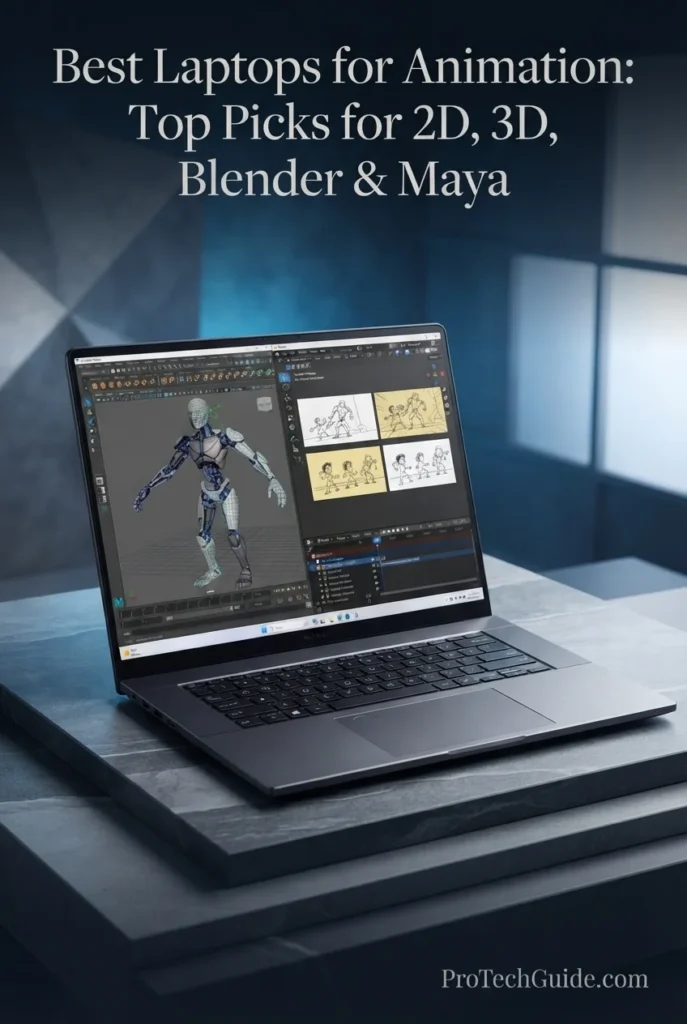
The HIDevolution ASUS ProArt P16 H7606WP with Ryzen AI 9 HX 370, RTX 5070, 64GB LPDDR5X memory, and a 2TB PCIe 4.0 SSD is our Best Overall Animation Laptop for 2026. Its combination of a 12-core/24-thread processor, dedicated NVIDIA graphics with 8GB of GDDR7 memory, unusually generous 64GB system memory, fast 2TB storage, and a 16-inch 4K OLED touchscreen creates a well-balanced platform for demanding animation workflows. It is particularly well positioned for creators who move between 2D animation, 3D modeling, Blender, Maya, compositing, motion graphics, and other content-creation applications where both compute capacity and a high-resolution display matter.
The ProArt P16 earns our Best Overall Animation Laptop position because its configuration avoids over-specializing in a single type of creative workload. The combination of Ryzen AI 9 HX 370 processing, RTX 5070 graphics, 64GB of memory, 2TB storage, and a 4K OLED touchscreen gives animators a strong balance between 3D capability, creative multitasking, visual quality, and everyday mobility. It is a particularly compelling fit for creators who want one premium Windows laptop capable of handling both animation production and broader creative work.
Compared with the Lenovo Legion Pro 7i Gen 10 and MSI Vector 16 HX AI, which emphasize higher-tier RTX 5080 graphics and maximum performance for demanding 3D workloads, the ProArt P16 takes a more balanced creator-oriented approach while providing twice the system memory of the 32GB configurations selected for those models. Its 4K OLED touchscreen and 64GB memory also distinguish it from performance-focused gaming laptops. For users whose priority is the highest possible GPU performance rather than an overall creator balance, one of the higher-powered RTX configurations in this guide may be more appropriate.
Key Features
Lenovo Legion Pro 7i Gen 10
Best for Blender, Maya, 3D Rendering & GPU-Intensive Animation
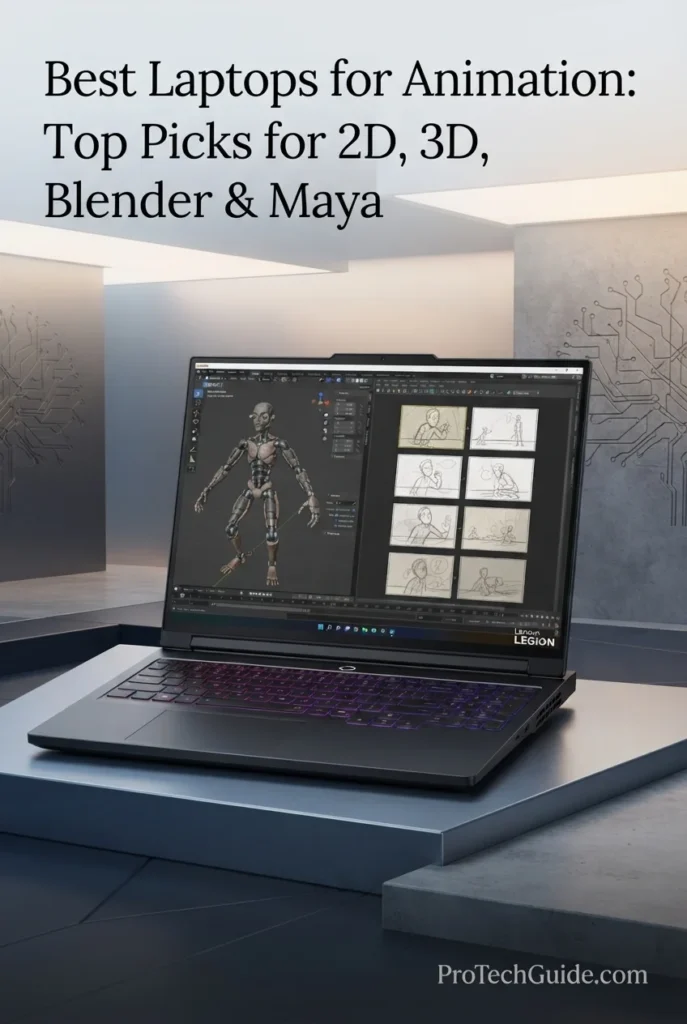
The Lenovo Legion Pro 7i Gen 10 with the Intel Core Ultra 9 275HX, NVIDIA GeForce RTX 5080, 32GB DDR5 memory, and 1TB Gen 5 NVMe SSD is our Best for High-End 3D Animation in 2026. Its 24-core processor and RTX 5080 Laptop GPU with 16GB of dedicated GDDR7 memory give this configuration the hardware foundation needed for demanding 3D modeling, animation, GPU-accelerated rendering, complex viewport work, and visual-effects workflows. The 16-inch 2560 × 1600 OLED display adds a high-resolution workspace with a 240Hz refresh rate and 500-nit listed brightness, making the Legion Pro 7i particularly well suited to creators who prioritize sustained performance and detailed visual work over maximum portability.
The Legion Pro 7i Gen 10 earns our Best for High-End 3D Animation position because its configuration puts the emphasis where demanding 3D workflows need it most: a high-core-count processor, RTX 5080 graphics, and 16GB of dedicated VRAM. That combination gives Blender and Maya users substantially more GPU memory headroom than mainstream RTX configurations, making it particularly relevant for complex scenes, detailed assets, GPU rendering, and visually demanding animation projects.
Compared with the ASUS ProArt P16, the Legion Pro 7i Gen 10 places greater emphasis on raw 3D performance through its RTX 5080 16GB GPU, while the ProArt configuration provides 64GB of system memory, 2TB of storage, and a 4K OLED touchscreen. The MSI Vector 16 HX AI offers a closely related RTX 5080/32GB performance profile, making the Legion's OLED display and specific configuration important differentiators. For animators primarily focused on demanding 3D rendering and GPU-intensive workloads, the Legion's 16GB VRAM configuration provides substantial capacity for supported GPU-based workflows.
Key Features
MSI Vector 16 HX AI Gaming Laptop
High-Performance Laptop for Blender, Maya & GPU-Accelerated Rendering
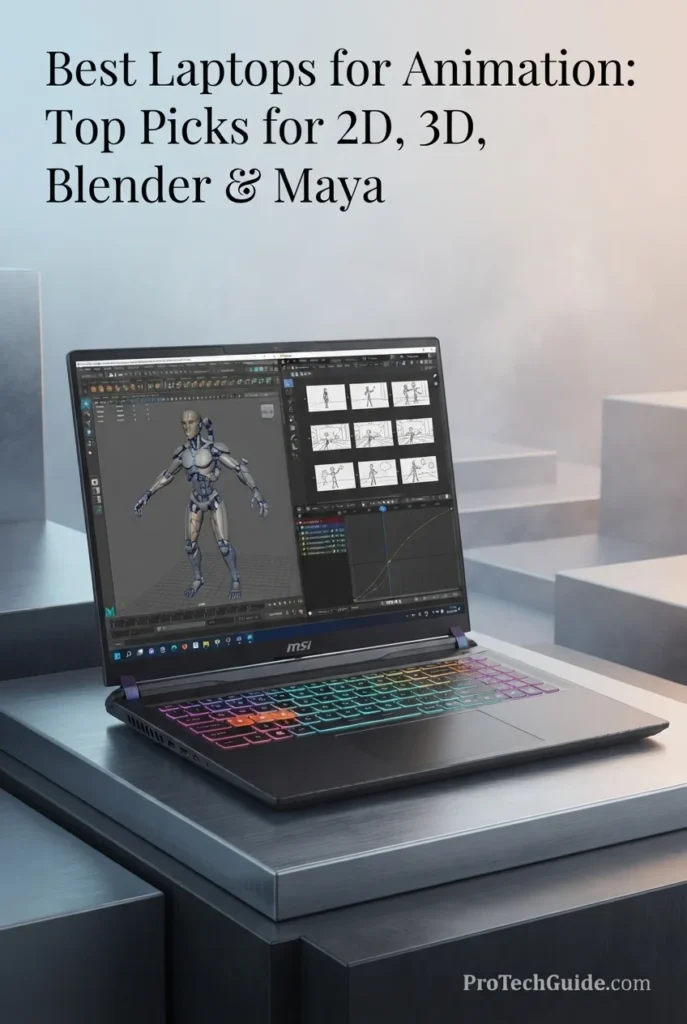
The MSI Vector 16 HX AI with the Intel Core Ultra 9 275HX, NVIDIA GeForce RTX 5080 Laptop GPU with 16GB GDDR7, 32GB DDR5 memory, and 1TB NVMe SSD is a high-performance choice for 3D animation, Blender, Maya, rendering, VFX, and demanding creative production in 2026. Its 24-core processor, 16GB of dedicated GPU memory, QHD+ 2560×1600 240Hz display, and high-power thermal platform give animators substantial performance headroom for complex 3D scenes, viewport work, GPU-accelerated rendering, simulations, texturing, compositing, and multitasking across professional creative applications. The RTX 5080 Laptop GPU also brings NVIDIA's Blackwell architecture, 16GB GDDR7 memory, and up to 1334 AI TOPS to workflows that can benefit from modern GPU acceleration.
The MSI Vector 16 HX AI earns our Best Performance Value for 3D Animation award because it combines a 24-core Core Ultra 9 275HX processor, RTX 5080 Laptop GPU with 16GB GDDR7, 32GB RAM, and a high-refresh QHD+ display in a performance-focused 16-inch chassis. It is especially compelling for creators who need serious GPU and CPU capability for Blender, Maya, rendering, VFX, and real-time 3D work without moving to a heavier mobile workstation platform.
Compared with premium creator and gaming laptops using lower-tier GPUs, the Vector 16 HX AI's 16GB RTX 5080 Laptop GPU gives it considerably more VRAM headroom for demanding 3D scenes and GPU rendering. Its gaming-oriented chassis is less focused on workstation certification than professional mobile workstations, but its combination of high-end NVIDIA graphics, a 24-core processor, strong display specifications, and extensive connectivity makes it particularly well suited to animation creators who value raw performance and flexible Windows-based production workflows.
Key Features
Razer Blade 16 (2026) Gaming Laptop
Portable Performance for Blender, Maya & Creative Workflows
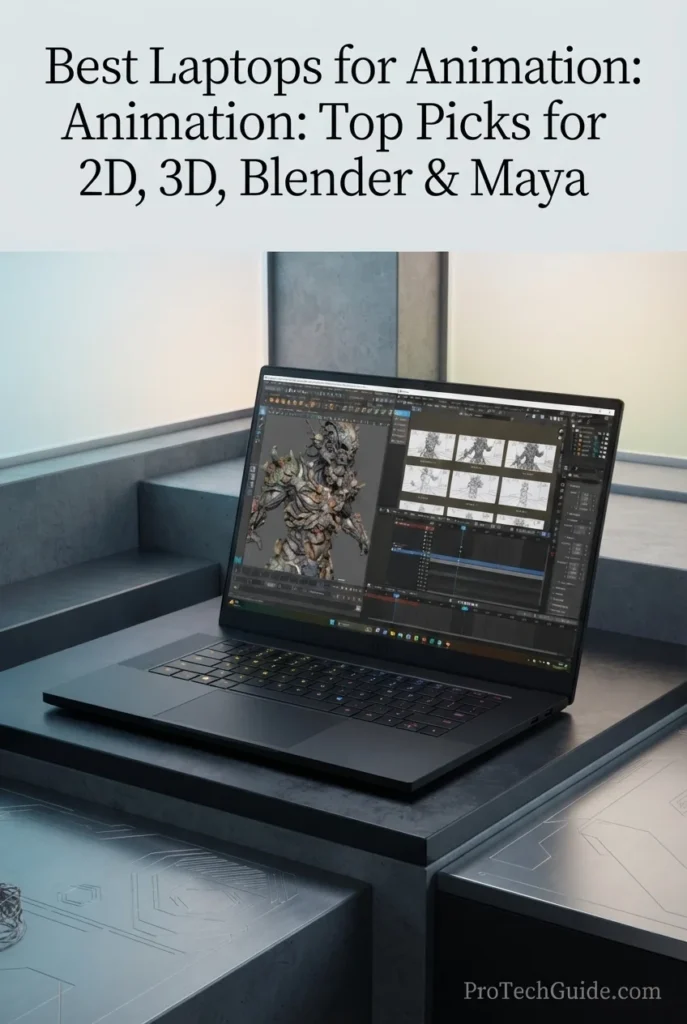
The Razer Blade 16 (2026) with the Intel Core Ultra 9 386H, NVIDIA GeForce RTX 5070 Ti with 12GB GDDR7, 32GB LPDDR5X memory, and 1TB PCIe 4.0 SSD is our portable-performance recommendation for animation, Blender, Maya, motion graphics, and professional creative work in 2026. Its 16-core processor, Blackwell-based RTX 5070 Ti Laptop GPU, high-speed memory, and 16-inch QHD+ OLED display create a powerful combination for creators who need serious 3D capability without moving to a larger, heavier performance laptop. The 12GB of dedicated VRAM provides useful headroom for 3D scenes, textures, viewport work, and GPU-accelerated rendering, while the OLED panel's 240Hz refresh rate, 16:10 format, and wide-gamut presentation make it particularly attractive for both animation production and visual content creation.
The Razer Blade 16 earns our Best Portable Laptop for Animation award because it balances serious 3D capability with a thinner premium chassis than many high-performance gaming and rendering laptops. The combination of the Core Ultra 9 386H, RTX 5070 Ti with 12GB VRAM, 32GB high-speed memory, and QHD+ OLED display makes it especially compelling for animators who need to work away from a permanent desktop setup without dropping into entry-level hardware.
Compared with larger performance laptops equipped with RTX 5080-class GPUs, the Razer Blade 16 trades some GPU and VRAM headroom for a more portable design. Its 12GB RTX 5070 Ti is well positioned for mainstream professional Blender and Maya work, but creators working regularly with exceptionally large scenes, heavy simulations, or very demanding GPU rendering may benefit from moving to a 16GB or higher GPU configuration. The Blade 16 is therefore particularly well matched to mobile creators who value the balance between performance, display quality, and portability.
Key Features
Dell Pro Max 16 Plus MB16250
Professional Workstation for 3D Animation, VFX & Creative Production
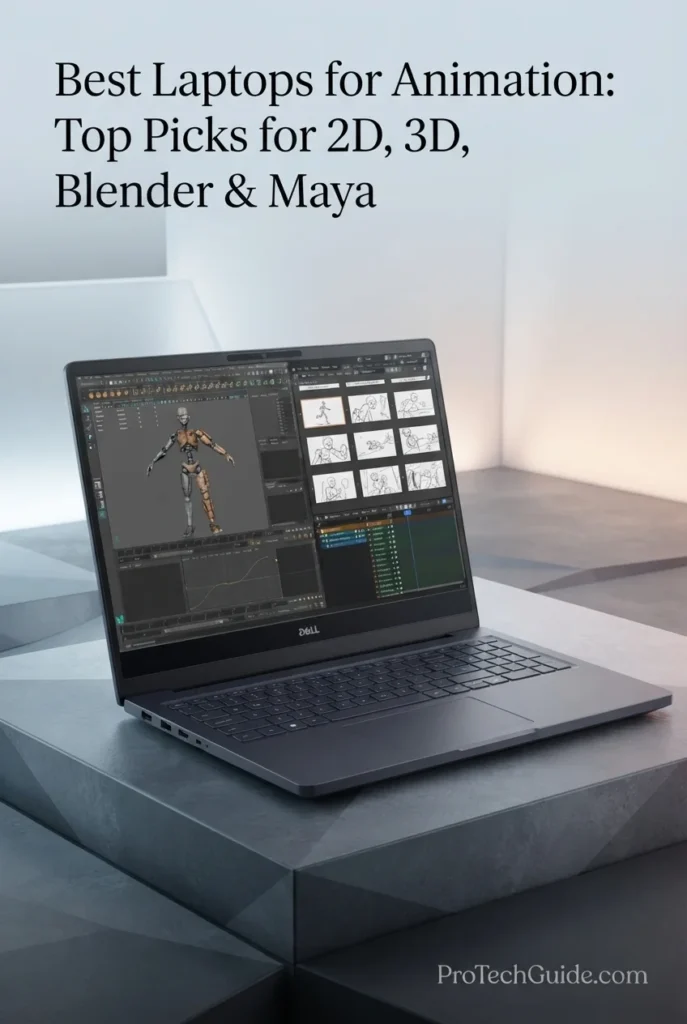
The Dell Pro Max 16 Plus MB16250 with Intel Core Ultra 7 265HX, 64GB of RAM, NVIDIA RTX PRO 1000 Blackwell graphics, 512GB SSD, and a 16-inch UHD+ touchscreen is a professional mobile workstation designed for demanding creative and engineering workloads where workstation-class graphics, substantial memory, and Windows compatibility are important. Its 20-core processor, 8GB RTX PRO 1000 Blackwell GPU, 64GB memory configuration, and high-resolution 3840 × 2400 display make it particularly well suited to professional 3D animation, Blender, Maya, VFX, CAD visualization, rendering, compositing, and multi-application creative workflows. The 64GB memory capacity is especially valuable for animators working with complex scenes, large assets, high-resolution textures, multiple creative applications, and extensive multitasking.
The Dell Pro Max 16 Plus earns our Best Mobile Workstation for Animation distinction because it combines a 20-core Intel processor, 64GB of memory, NVIDIA RTX PRO Blackwell graphics, a high-resolution 4K-class touchscreen, and Windows 11 Pro in a professional workstation platform. Its focus is different from a gaming laptop: instead of prioritizing maximum gaming performance, it is designed around professional graphics acceleration, memory capacity, software compatibility, and sustained creative productivity.
Compared with high-performance gaming laptops equipped with faster GeForce RTX GPUs, the Pro Max 16 Plus emphasizes professional workstation capabilities and business-oriented deployment rather than maximum consumer GPU performance. Its 8GB RTX PRO 1000 Blackwell is appropriate for many professional animation and visualization workloads, but creators working with exceptionally large GPU-rendered scenes, complex simulations, or extremely demanding VFX projects should consider workstation configurations with more VRAM, such as the higher RTX PRO options Dell offers for the same platform.
Key Features
HP ZBook Fury G1i 16 Mobile Workstation
Professional Workstation for 3D Animation, VFX & Production Workflows
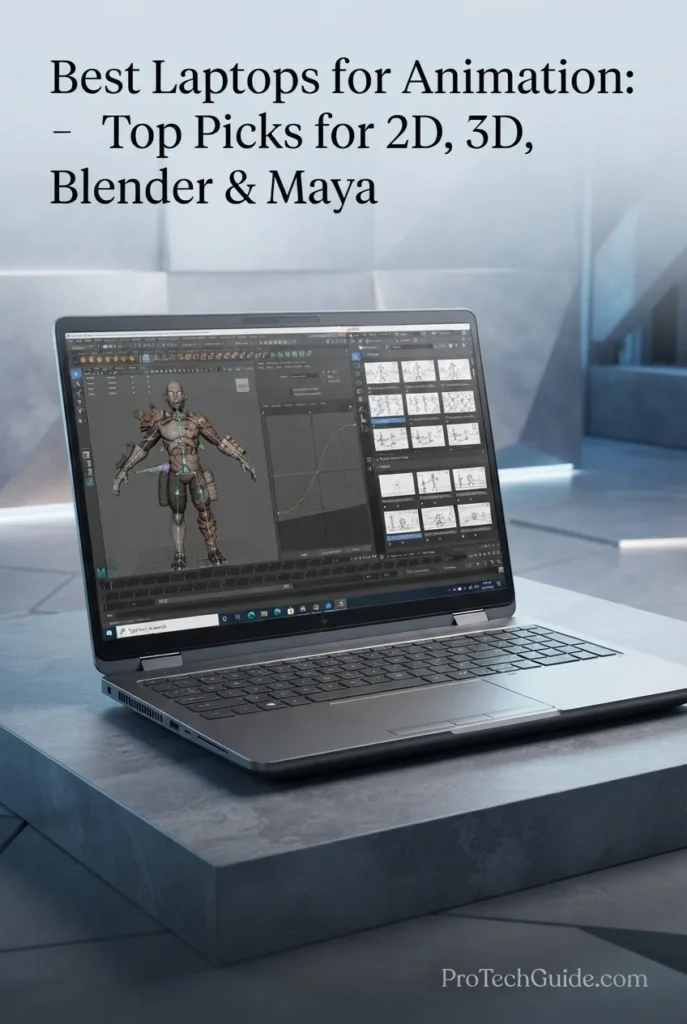
The HP ZBook Fury G1i 16 Mobile Workstation with Intel Core Ultra 7 255HX, 32GB of DDR5 memory, NVIDIA RTX PRO 1000 Blackwell graphics, and a 512GB PCIe 4.0 SSD is a professional Windows workstation designed for creators who need workstation-class graphics and expandability in a mobile platform. Its 20-core processor, dedicated 8GB RTX PRO 1000 Blackwell GPU, 32GB memory configuration, and 16-inch 2560 × 1600 WQXGA display provide a strong foundation for Blender, Maya, 3D modeling, animation, VFX, visualization, compositing, and professional production workflows. Its workstation-oriented design is particularly relevant to professionals who value certified graphics drivers, upgradeability, professional connectivity, and long-term expansion potential.
The ZBook Fury G1i 16 earns our Best Professional Workstation for Animation distinction because it combines a high-core-count Intel HX processor, NVIDIA RTX PRO Blackwell graphics, expandable DDR5 memory, professional Windows software compatibility, and a workstation-focused design. It is particularly compelling for animators and technical artists who value expandability and professional graphics support as much as raw performance.
Compared with high-performance gaming laptops equipped with faster GeForce RTX GPUs, the ZBook Fury G1i places greater emphasis on professional workstation characteristics, expandability, business deployment, and NVIDIA RTX PRO graphics. Its 8GB RTX PRO 1000 is well suited to many professional 3D and visualization workloads, but artists working with exceptionally large GPU-rendered scenes, complex simulations, or demanding VFX projects should consider higher-VRAM workstation configurations when available.
Key Features
Apple MacBook Pro 16-inch M5 Max
High-End Performance for 3D Animation, Rendering & Creative Production
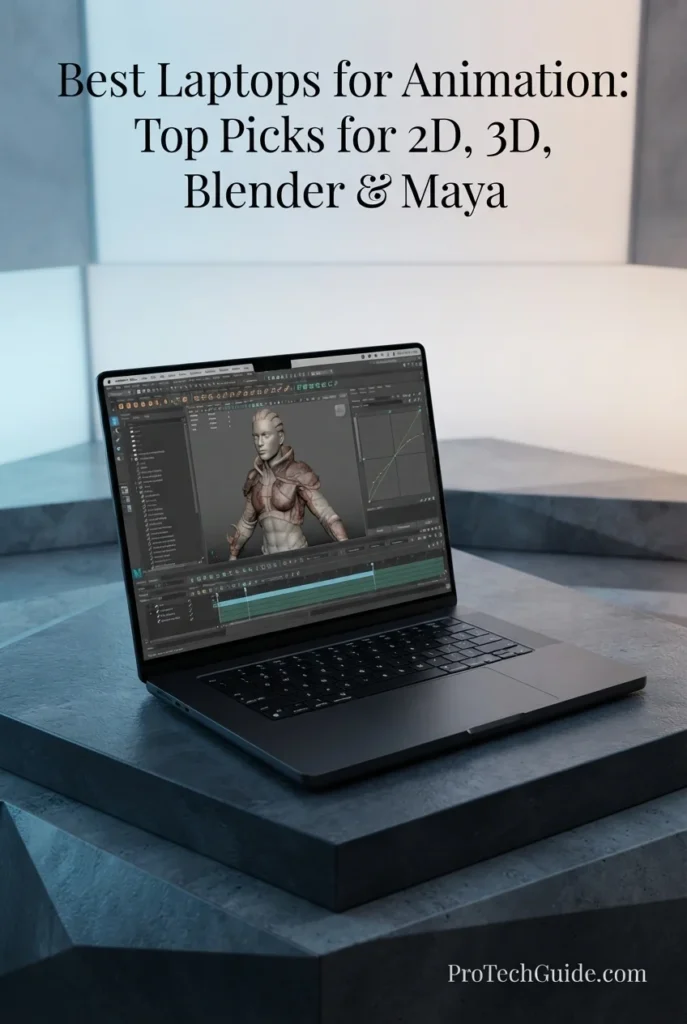
The Apple MacBook Pro 16-inch with the M5 Max chip, 18-core CPU, 40-core GPU, 48GB of unified memory, and 2TB SSD is our top macOS recommendation for professional animation in 2026. Its 18-core CPU, 40-core GPU with hardware-accelerated ray tracing, 614GB/s memory bandwidth, large unified memory pool, fast SSD, and 16.2-inch Liquid Retina XDR display create a powerful platform for 3D animation, motion graphics, video production, compositing, rendering, and demanding creative workflows. The 48GB unified-memory configuration is particularly valuable for creators working with complex scenes, high-resolution assets, multiple creative applications, and large projects simultaneously, while Apple's dedicated media engines are especially useful for video-heavy production pipelines.
The MacBook Pro 16 earns our Best MacBook for Animation award because it combines an unusually powerful M5 Max configuration with 48GB of unified memory, 2TB of storage, a reference-quality-class Liquid Retina XDR display, advanced media acceleration, and strong mobile performance. For animation professionals whose software ecosystem is compatible with macOS, it provides a sophisticated alternative to Windows-based gaming and mobile workstations, particularly for motion graphics, video production, compositing, and color-sensitive creative work.
Compared with high-end Windows animation laptops such as the Lenovo Legion Pro 7i Gen 10 and MSI Vector 16 HX AI, the MacBook Pro takes a fundamentally different approach. Its M5 Max architecture delivers very high unified-memory bandwidth, hardware-accelerated ray tracing, dedicated media engines, and exceptional power efficiency, while Windows RTX workstations offer NVIDIA CUDA and broader compatibility with GPU-accelerated 3D applications and specialized Windows workflows. For creators whose production pipeline depends on CUDA-specific rendering engines, Windows-only software, or NVIDIA-exclusive plugins, a Windows workstation may be the more appropriate platform.
Key Features
ASUS ROG Strix SCAR 18 (2025)
Extreme RTX 5090 Performance for 3D Animation, Blender & Rendering
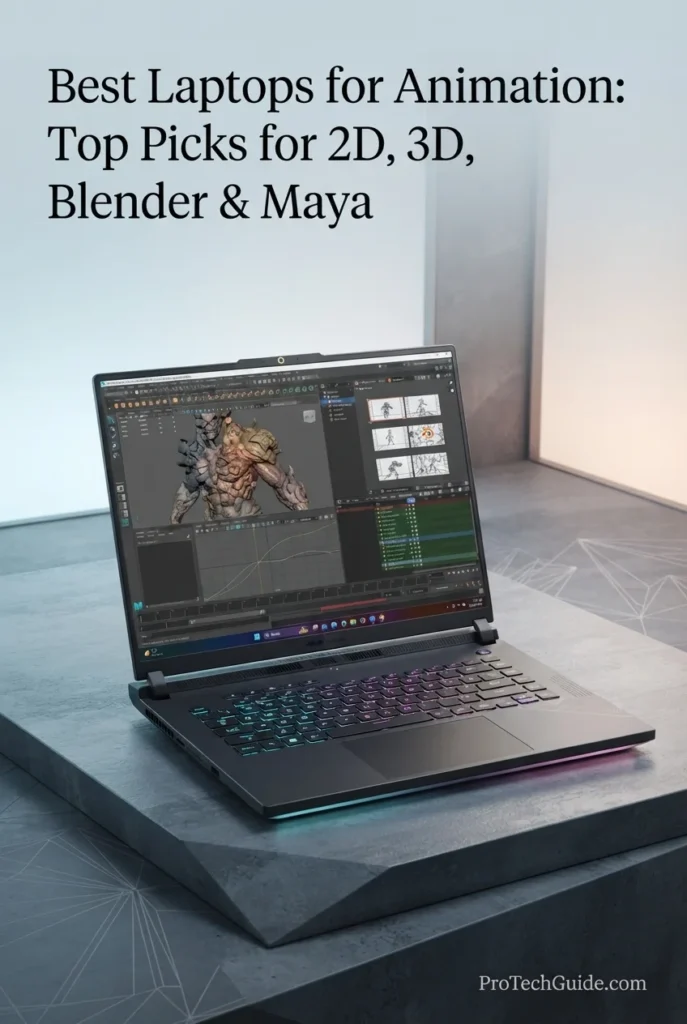
The ASUS ROG Strix SCAR 18 (2025) with the Intel Core Ultra 9 275HX, NVIDIA GeForce RTX 5090 Laptop GPU, 32GB DDR5-5600 memory, and 2TB PCIe 4.0 SSD is our extreme-performance recommendation for 3D animation, GPU rendering, Blender, Maya, and demanding creative production in 2026. Its 24-core processor, RTX 5090 with 24GB of GDDR7 VRAM and up to 175W GPU power, large 18-inch 2560 × 1600 Mini LED display, and high-speed storage create a powerful platform for complex 3D scenes, GPU-accelerated rendering, animation, VFX, simulation, and content creation. The 24GB VRAM capacity is particularly significant for professional 3D artists working with large scenes, high-resolution textures, complex geometry, and GPU-intensive rendering workloads where graphics memory can become a limiting factor.
The ROG Strix SCAR 18 earns our Best GPU Power for Animation award because it combines an RTX 5090 Laptop GPU with an unusually large 24GB of GDDR7 VRAM, a 24-core Core Ultra 9 processor, 32GB of DDR5 memory, 2TB of storage, and a large 18-inch Mini LED display. For creators whose priority is GPU-intensive 3D animation, rendering, VFX, and complex visual workloads, its hardware configuration provides substantial graphics and memory headroom.
Compared with premium creator laptops such as the Apple MacBook Pro 16-inch M5 Max and more portable RTX-based systems, the ROG Strix SCAR 18 takes a distinctly performance-first approach. Its RTX 5090 and 24GB VRAM provide a major advantage for compatible NVIDIA-accelerated 3D and rendering workflows, while the 18-inch chassis, high-power cooling system, and 6.28-pound listed weight make it considerably more focused on sustained desktop-replacement performance than mobility.
Key Features
Best Laptops for Animation in 2026
Compared by CPU Performance, GPU Power, VRAM, RAM Capacity, Blender, Maya, Rendering, Display Quality, Thermals & Overall Animation Capability
Choosing the best laptop for animation in 2026 requires more than comparing processor specifications. Animators need the right balance of CPU performance for scene preparation and simulation, GPU power and VRAM for Blender and Maya workloads, sufficient RAM for complex projects, fast storage for large creative assets, a color-capable display, sustained thermal performance, and software compatibility. We evaluated these laptops across real-world animation workflows including 2D animation, 3D modeling, Blender, Maya, rendering, motion graphics, VFX, visualization, compositing, multitasking, and professional creative production to help you match the right hardware to your animation workflow.
| Laptop | CPU & Key Specs | Best For | Why It Wins | Editor's Verdict |
|---|---|---|---|---|
Best Overall
ASUS ProArt P16 H7606WP
Check Price
|
Ryzen AI 9 HX 370 12-Core / 24-Thread CPU RTX 5070 8GB GDDR7 64GB LPDDR5X 2TB PCIe 4.0 SSD 16" 4K OLED Touch |
3D Animation Blender & Maya Motion Graphics VFX & Rendering | The ProArt P16 combines a high-performance Ryzen AI 9 HX 370 processor, RTX 5070 graphics, 64GB of memory, 2TB of fast storage, and a 16-inch 4K OLED touchscreen in a creator-focused chassis. Its balanced hardware configuration makes it particularly well suited to animators who move between 3D modeling, Blender and Maya, rendering, compositing, motion graphics, and color-sensitive creative work. | Best Overall Laptop for Animation |
Best High-End 3D
Lenovo Legion Pro 7i Gen 10
Check Price
|
Intel Core Ultra 9 275HX 24-Core / 24-Thread CPU RTX 5080 16GB GDDR7 32GB DDR5-6400 1TB PCIe 4.0 SSD 16" 2560×1600 OLED 240Hz |
High-End 3D Animation Blender Rendering Maya & VFX Complex 3D Scenes | The Legion Pro 7i pairs a 24-core Core Ultra 9 275HX processor with an RTX 5080 Laptop GPU featuring 16GB of GDDR7 memory. Its 32GB DDR5 configuration and 16-inch 2560×1600 OLED display provide a strong foundation for demanding 3D animation, GPU-accelerated rendering, Maya, Blender, VFX, and professional creative production. | Best High-End Laptop for 3D Animation |
Best Performance Value
MSI Vector 16 HX AI
Check Price
|
Intel Core Ultra 9 275HX 24-Core / 24-Thread CPU RTX 5080 16GB GDDR7 32GB DDR5 1TB SSD 16" 2560×1600 IPS 240Hz |
3D Animation GPU Rendering Blender & Maya VFX Production | The MSI Vector 16 HX AI combines the same high-end Core Ultra 9 275HX platform with an RTX 5080 Laptop GPU and 16GB of GDDR7 VRAM, while its high-power cooling design is built around sustained CPU and GPU performance. The 240Hz QHD+ display, 32GB of DDR5 memory, Wi-Fi 7, and extensive connectivity further support demanding animation and production workflows. | Best Performance Value for 3D Animation |
Best Portable
Razer Blade 16 (2026)
Check Price
|
Intel Core Ultra 9 386H 16-Core CPU RTX 5070 Ti 12GB GDDR7 32GB LPDDR5X-9600 1TB PCIe 4.0 SSD 16" 2560×1600 OLED 240Hz |
Mobile Animators Blender & Maya Motion Graphics Traveling Creators | The Razer Blade 16 emphasizes portability without dropping into entry-level animation hardware. Its Core Ultra 9 386H processor, RTX 5070 Ti with 12GB of GDDR7 VRAM, 32GB LPDDR5X memory, and 16-inch QHD+ OLED display create a strong mobile platform for Blender, Maya, motion graphics, VFX, and creative production. | Best Portable Laptop for Animation |
Best Workstation
Dell Pro Max 16 Plus MB16250
Check Price
|
Intel Core Ultra 7 265HX 20-Core / 20-Thread CPU RTX PRO 1000 Blackwell 8GB 64GB RAM 512GB SSD 16" 3840×2400 Touch |
Professional Animation VFX & Visualization Workstation Workloads Technical Creatives | The Dell Pro Max 16 Plus is built around a professional mobile-workstation platform, combining a 20-core Core Ultra 7 265HX processor, RTX PRO 1000 Blackwell graphics, 64GB of memory, and a high-resolution 16-inch UHD+ touchscreen. Its workstation-oriented hardware makes it particularly relevant to professional animation, VFX, visualization, and technical creative workflows where memory capacity and professional graphics support matter. | Best Professional Mobile Workstation for Animation |
Best Professional Workstation
HP ZBook Fury G1i 16
Check Price
|
Intel Core Ultra 7 255HX 20-Core / 20-Thread CPU RTX PRO 1000 Blackwell 8GB 32GB DDR5 512GB PCIe 4.0 SSD 16" 2560×1600 IPS 120Hz |
Professional 3D Animation VFX & Production Maya & CAD Visualization Upgradeable Workstations | The ZBook Fury G1i combines a 20-core Core Ultra 7 255HX processor with professional RTX PRO 1000 Blackwell graphics and a workstation-oriented memory architecture. Its 32GB DDR5 configuration and four SODIMM slots provide a practical foundation for professional animation workflows, while the 16-inch WQXGA display offers additional workspace for timelines, scene panels, modeling tools, and production applications. | Best Professional Workstation for Animation |
Best MacBook
Apple MacBook Pro 16-inch M5 Max
Check Price
|
Apple M5 Max 18-Core CPU / 40-Core GPU 48GB Unified Memory 2TB SSD 16.2" Liquid Retina XDR Wi-Fi 7 |
macOS Animation Motion Graphics Video & VFX Creative Professionals | The 16-inch MacBook Pro with M5 Max provides substantial CPU and GPU resources, 48GB of unified memory, 2TB of storage, and a high-end Liquid Retina XDR display. Its dedicated media engines and efficient Apple silicon platform make it particularly suitable for macOS-based animation, motion graphics, video, compositing, and creative production, while software and GPU-acceleration compatibility should be considered for Windows- or CUDA-specific workflows. | Best MacBook for Animation |
Best GPU Power
ASUS ROG Strix SCAR 18 (2025)
Check Price
|
Intel Core Ultra 9 275HX 24-Core / 24-Thread CPU RTX 5090 24GB GDDR7 32GB DDR5-5600 2TB PCIe Gen 4 SSD 18" 2560×1600 Mini LED 240Hz |
Extreme 3D Animation GPU Rendering Blender & Maya Large 3D Scenes | The ROG Strix SCAR 18 is the most GPU-focused configuration in this lineup, pairing the Core Ultra 9 275HX with an RTX 5090 Laptop GPU and 24GB of GDDR7 VRAM. Its 32GB DDR5 memory, 2TB SSD, large 18-inch Mini LED display, and high-performance cooling platform are designed for demanding 3D animation, GPU rendering, Blender, Maya, VFX, and complex scene workloads. | Best GPU Power for Animation |
Recommended Next Reads
Finished comparing the best laptops for animation? Explore our related creative laptop guides for 3D modeling, video editing, graphic design, professional displays, CAD, high-performance workflows, and demanding visual production.
Whether you're creating 2D animation, working in Blender or Maya, producing motion graphics in After Effects, building 3D scenes, rendering VFX, designing visual assets, or working across demanding creative applications, these guides can help you understand the hardware requirements behind different workflows and choose the right laptop for your specific needs.
Best Laptops for 3D Modeling in 2026
Explore laptops selected for 3D modeling, Blender, Maya, rendering, visualization, CAD, and demanding professional 3D workflows.
Explore 3D Modeling Laptops →Best Laptops for Video Editing in 2026
Compare laptops for video editing, After Effects, motion graphics, compositing, VFX, 4K workflows, and demanding creative production.
Explore Video Editing Laptops →Graphic Design & Creative WorkBest Laptops for Graphic Design in 2026
Find laptops for Photoshop, Illustrator, visual design, digital art, creative applications, color-sensitive work, and professional design workflows.
Explore Graphic Design Laptops →Display QualityBest OLED Laptops in 2026
Explore OLED laptops with high-quality displays suited to animation, digital art, video production, color-sensitive creative work, and visual content creation.
Explore OLED Laptops →CAD & 3D DesignBest Laptops for CAD in 2026
Compare laptops for AutoCAD, SolidWorks, 3D design, engineering modeling, visualization, and demanding computer-aided design workflows.
Explore CAD Laptops →Performance & ValueBest Laptops Under $2000 in 2026
Explore powerful laptops for creative professionals, students, 3D applications, rendering, gaming-class GPUs, and demanding productivity workloads.
Explore Laptops Under $2000 →Professional 3D WorkflowsBest Laptops for AutoCAD in 2026
Find laptops built for AutoCAD, 2D drafting, 3D modeling, visualization, technical design, and demanding professional CAD workflows.
Explore AutoCAD Laptops →EDITOR'S FINAL RECOMMENDATIONS
After comparing laptops across CPU performance, GPU power, VRAM capacity, RAM, Blender and Maya workloads, 2D animation, 3D animation, rendering, VFX, motion graphics, display quality, storage, thermals, portability, software compatibility, and long-term creative capability, these are our final recommendations for animators in 2026. Whether you create 2D artwork, build complex Blender or Maya scenes, produce motion graphics in After Effects, work with VFX, or need a professional mobile workstation for demanding production workflows, there is an option here for your specific creative needs.
ASUS ProArt P16 H7606WP
The best overall balance for animation in 2026. This ProArt P16 configuration combines the Ryzen AI 9 HX 370, RTX 5070 Laptop GPU with 8GB of GDDR7 VRAM, 64GB of LPDDR5X memory, a 2TB PCIe 4.0 SSD, and a 16-inch 4K OLED touchscreen. It is particularly well suited to Blender, Maya, After Effects, 2D and 3D animation, motion graphics, compositing, and professional creative production where display quality and memory capacity matter alongside GPU acceleration.
- ✓ AMD Ryzen AI 9 HX 370
- ✓ NVIDIA GeForce RTX 5070 8GB GDDR7
- ✓ 64GB LPDDR5X Memory
- ✓ 16-inch 4K OLED Touchscreen
Lenovo Legion Pro 7i Gen 10
The high-end choice for animators who regularly build demanding 3D scenes, work with complex Blender or Maya projects, or need substantial GPU rendering headroom. Its Core Ultra 9 275HX and RTX 5080 Laptop GPU with 16GB of GDDR7 provide a powerful combination for GPU-accelerated rendering, viewport work, simulation, VFX, and other intensive 3D production workloads, while the OLED display adds strong color and contrast for creative work.
- ✓ Intel Core Ultra 9 275HX
- ✓ NVIDIA GeForce RTX 5080 16GB GDDR7
- ✓ 32GB DDR5-6400 Memory
- ✓ 16-inch 2560×1600 OLED 240Hz Display
MSI Vector 16 HX AI
The performance-focused option for creators who want RTX 5080-class GPU power without moving to a larger 18-inch system. The Core Ultra 9 275HX, RTX 5080 with 16GB GDDR7, 32GB DDR5 memory, and QHD+ 240Hz display create a strong platform for Blender, Maya, GPU rendering, VFX, animation previews, and high-load creative applications. Its high-power thermal design is especially relevant to sustained production workloads.
- ✓ Intel Core Ultra 9 275HX
- ✓ NVIDIA GeForce RTX 5080 16GB GDDR7
- ✓ 32GB DDR5 Memory
- ✓ 16-inch QHD+ 2560×1600 240Hz Display
Razer Blade 16 (2026)
The portable choice for animators who need serious GPU capability without carrying a traditional workstation-sized laptop. Its Core Ultra 9 386H, RTX 5070 Ti with 12GB of GDDR7, 32GB LPDDR5X memory, and 16-inch QHD+ 240Hz OLED display provide a strong combination for Blender, Maya, motion graphics, VFX, and mobile creative production. Its CNC-milled aluminum chassis and compact 16-inch design make it particularly practical for creators who move between studios, classrooms, offices, and home setups.
- ✓ Intel Core Ultra 9 386H
- ✓ NVIDIA GeForce RTX 5070 Ti 12GB GDDR7
- ✓ 32GB LPDDR5X-9600 Memory
- ✓ 16-inch QHD+ 2560×1600 240Hz OLED
Dell Pro Max 16 Plus MB16250
The professional workstation option for animators who prioritize certified workstation hardware, large memory capacity, professional applications, and Windows 11 Pro. Its Core Ultra 7 265HX, RTX PRO 1000 Blackwell with 8GB GDDR7, 64GB of RAM, and 16-inch UHD+ touchscreen provide a workstation-oriented platform for professional 3D animation, visualization, VFX, technical content creation, and demanding production environments.
- ✓ Intel Core Ultra 7 265HX
- ✓ NVIDIA RTX PRO 1000 Blackwell 8GB
- ✓ 64GB Memory
- ✓ 16-inch 3840×2400 UHD+ Touchscreen
HP ZBook Fury G1i 16 Mobile Workstation
The professional workstation choice for animators and technical artists who want workstation-class hardware, Windows 11 Pro, and substantial memory expansion potential. This configuration pairs the Core Ultra 7 255HX with an RTX PRO 1000 Blackwell GPU with 8GB GDDR7, 32GB DDR5 memory, and a 16-inch 2560×1600 display. Its four SODIMM slots also provide a practical upgrade path for workflows that eventually require more memory for large scenes, simulations, multitasking, or professional production.
- ✓ Intel Core Ultra 7 255HX
- ✓ NVIDIA RTX PRO 1000 Blackwell 8GB
- ✓ 32GB DDR5 Memory
- ✓ 16-inch 2560×1600 IPS 120Hz Display
Apple MacBook Pro 16-inch M5 Max
The macOS choice for animators who prefer Apple's platform and work primarily with creative applications that support Apple silicon. This configuration combines the M5 Max with an 18-core CPU, 40-core GPU, 48GB of unified memory, and a 2TB SSD. It offers substantial CPU and GPU resources for creative production, animation, compositing, editing, and rendering workflows while retaining the display, battery, and software ecosystem advantages of a high-end MacBook Pro. Creators who depend on CUDA, NVIDIA-specific rendering, or Windows-only software should verify workflow compatibility before choosing macOS.
- ✓ Apple M5 Max 18-core CPU
- ✓ 40-core GPU
- ✓ 48GB Unified Memory
- ✓ 2TB SSD Storage
ASUS ROG Strix SCAR 18 (2025)
The GPU-focused choice for animators who prioritize maximum graphics memory and GPU-accelerated rendering capability. Its RTX 5090 Laptop GPU with 24GB of GDDR7 gives complex Blender and Maya scenes significantly more VRAM headroom than the 8GB and 12GB configurations elsewhere in this lineup. Combined with the Core Ultra 9 275HX, 32GB DDR5 memory, and a large 18-inch Mini LED display, it is designed around demanding 3D animation, rendering, VFX, simulation, and GPU-intensive creative workloads.
- ✓ Intel Core Ultra 9 275HX
- ✓ NVIDIA GeForce RTX 5090 24GB GDDR7
- ✓ 32GB DDR5-5600 Memory
- ✓ 18-inch 2560×1600 Mini LED 240Hz Display
Which animation laptop should you choose?
ASUS ProArt P16 H7606WP
Lenovo Legion Pro 7i Gen 10
MSI Vector 16 HX AI
Razer Blade 16 (2026)
Dell Pro Max 16 Plus MB16250
HP ZBook Fury G1i 16
MacBook Pro 16-inch M5 Max
ASUS ROG Strix SCAR 18
- Choose the ASUS ProArt P16 H7606WP if you want the most balanced combination of CPU performance, GPU acceleration, 64GB of memory, 2TB of storage, and a 4K OLED touchscreen for Blender, Maya, 2D/3D animation, motion graphics, and general creative production.
- Choose the Lenovo Legion Pro 7i Gen 10 if your work is heavily focused on demanding 3D animation, GPU rendering, complex Blender or Maya scenes, VFX, and other workloads where the RTX 5080's 16GB of VRAM provides more headroom than 8GB-class configurations.
- Choose the MSI Vector 16 HX AI if sustained performance and high-end GPU capability are central to your workflow. Its Core Ultra 9 275HX, RTX 5080 16GB, and high-power thermal design are well aligned with intensive 3D production and rendering workloads.
- Choose the Razer Blade 16 (2026) if you need a more portable high-performance system for animation. Its RTX 5070 Ti with 12GB of VRAM, 32GB LPDDR5X memory, and QHD+ 240Hz OLED display create a strong mobile platform, although its 12GB VRAM provides less headroom than the 16GB and 24GB options for exceptionally large GPU-heavy scenes.
- Choose the Dell Pro Max 16 Plus MB16250 if your animation workflow benefits from professional workstation hardware, Windows 11 Pro, 64GB of memory, and a high-resolution UHD+ touchscreen. Its RTX PRO 1000 Blackwell provides 8GB of VRAM, so extremely large GPU-rendered scenes may benefit from a higher-VRAM configuration.
- Choose the HP ZBook Fury G1i 16 if workstation expandability is important. Its 32GB DDR5 configuration and four SODIMM slots provide a useful foundation for professional animation, VFX, visualization, and simulation workflows that may require additional memory over time.
- Choose the Apple MacBook Pro 16-inch M5 Max if you prefer macOS and your animation software, plugins, render engines, and production pipeline are compatible with Apple silicon. Verify Windows-, NVIDIA-, and CUDA-dependent applications before moving a specialized production workflow to macOS.
- Choose the ASUS ROG Strix SCAR 18 if maximum GPU memory is the central requirement. Its RTX 5090 Laptop GPU with 24GB of GDDR7 provides the largest VRAM capacity in this lineup, making the configuration particularly relevant to complex 3D scenes, GPU rendering, VFX, simulation, and other memory-intensive animation workloads.
EDITOR'S FINAL VERDICT
After comparing CPU performance, GPU power, VRAM capacity, RAM, SSD storage, Blender and Maya workflows, 2D animation, 3D animation, rendering, VFX, motion graphics, display quality, thermals, portability, software compatibility, and long-term creative capability, one conclusion stands out:The best laptop for animation is not necessarily the most expensive workstation or the laptop with the fastest GPU. It is the system that provides the right balance of CPU performance, GPU acceleration, VRAM, memory capacity, display quality, thermal performance, software compatibility, portability, and storage for the type of animation you actually create.
Modern animators can work across 2D illustration and animation, Blender and Maya scenes, character modeling, rigging, texturing, compositing, After Effects motion graphics, VFX, simulation, viewport work, and final rendering. These workloads can place very different demands on a laptop: CPU performance matters for many modeling, simulation, and general production tasks, while a capable discrete GPU and sufficient VRAM become increasingly important for GPU rendering, real-time previews, complex 3D scenes, and GPU-accelerated creative workflows.
For most serious 3D animation workflows, 32GB of memory is a strong long-term target, while 16GB can remain suitable for lighter 2D work and moderate creative projects. GPU VRAM also deserves careful attention: 8GB can handle many mainstream Blender and Maya projects, 12GB provides additional headroom, while 16GB or 24GB becomes increasingly valuable for complex scenes, demanding textures, GPU rendering, VFX, and memory-intensive production workloads.- Choose the ASUS ProArt P16 H7606WP if you want the strongest overall balance of CPU performance, GPU acceleration, 64GB of memory, 2TB of storage, and a 4K OLED touchscreen for Blender, Maya, 2D/3D animation, motion graphics, compositing, and general creative production.
- Choose the Lenovo Legion Pro 7i Gen 10 if your workflow is centered on demanding 3D animation, complex Blender or Maya scenes, GPU rendering, VFX, and other workloads where the RTX 5080's 16GB of VRAM provides substantially more headroom than 8GB-class configurations.
- Choose the Apple MacBook Pro with M5 Max if your animation pipeline is compatible with macOS and Apple silicon and you value a high-end creative platform with substantial CPU/GPU resources, 48GB of unified memory, and a premium Liquid Retina XDR display. Verify specialized Windows-, NVIDIA-, or CUDA-dependent applications and plugins before choosing macOS.
- Choose the ASUS ROG Strix SCAR 18 if your primary requirement is maximum GPU memory for complex 3D scenes, GPU rendering, VFX, simulation, or other animation workloads where 24GB of VRAM can provide substantially more scene headroom.
Top Animation Laptop Recommendations (2026)
ASUS ProArt P16 H7606WP
Our Editor's Choice for animators who want a balanced professional creative platform. Its Ryzen AI 9 HX 370, RTX 5070 Laptop GPU, 64GB of LPDDR5X memory, 2TB SSD, and 16-inch 4K OLED touchscreen create a strong combination for Blender, Maya, 2D and 3D animation, motion graphics, compositing, visualization, and demanding creative production.
- ✓ AMD Ryzen AI 9 HX 370
- ✓ NVIDIA GeForce RTX 5070 8GB GDDR7
- ✓ 64GB LPDDR5X Memory
- ✓ 16-inch 4K OLED Touchscreen
Lenovo Legion Pro 7i Gen 10
The high-end choice for animators working with demanding 3D scenes, GPU rendering, VFX, and advanced Blender or Maya projects. The combination of the Core Ultra 9 275HX, RTX 5080 with 16GB GDDR7, 32GB DDR5-6400 memory, and 16-inch OLED display provides substantial performance headroom for intensive production workflows.
- ✓ Intel Core Ultra 9 275HX
- ✓ NVIDIA GeForce RTX 5080 16GB GDDR7
- ✓ 32GB DDR5-6400 Memory
- ✓ 16-inch 2560×1600 OLED 240Hz Display
Apple MacBook Pro 16-inch M5 Max
The Mac option for animators whose software and production pipeline are compatible with macOS and Apple silicon. Its M5 Max with an 18-core CPU, 40-core GPU, 48GB of unified memory, and 2TB SSD provides substantial resources for animation, creative production, compositing, editing, and rendering while maintaining the advantages of Apple's premium mobile platform.
- ✓ Apple M5 Max 18-core CPU
- ✓ 40-core GPU
- ✓ 48GB Unified Memory
- ✓ 2TB SSD Storage
- ✓ You want the strongest overall balance for 2D and 3D animation
- ✓ You regularly work with Blender, Maya, After Effects, VFX, and other creative applications
- ✓ You want 64GB of memory and 2TB of storage for demanding creative projects
- ✓ You value a high-resolution 4K OLED touchscreen alongside strong Windows performance
- ✓ Your workload is heavily focused on demanding 3D animation and rendering
- ✓ You want an RTX 5080 with 16GB of GDDR7 VRAM
- ✓ You regularly work with complex Blender or Maya scenes, VFX, or GPU-accelerated workloads
- ✓ You want a high-refresh OLED display alongside high-end CPU and GPU performance
- ✓ Target 32GB of RAM for demanding professional animation workflows and long-term use
- ✓ Consider 16GB suitable for lighter 2D animation, students, and moderate creative workloads
- ✓ Pay close attention to GPU VRAM when working with complex 3D scenes, large textures, GPU rendering, VFX, or simulations
- ✓ Prioritize sustained cooling and performance when rendering or working under prolonged production loads
- ✓ Verify Blender, Maya, render-engine, plugin, and operating system compatibility before choosing between Windows and macOS
An animation laptop is a professional creative tool that may be used for thousands of hours across modeling, illustration, rigging, texturing, animation, compositing, rendering, VFX, motion graphics, and visual production. Raw CPU and GPU specifications matter, but memory capacity, VRAM, display quality, thermal design, storage, software compatibility, keyboard and trackpad experience, portability, and long-term expandability can have an equally important impact on everyday creative work.
Among the models evaluated in this guide, the ASUS ProArt P16 H7606WP provides the strongest overall balance of CPU performance, RTX graphics, 64GB of memory, 2TB storage, and a 4K OLED touchscreen, making it our Editor's Choice for the best laptop for animation in 2026.The Lenovo Legion Pro 7i Gen 10 is particularly well matched to demanding 3D animation and rendering workloads because of its RTX 5080 with 16GB of VRAM, while the MSI Vector 16 HX AI provides another RTX 5080-based option focused on high sustained performance. The Razer Blade 16 (2026) offers a more portable high-performance alternative with 12GB of VRAM. For creators who need maximum GPU memory, the ASUS ROG Strix SCAR 18 provides 24GB of GDDR7 VRAM. The Apple MacBook Pro 16-inch M5 Max remains the macOS alternative for animation pipelines compatible with Apple silicon and macOS.
Compare current prices, configurations, memory, VRAM, storage, display specifications, warranty coverage, and availability before choosing the laptop that best matches your 2D, 3D, Blender, Maya, VFX, or rendering workflow.
Check Latest DealsEDITOR'S FAQ
Choosing the best laptop for animation requires more than comparing processor specifications. Animators need to consider CPU performance, GPU power, VRAM capacity, RAM, SSD storage, display quality, thermals, software compatibility, portability, and the type of creative workload they expect to perform.These frequently asked questions address the most important buying decisions, from determining how much RAM and VRAM you need for Blender and Maya to choosing between Windows and macOS, understanding the difference between 2D and 3D animation requirements, and selecting the right laptop for rendering, VFX, After Effects, and professional animation production.
Its Ryzen AI 9 HX 370 processor, NVIDIA GeForce RTX 5070 Laptop GPU with 8GB of GDDR7 VRAM, 64GB of LPDDR5X memory, 2TB PCIe 4.0 SSD, and 16-inch 4K OLED touchscreen create a strong balance for 2D animation, 3D animation, Blender, Maya, After Effects, compositing, visualization, and general creative production.
- AMD Ryzen AI 9 HX 370 with 12 cores and 24 threads.
- NVIDIA GeForce RTX 5070 Laptop GPU with 8GB GDDR7 VRAM.
- 64GB LPDDR5X memory for demanding creative multitasking.
- 2TB PCIe 4.0 NVMe SSD for large projects and applications.
- 16-inch 3840×2400 4K OLED touchscreen for detailed visual work.
For animators focused primarily on demanding 3D rendering and complex scenes, the Lenovo Legion Pro 7i Gen 10 and MSI Vector 16 HX AI provide RTX 5080 graphics with 16GB of GDDR7 VRAM. Creators who need maximum GPU memory can move to the ASUS ROG Strix SCAR 18 with its 24GB RTX 5090 Laptop GPU.
Check PriceAnimation software can consume substantial memory when working with high-resolution assets, multiple applications, large textures, complex scenes, simulations, compositing projects, and numerous browser or reference windows at the same time.
- 16GB → Suitable for students, lighter 2D animation, illustration, basic motion graphics, and moderate creative projects.
- 32GB → Recommended for professional animation, Blender, Maya, After Effects, larger projects, and heavier multitasking.
- 64GB or more → Valuable for complex 3D scenes, large textures, simulation, VFX, heavy compositing, demanding multitasking, and professional production environments.
If you expect your projects to become more complex over the next several years, 32GB provides a more comfortable long-term target. The ASUS ProArt P16 in this guide goes further with 64GB of memory, while the Dell Pro Max 16 Plus also provides 64GB for workstation-oriented workloads.
A 16GB system can handle many modeling, animation, viewport, and educational workflows, particularly when scenes are relatively modest. Memory requirements increase as scenes become more complex and projects involve high-resolution textures, multiple applications, simulations, compositing, or rendering.
- 16GB can work for students and smaller Blender or Maya projects.
- 32GB provides substantially more headroom for professional 3D animation.
- 64GB is useful for complex scenes, simulations, large assets, and demanding multitasking.
- Large After Effects, Photoshop, Blender, and Maya workflows can benefit from additional memory when used simultaneously.
- Memory requirements depend heavily on scene complexity and the number of applications running at once.
In this guide, the higher-memory configurations include the 64GB ASUS ProArt P16 and Dell Pro Max 16 Plus, while the Lenovo Legion Pro 7i, MSI Vector 16 HX AI, Razer Blade 16, HP ZBook Fury G1i, and ASUS ROG Strix SCAR 18 use 32GB in the specific configurations evaluated.
Check ProArt P16VRAM is particularly important when the GPU must hold scene data, textures, geometry, and other assets in memory. If a project exceeds available GPU memory, the workflow may become more constrained depending on the application and rendering method being used.
- 8GB VRAM → Suitable for many mainstream Blender and Maya projects, 2D/3D learning, moderate scenes, and general GPU-accelerated creative work.
- 12GB VRAM → Provides additional headroom for more demanding 3D scenes, textures, and GPU-accelerated workflows.
- 16GB VRAM → A strong target for demanding 3D animation, complex scenes, GPU rendering, VFX, and professional creative workloads.
- 24GB VRAM → Designed for maximum GPU memory headroom in exceptionally large scenes, demanding rendering, simulation, and memory-intensive workloads.
The configurations in this guide range from 8GB RTX 5070 and RTX PRO 1000 GPUs to 12GB on the Razer Blade 16, 16GB on the RTX 5080 systems, and 24GB on the RTX 5090-powered ASUS ROG Strix SCAR 18.
Check RTX 5090 OptionWindows offers a broad ecosystem of NVIDIA-powered laptops and provides access to CUDA- and OptiX-based workflows that can be important for certain GPU rendering and creative applications. macOS offers strong Apple silicon performance and a mature ecosystem for many creative applications.
- Windows → Strong choice for NVIDIA GPU acceleration, CUDA/OptiX workflows, Blender GPU rendering, broad creative-software compatibility, and demanding 3D production.
- macOS → Attractive for creators whose animation applications, plugins, and render engines are fully compatible with Apple silicon.
- NVIDIA laptops → Particularly relevant when your workflow depends on CUDA, OptiX, NVIDIA-specific rendering features, or large amounts of dedicated VRAM.
- MacBook Pro → Best considered when your production pipeline is already well supported on macOS and Apple silicon.
The Apple MacBook Pro M5 Max in this guide is a high-end macOS option, but creators using Windows-only applications, NVIDIA-specific workflows, or specialized plugins should verify compatibility before moving to macOS.
Check MacBook ProThe specific configuration evaluated here combines an M5 Max with an 18-core CPU, 40-core GPU, 48GB of unified memory, and a 2TB SSD. This provides substantial hardware resources for modeling, animation, compositing, editing, creative applications, and supported rendering workflows.
- Strong CPU and GPU resources for demanding creative applications.
- 48GB of unified memory provides substantial multitasking capacity.
- 2TB SSD provides useful local storage for large creative projects.
- Liquid Retina XDR display is well suited to detailed visual and color-sensitive work.
- Apple silicon provides an efficient high-end mobile creative platform.
The main consideration is software compatibility. Blender supports macOS, but individual render engines, plugins, production tools, and studio pipelines can have different platform requirements. Maya and other professional applications should also be checked against the specific plugins and workflow you use.
Check MacBook Pro PriceFor animation, GPU selection should not be based solely on the GPU model name. VRAM capacity, power limits, cooling, CPU performance, and the specific rendering engine used can all influence the practical capability of a laptop.
- RTX 5070 8GB → Strong platform for mainstream 3D animation, Blender/Maya work, visualization, and general creative production.
- RTX 5070 Ti 12GB → Adds VRAM headroom for more demanding 3D scenes and GPU-accelerated workflows.
- RTX 5080 16GB → A high-end configuration for demanding Blender, Maya, rendering, VFX, and complex 3D production.
- RTX 5090 24GB → Provides the largest dedicated VRAM capacity in this guide for exceptionally demanding GPU-heavy animation workloads.
The ASUS ROG Strix SCAR 18 has the highest VRAM configuration in this guide with its RTX 5090 Laptop GPU and 24GB of GDDR7, while the Lenovo Legion Pro 7i Gen 10 and MSI Vector 16 HX AI provide RTX 5080 graphics with 16GB.
Check RTX 5090 Laptop- 14-inch to 16-inch → Better suited to creators who travel, attend classes, move between studios, or need a more portable production system.
- 16-inch → A strong all-around size for Blender, Maya, After Effects, compositing, editing, and professional creative work.
- 18-inch → Provides a larger physical workspace for timelines, tool panels, 3D viewports, reference material, and multitasking.
The ASUS ProArt P16, Lenovo Legion Pro 7i, MSI Vector 16 HX AI, Razer Blade 16, Dell Pro Max 16 Plus, and HP ZBook Fury G1i all use 16-inch-class displays in the configurations evaluated here. The ASUS ROG Strix SCAR 18 moves to an 18-inch 2560×1600 Mini LED panel for creators who value a larger built-in workspace.
Check 18-inch OptionThe Lenovo Legion Pro 7i Gen 10 and MSI Vector 16 HX AI both pair the Core Ultra 9 275HX with an RTX 5080 Laptop GPU and 16GB of GDDR7 VRAM, creating a strong hardware combination for demanding GPU-accelerated Blender workloads.
- RTX 5080 16GB provides substantial GPU memory for demanding scenes.
- Core Ultra 9 275HX provides 24 CPU cores for CPU-intensive production tasks.
- 32GB of DDR5 memory provides a solid foundation for professional animation.
- High-power cooling systems are important for maintaining performance during prolonged rendering.
- 1TB SSD configurations can be expanded or supplemented with additional storage as project libraries grow.
For exceptionally VRAM-intensive scenes, the ASUS ROG Strix SCAR 18 offers 24GB of GDDR7 on its RTX 5090 Laptop GPU. For creators who also prioritize display quality and 64GB of system memory, the ASUS ProArt P16 provides a different balance with its RTX 5070 8GB and 4K OLED display.
Check Legion Pro 7iThere is no single configuration that fits every animator. A student creating 2D animation does not necessarily need the same hardware as a 3D artist working with complex Blender scenes, GPU rendering, VFX, or large simulations.
- Best Overall → ASUS ProArt P16 H7606WP
- Best High-End 3D → Lenovo Legion Pro 7i Gen 10
- Best Performance Value → MSI Vector 16 HX AI
- Best Portable → Razer Blade 16 (2026)
- Best Mobile Workstation → Dell Pro Max 16 Plus MB16250
- Best Professional Workstation → HP ZBook Fury G1i 16
- Best MacBook → Apple MacBook Pro 16-inch M5 Max
- Best GPU Power → ASUS ROG Strix SCAR 18
If your work centers on Blender and Maya with demanding 3D scenes, prioritize GPU power and VRAM alongside CPU and RAM. For 2D animation, illustration, and motion graphics, display quality, CPU performance, memory, and application compatibility can be more important than buying the highest-end GPU available. For professional workstation environments, expandability and certified hardware may also matter.
Check Best Overall DealANIMATION LAPTOP BUYING GUIDE
Choosing a laptop for animation is not simply about buying the fastest processor or the most expensive graphics card. Animators need a system that can handle 2D animation, 3D modeling, Blender, Maya, After Effects, rendering, VFX, compositing, large project files, and demanding creative applications while remaining responsive and reliable over several years.The wrong laptop can become a daily source of frustration through insufficient RAM or VRAM, limited storage, weak cooling, poor display quality, software compatibility issues, excessive weight, or hardware that does not match the way you actually create. Avoid these common mistakes before choosing your next animation laptop.
The best animation laptop is rarely the one with the most impressive specification sheet. For animators, GPU performance, VRAM capacity, CPU performance, RAM, sustained cooling, display quality, storage, software compatibility, and portability all influence the real creative experience.For most serious 3D animation workflows in 2026, a strong target is 32GB of RAM, a modern multi-core processor, fast SSD storage, and a dedicated GPU with at least 8GB of VRAM. Creators working with complex Blender or Maya scenes, GPU rendering, simulations, VFX, or exceptionally large assets can benefit from 64GB or more RAM and 12GB–24GB of VRAM. For 2D animation and lighter motion-graphics workflows, the hardware requirements can be considerably lower.
Choosing Only 16GB of RAM for Demanding Animation Work
- Blender, Maya, After Effects, Photoshop, reference material, browser tabs, and other creative applications can consume substantial memory when used simultaneously.
- Large 3D scenes, high-resolution textures, simulations, compositing projects, and multitasking can push beyond the comfortable limits of entry-level memory configurations.
- Insufficient RAM can create a bottleneck even when the laptop has a powerful CPU and dedicated GPU.
Better decision:Choose 32GB of RAM as a strong baseline for serious animation work. A 16GB configuration can still be suitable for students, 2D animation, lighter Blender projects, and moderate creative workloads, while 64GB becomes increasingly valuable for professional 3D scenes, simulations, VFX, heavy multitasking, and long-term use.
Ignoring VRAM When Choosing a GPU for Blender and Maya
- GPU performance is important for many Blender rendering, viewport, VFX, and GPU-accelerated creative workloads.
- VRAM capacity can become a limiting factor when scenes contain large textures, detailed geometry, complex materials, or other memory-intensive assets.
- A faster GPU does not automatically solve a VRAM limitation if the project exceeds the available graphics memory.
Better decision:Treat VRAM as a core specification for 3D animation. An 8GB GPU can handle many mainstream Blender and Maya projects, while 12GB provides additional headroom for more demanding scenes. Creators working with very large 3D environments, GPU rendering, complex VFX, or exceptionally heavy assets should consider 16GB or more when the budget allows.
Buying a Powerful GPU Without Considering the CPU
- Animation workloads do not depend exclusively on GPU performance. CPU power remains important for modeling, simulation, scene preparation, application responsiveness, and many rendering workflows.
- Blender and Maya can use both CPU and GPU resources depending on the task, while applications such as After Effects also benefit from strong CPU performance and sufficient memory.
- Choosing a high-end GPU with an underpowered processor can create an unbalanced creative workstation.
Better decision:Look for a balanced CPU and GPU combination. High-end systems such as the Lenovo Legion Pro 7i Gen 10, MSI Vector 16 HX AI, and ASUS ROG Strix SCAR 18 combine powerful multi-core processors with high-end NVIDIA GPUs for demanding 3D animation and rendering workloads.
Choosing Too Little SSD Storage
- Animation projects can quickly accumulate Blender and Maya files, textures, image sequences, video assets, caches, renders, project backups, and creative applications.
- High-resolution textures, 4K footage, simulations, and rendered sequences can consume considerably more storage than ordinary office files.
- A nearly full SSD can make project management increasingly inconvenient and reduce the available space for active creative work.
Better decision:Target a 1TB SSD for serious animation work when possible. A 512GB drive can work for lighter projects or creators who rely heavily on external or network storage, while 2TB is much more comfortable for large local project libraries, assets, caches, and rendered files. Systems with multiple M.2 slots also provide a useful upgrade path.
Buying More Performance Than Your Animation Workflow Requires
- Not every animator needs an RTX 5090 or a workstation-class configuration with maximum CPU and GPU performance.
- 2D animation, illustration, storyboarding, and lighter motion-graphics workflows can require substantially less hardware than complex 3D rendering and simulation.
- Excess performance can increase cost, weight, heat, and power consumption without providing a proportional productivity benefit for lighter creative workloads.
Better decision:Match the laptop to the type of animation you actually create. A balanced creator laptop such as the ASUS ProArt P16 can cover a broad range of professional creative work, while systems such as the ASUS ROG Strix SCAR 18 with an RTX 5090 are designed for workloads where maximum GPU and VRAM capacity are genuinely useful.
Overlooking Display Quality and Color Accuracy
- Animators can spend hours working with character designs, textures, lighting, compositing, timelines, and detailed visual assets.
- A display with poor color reproduction can make creative work less predictable, particularly when color accuracy matters for professional production.
- Screen size, resolution, brightness, contrast, refresh rate, and color gamut all influence the overall creative workspace.
Better decision:Prioritize a high-quality display with strong color coverage and sufficient resolution. OLED systems such as the ASUS ProArt P16, Lenovo Legion Pro 7i Gen 10, and Razer Blade 16 can provide premium image quality, while the ASUS ROG Strix SCAR 18 combines a large 18-inch Mini LED panel with 2560×1600 resolution, 240Hz refresh rate, and 100% DCI-P3 coverage.
Ignoring Cooling and Sustained Performance
- Rendering, simulations, scene processing, and other animation workloads can place sustained loads on the CPU and GPU for extended periods.
- Peak processor or graphics specifications do not tell the entire story of how a laptop behaves during long creative sessions.
- Poor thermal design can make sustained workloads less predictable and can increase fan noise and chassis temperatures.
Better decision:Consider the laptop's cooling architecture, chassis design, power configuration, and sustained-performance characteristics alongside CPU and GPU specifications. High-performance systems such as the MSI Vector 16 HX AI and ASUS ROG Strix SCAR 18 use dedicated cooling systems designed around demanding CPU and GPU workloads.
Choosing a MacBook Without Checking Software Compatibility
- macOS supports many professional creative applications and can be an excellent platform for animation, video, design, and general creative production.
- However, some Windows-specific tools, plugins, pipelines, and NVIDIA CUDA-dependent workflows may differ from their macOS equivalents.
- Choosing a MacBook without checking the applications, render engines, plugins, and production pipeline you use can create unnecessary compatibility limitations.
Better decision:Choose the Apple MacBook Pro 16-inch M5 Max when your animation workflow is compatible with macOS and you value its high-performance Apple silicon, unified memory architecture, display quality, and portable professional design. For workflows built around Windows-only software, NVIDIA CUDA, or specific Windows production pipelines, verify compatibility before purchasing.
Smart Buying Advice for Animators
You work across 2D animation, 3D modeling, Blender, Maya, After Effects, illustration, motion graphics, and general creative production. The ASUS ProArt P16 is particularly well suited to creators who want a high-resolution 4K OLED touchscreen, 64GB of memory, 2TB of storage, and a dedicated RTX 5070 GPU in a relatively portable 16-inch design.
Your priority is demanding 3D animation, GPU rendering, simulations, complex Blender scenes, or other workloads that benefit from high-end NVIDIA graphics. The Lenovo Legion Pro 7i Gen 10, MSI Vector 16 HX AI, and ASUS ROG Strix SCAR 18 provide substantially more GPU and VRAM capacity for demanding 3D production.
Your workflow depends on workstation-class hardware, professional applications, Windows 11 Pro, large memory configurations, and a business-oriented platform. The Dell Pro Max 16 Plus MB16250 and HP ZBook Fury G1i 16 are designed around professional workstation use rather than gaming-oriented hardware.
Your animation applications, plugins, render engines, and production pipeline are compatible with macOS and you value Apple's unified-memory architecture, premium display, battery-oriented mobile design, and creative software ecosystem. The Apple MacBook Pro 16-inch M5 Max provides an especially powerful configuration with an 18-core CPU, 40-core GPU, 48GB unified memory, and 2TB SSD.
Key takeaway:The best animation laptop is not necessarily the fastest or most expensive machine. It is the laptop that provides the right balance of CPU performance, GPU power, VRAM, RAM, storage, display quality, cooling, software compatibility, portability, and reliability for the animation applications and projects you actually use.
After evaluating the laptops featured in this guide, these are our Editor's top recommendations for different animation workflows in 2026:
- Best Overall Animation Laptop:ASUS ProArt P16 H7606WP — a versatile creator-focused configuration combining a Ryzen AI 9 HX 370 processor, RTX 5070 with 8GB GDDR7, 64GB LPDDR5X memory, 2TB SSD, and a 16-inch 4K OLED touchscreen for a broad range of 2D, 3D, Blender, Maya, motion graphics, and creative production workloads.
- Best High-End 3D Animation Laptop:Lenovo Legion Pro 7i Gen 10 — built around the Core Ultra 9 275HX and RTX 5080 with 16GB GDDR7, making it particularly relevant to demanding Blender, Maya, GPU rendering, and complex 3D production workflows.
- Best Performance Value for 3D Animation:MSI Vector 16 HX AI — combines the Core Ultra 9 275HX with an RTX 5080 16GB, 32GB DDR5, and a 16-inch 2560×1600 240Hz display for creators who need substantial 3D performance without moving directly to the RTX 5090 class.
- Best GPU Power for Animation:ASUS ROG Strix SCAR 18 (2025) — its RTX 5090 Laptop GPU with 24GB GDDR7 provides the highest VRAM capacity in this lineup, making this configuration particularly relevant to exceptionally demanding 3D scenes, GPU rendering, and graphics-intensive production workloads.
Need help choosing your laptop?
Not sure which option fits your workflow? Get a personalized recommendation based on your budget, performance needs, and usage.
Get personalized recommendation⚡ Usually responds within 24 hours